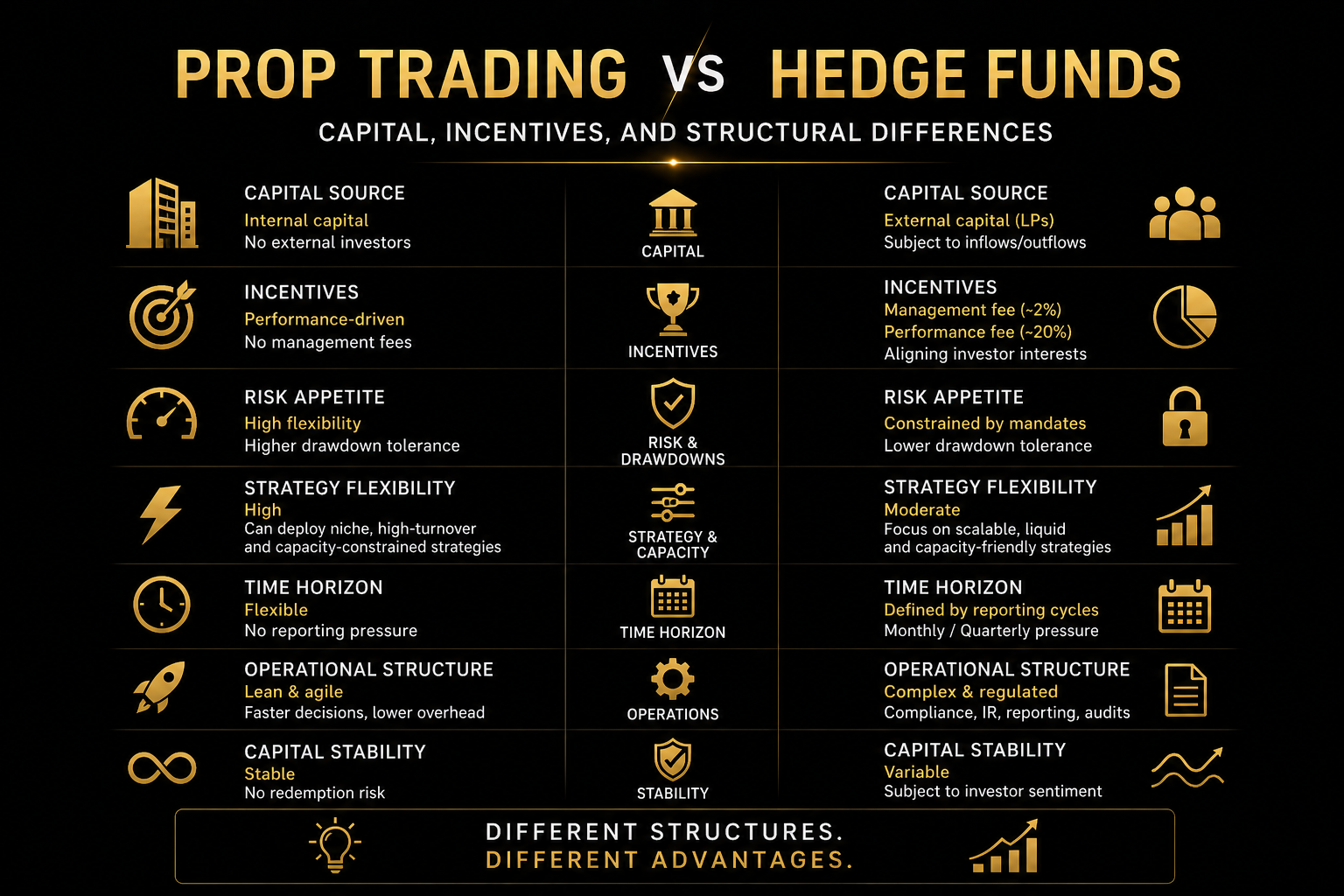
The distinction between proprietary trading firms and hedge funds is often misunderstood.
Both:
- Trade systematically
- Deploy capital in markets
- Use quantitative strategies
Yet structurally, they operate under fundamentally different constraints and incentives.
At Linitics, we view this distinction as critical—because structure determines:
- Risk behavior
- Strategy selection
- Performance consistency
- Scalability
This is not a difference in trading skill.
It is a difference in institutional design.
1. Capital Source: Internal vs External
Prop Trading Firms
- Trade internal capital
- No external investors
- No redemption pressure
Hedge Funds
- Manage external capital (LPs)
- Subject to inflows/outflows
- Investor expectations influence behavior
Implication:
Internal capital allows flexibility.
External capital introduces constraints.
2. Incentive Structures
Prop Firms
- Profit participation directly tied to performance
- No management fees
- Compensation is performance-driven
Hedge Funds
- Typically “2 and 20” structure:
- ~2% management fee
- ~20% performance fee
This creates:
- Asset gathering incentives
- Stability bias
- Risk-adjusted positioning
Implication:
Prop firms optimize for absolute performance.
Hedge funds optimize for risk-adjusted, investor-acceptable returns.
3. Risk Appetite & Drawdown Tolerance
Prop Firms
- Can tolerate higher volatility
- More flexible drawdown thresholds
- Faster risk reallocation
Hedge Funds
- Constrained by:
- Investor mandates
- Risk committees
- Redemption risk
Drawdowns lead to:
- Capital outflows
- Strategy pressure
- Potential shutdown
Implication:
Hedge funds must manage perception of risk—not just risk itself.
4. Strategy Selection & Deployment
Prop Firms
- Can deploy:
- Short-term strategies
- High-turnover systems
- Capacity-constrained alpha
Hedge Funds
- Prefer:
- Scalable strategies
- Institutional capacity
- Lower turnover
Because:
- Larger AUM requires liquidity
- Execution constraints increase
Implication:
Some strategies exist only in prop environments.
5. Time Horizon
Prop Firms
- Flexible time horizons
- Can pivot quickly
- No reporting pressure
Hedge Funds
- Structured reporting cycles:
- Monthly
- Quarterly
This creates:
- Short-term performance pressure
- Behavioral constraints
Implication:
Time horizon is often dictated by capital structure—not strategy logic.
6. Liquidity & Capacity Constraints
Prop Firms
- Smaller capital base
- Can operate in niche opportunities
- Lower market impact
Hedge Funds
- Large AUM
- Require deep liquidity
- Limited access to small inefficiencies
Implication:
Scale reduces opportunity set.
7. Operational Complexity
Prop Firms
- Lean structure
- Faster decision-making
- Lower administrative overhead
Hedge Funds
- Complex operations:
- Compliance
- Reporting
- Auditing
- Investor relations
This introduces:
- Slower adaptation
- Higher cost structures
8. Capital Stability
Prop Firms
- Stable capital base
- No redemption risk
Hedge Funds
- Capital is conditional
- Subject to:
- Performance cycles
- Investor sentiment
This creates:
- Forced de-risking
- Strategy distortion
Implication:
Stability of capital directly affects strategy stability.
9. Governance & Oversight
Hedge Funds
- Formal governance:
- Risk committees
- Compliance frameworks
- External oversight
Prop Firms
- Internal governance
- More autonomy
- Faster execution decisions
Implication:
Governance improves control—but reduces flexibility.
10. Performance vs Asset Growth
Prop Firms
- Focus on:
- Return on capital
- Efficiency
Hedge Funds
- Balance between:
- Performance
- Asset growth
Large AUM leads to:
- Strategy dilution
- Lower marginal returns
11. Scalability Trade-Off
Prop firms face:
- Limited scalability
- Capacity constraints
Hedge funds achieve:
- Capital scale
- Institutional reach
But often at the cost of:
- Reduced agility
- Lower alpha per unit capital
12. Where the Real Edge Lies
The industry often debates:
- Which model performs better
The reality:
They optimize for different objectives.
| Dimension | Prop Trading | Hedge Funds |
|---|---|---|
| Capital | Internal | External |
| Incentives | Performance-driven | Fee + performance |
| Flexibility | High | Moderate |
| Scale | Limited | High |
| Stability | High (capital) | Variable |
| Constraints | Low | High |
13. Convergence Trends
The line between the two is evolving:
- Prop firms are institutionalizing
- Hedge funds are adopting systematic strategies
- Technology is bridging gaps
However:
The structural differences remain intact.
14. The Linitics Perspective
At Linitics, we recognize:
- The flexibility of prop trading
- The discipline of institutional frameworks
Our approach integrates:
- Systematic strategy design
- Institutional-grade risk management
- Capital efficiency
- Scalable infrastructure
Because:
The future of trading is not one model replacing another.
It is:
Combining the strengths of both.
Final Thoughts
Prop trading firms and hedge funds operate in the same markets—
But under different structural realities.
Understanding these differences is essential for:
- Strategy design
- Capital allocation
- Risk management
- Business building
Because in trading:
- Strategy matters
- Execution matters
But structure determines:
Whether any of it scales.
At Linitics, we build systems designed not just to trade—
But to operate within the realities of modern capital markets.