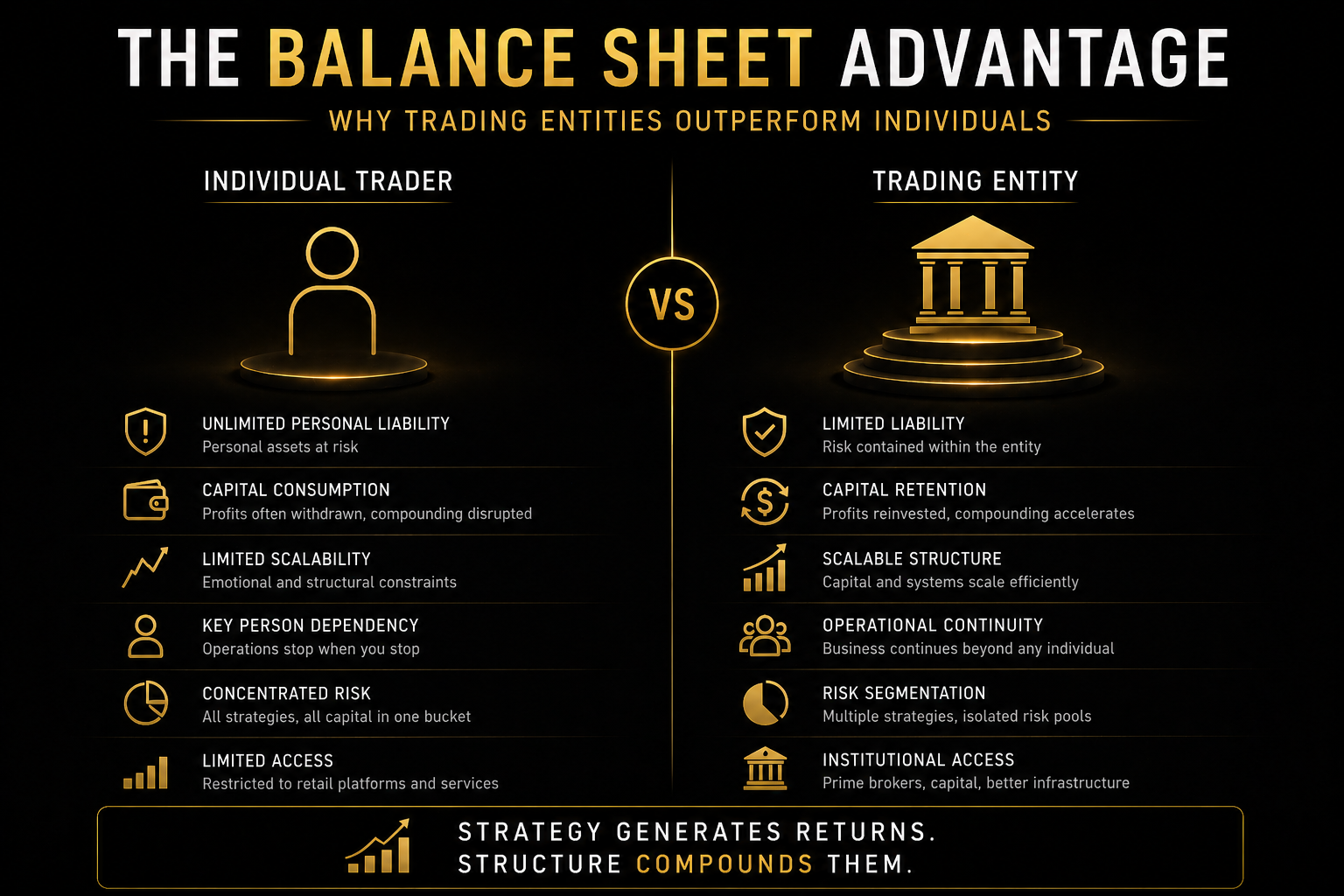
Most traders think in terms of strategies.
Professionals think in terms of balance sheets.
The difference between:
- A profitable trader
and - A scalable trading operation
Is not just skill.
It is structure.
At Linitics, we view the transition from individual trading to entity-based trading as one of the most important inflection points in capital growth.
Because:
The balance sheet determines how capital behaves over time.
1. The Individual Constraint
An individual trader operates with:
- A single pool of capital
- Unlimited personal liability (in many structures)
- Direct exposure to losses
This creates:
- Fragility
- Behavioral pressure
- Limited scalability
Losses are not just financial.
They are personal.
2. The Entity Framework
A trading entity introduces:
- Defined capital structure
- Legal separation
- Controlled exposure
Core features:
- Capital is ring-fenced
- Losses are contained within the entity
- Operations are structured
This transforms trading from:
- Activity
to - System
3. Limited Liability as Structural Protection
Entities provide:
- Liability containment
- Risk isolation
In adverse scenarios:
- Losses remain within the entity
- Personal balance sheet is protected
This enables:
- Rational risk-taking
- Strategic positioning
Without existential risk.
4. Capital Retention vs Capital Leakage
Individual traders often:
- Withdraw profits
- Use capital for consumption
- Disrupt compounding
Entities allow:
- Retained earnings
- Controlled distributions
- Structured reinvestment
This creates:
Continuous capital growth loops
5. Internal Compounding Engine
Inside an entity:
- Profits remain within the system
- Capital base increases
- Position sizing scales naturally
This enables:
- Exponential compounding
- Efficient capital deployment
Without interruption.
6. Reinvestment Efficiency
Entities can:
- Allocate capital across strategies
- Adjust exposures dynamically
- Recycle profits into new opportunities
Individuals often:
- Operate with static capital
- Lack structured allocation frameworks
The result:
Lower capital efficiency
7. Risk Segmentation
Entities enable:
- Multiple strategies under one structure
- Segregation of risk pools
- Controlled exposure allocation
This reduces:
- Cross-contamination of risk
- Concentration issues
Individuals typically:
- Mix strategies within a single account
Increasing systemic risk.
8. Behavioral Stability
Individual trading introduces:
- Emotional pressure
- Personal financial impact
- Short-term decision bias
Entity-based trading creates:
- Psychological separation
- Process-driven execution
- Reduced emotional interference
Because:
The capital is managed—not lived on.
9. Continuity & Survivability
An individual trader faces:
- Key person dependency
- Operational fragility
- Lack of continuity
Entities provide:
- Operational structure
- Process documentation
- System continuity
This enables:
- Long-term sustainability
- Institutional growth
10. Access to Infrastructure
Entities gain better access to:
- Prime brokers
- Institutional platforms
- Data infrastructure
- Financing arrangements
Individuals are often limited by:
- Account size
- Regulatory constraints
- Platform limitations
Structure unlocks capability.
11. Capital Scaling
Scaling capital as an individual is difficult due to:
- Risk concentration
- Psychological limits
- Structural constraints
Entities allow:
- Structured scaling
- Capital layering
- External capital integration (if desired)
This enables:
- Growth without instability
12. Tax Efficiency
Entities often allow:
- More efficient capital management
- Deferred realization structures
- Controlled distribution timing
This is not about tax minimization.
It is about:
Preserving capital within the system for compounding
13. Institutional Credibility
An entity provides:
- Formal structure
- Auditability
- Transparency
This is essential for:
- Counterparties
- Brokers
- Potential investors
Individuals lack:
- Institutional signaling
Structure builds trust.
14. The Strategic Shift
Moving from individual to entity changes:
| Dimension | Individual | Entity |
|---|---|---|
| Capital | Personal | Structured |
| Risk | Personal exposure | Contained |
| Compounding | Interrupted | Continuous |
| Scalability | Limited | Expandable |
| Stability | Fragile | Structured |
15. The Linitics Perspective
At Linitics, we emphasize:
- Treating trading as a capital system
- Designing for compounding
- Structuring for longevity
We view:
- The balance sheet
as - The foundation of performance
Because:
A strong strategy without structure:
- Remains limited
A structured system:
- Scales and endures
Final Thoughts
In trading:
- Skill generates returns
- Execution realizes them
But structure determines:
- Whether they compound
The balance sheet is not just an accounting concept.
It is a strategic asset.
At Linitics, we believe:
The real transition is not from:
- Losing trader → profitable trader
But from:
- Trader → capital allocator
Because that is where:
- Performance becomes scalable
- Risk becomes manageable
- Growth becomes exponential