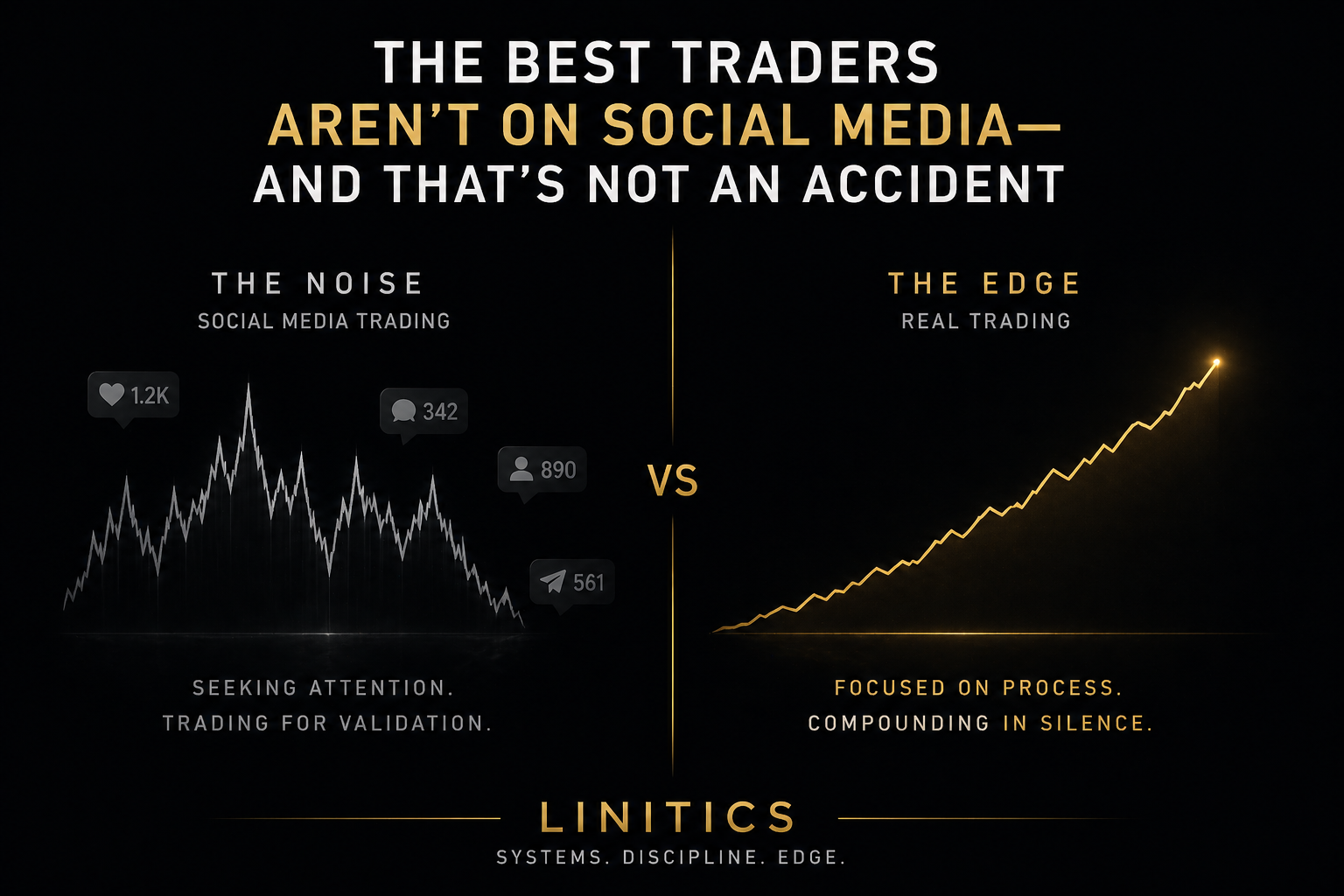
The Best Traders Aren’t on Social Media — And That’s Not an Accident
Introduction: The Visibility Paradox
Social media has made trading more visible than ever.
Trading screenshots, performance claims, market predictions, and investment opinions circulate continuously across digital platforms. Traders compete for attention, build audiences, and establish reputations through the public presentation of their market activity.
Yet a different operating model exists beneath this visible layer of the industry.
Many professional trading organizations devote comparatively little attention to public commentary. Their resources are directed toward research, execution, portfolio construction, risk management, and operational infrastructure.
Their competitive position does not necessarily depend on public recognition.
This creates an interesting paradox: the people most visible in the trading industry are not necessarily the people with the strongest trading capabilities.
Visibility measures attention. It does not establish investment skill, the durability of a strategy, or the quality of risk management.
The distinction matters because trading is an activity in which economic outcomes depend on decisions made under uncertainty—not on the ability to communicate those decisions convincingly.
At Linitics, we believe this distinction deserves closer examination. Understanding why professional trading organizations often operate away from public attention reveals something important about the economics of proprietary research, the protection of competitive advantages, and the incentives that shape the modern trading industry.
1. Attention and Trading Performance Are Different Businesses
Social media platforms reward content that attracts attention.
The mechanisms are familiar: frequent publishing, strong opinions, compelling narratives, and material that encourages continued engagement.
Trading operates under a different set of constraints.
A trading organization must determine whether an opportunity exists, estimate its expected return, assess its risk, execute at acceptable prices, and manage the position as market conditions evolve.
These activities do not necessarily produce compelling public content.
A quantitative researcher may spend weeks investigating a hypothesis only to reject it. An execution system may be improved through hundreds of small engineering changes that are invisible to an outside observer. A risk manager may prevent a loss by reducing exposure before a market event.
None of these activities necessarily generates an impressive screenshot.
Yet each can contribute meaningfully to the long-term performance of a trading business.
The fundamental difference is one of optimization.
A content business seeks to capture and retain attention. A trading business seeks to generate returns from capital within acceptable risk constraints.
The two objectives can coexist, but they should not be confused.
Audience growth is not evidence of trading competence, just as a lack of public visibility is not evidence of superior performance.
The relevant question is not how visible a trader is, but what the trader has demonstrated through a credible record of results, risk management, and operational discipline.
2. Proprietary Research Has an Economic Value
A trading strategy can represent years of accumulated research.
Its value may lie in the underlying hypothesis, the precise conditions under which it operates, the way positions are sized, the instruments selected, or the execution rules that convert a signal into a trade.
The strategy itself may be only one component of a much larger system.
For systematic trading firms, the competitive advantage can emerge from the interaction of:
- Market structure research.
- Data processing and validation.
- Signal generation.
- Portfolio construction.
- Execution algorithms.
- Risk management.
- Continuous monitoring and evaluation.
Publishing these details can expose valuable intellectual property.
It may also help other market participants replicate the strategy, compete for the same opportunities, or accelerate the process through which a market inefficiency disappears.
This does not mean that every publicly discussed strategy loses its effectiveness. Many established strategies are widely understood and continue to work because their returns depend on persistent economic mechanisms, risk premia, or implementation capabilities rather than secrecy alone.
However, some strategies are sensitive to capacity, execution, or crowding.
In these cases, greater participation can reduce the opportunity available to each participant.
The economic decision is therefore straightforward: if revealing a proprietary method offers little commercial benefit while potentially weakening its competitive position, there may be no reason to disclose it.
For a proprietary trading firm, confidentiality can be a rational business decision rather than a marketing preference.
3. The Competitive Advantage Often Extends Beyond the Signal
A common misconception is that successful trading depends primarily on discovering a profitable entry signal.
In practice, a signal is only the beginning of the process.
Consider a systematic strategy that identifies a potentially attractive market condition. Its realized performance will still depend on whether the signal is robust, whether the position is appropriately sized, whether execution costs remain manageable, and whether the strategy behaves as expected under different market regimes.
Two firms can implement similar trading hypotheses and achieve materially different results.
Their differences may arise from data quality, portfolio interactions, execution infrastructure, operational reliability, or the discipline with which they manage risk.
This is particularly important in quantitative trading, where the research process and the production environment must remain closely connected.
A model that performs well in historical testing is not necessarily profitable after realistic transaction costs. A strategy that works at a small scale may encounter capacity constraints when capital increases. A portfolio that performs well in ordinary conditions may be vulnerable to an unusual combination of market movements.
The durable advantage may therefore reside less in an isolated trading rule and more in the system surrounding it.
This also explains why public descriptions of strategies often reveal less than they appear to.
A chart can illustrate a historical outcome. It cannot, by itself, establish the quality of the underlying research, the validity of the assumptions, or the strategy’s behavior under adverse conditions.
For professional firms, these distinctions are central to the investment process.
4. Time Is an Operational Resource
Building a public profile requires ongoing work.
Content must be researched, prepared, reviewed, published, and distributed. Audience questions require responses. Public claims may require clarification. A growing audience can create expectations for increasingly frequent updates.
These activities are not inherently unproductive. For businesses that depend on distribution, education, or client acquisition, they can be commercially valuable.
But they carry an opportunity cost.
A lean quantitative trading firm has a finite amount of research, engineering, and management capacity. Time devoted to one activity is time unavailable for another.
The relevant comparison is not whether social media is useful in general. It is whether the expected commercial value of public visibility justifies the resources required to maintain it.
For a firm whose business depends on proprietary strategies and internal capital deployment, the answer may differ significantly from that of a trading educator, financial publisher, or brokerage.
Its highest-value work may happen entirely behind the scenes:
- Improving data quality.
- Investigating strategy deterioration.
- Testing execution assumptions.
- Monitoring portfolio exposures.
- Strengthening operational controls.
- Reviewing the relationship between expected and realized performance.
These activities may be difficult to communicate in a short post, but their economic consequences can be substantial.
For such organizations, maintaining a limited public presence can be a deliberate allocation of resources.
5. Trading Results Require Context, Not Just Screenshots
Public trading content often presents performance in a compact and visually persuasive form.
A profitable trade, a rising equity curve, or a reported monthly return can communicate an apparent result within seconds.
The problem is not that these representations are necessarily false. It is that they are incomplete without context.
A return figure, considered in isolation, tells us little about the process that generated it.
A serious evaluation should consider questions such as:
- What capital was exposed to risk?
- What was the maximum drawdown?
- How much leverage was used?
- How many trades contributed to the result?
- Were transaction costs and slippage included?
- Was the performance live or simulated?
- How did the strategy behave during adverse market conditions?
- Does the record cover multiple market regimes?
- Were results independently verified?
Even a genuine profitable trade does not establish that the underlying method has a positive long-term expectancy.
Likewise, an impressive annual return may conceal substantial downside risk or dependence on a narrow set of market conditions.
Institutional performance evaluation therefore requires more than attractive outcomes. It requires evidence about the process, the risks undertaken, and the consistency of the results.
This is one reason professional investment organizations tend to place greater emphasis on documented performance, risk-adjusted metrics, and operational due diligence than on public presentation.
The distinction is fundamental:
A performance claim is a starting point for analysis, not a substitute for it.
6. Risk Management Is Less Visible Than Profit
Trading discussions frequently focus on the decision to enter a position.
Yet long-term outcomes depend equally on how capital is allocated, how losses are controlled, and how exposures interact across a portfolio.
Risk management rarely produces the same immediate appeal as a successful trade.
A position that is never opened because the risk is unattractive does not appear on a profit-and-loss screenshot. A strategy that reduces exposure before an uncertain event may look less impressive during a short-lived rally. A portfolio that limits leverage may underperform during a period of unusually favorable market conditions.
The benefits of these decisions are often conditional and long-term.
Their value becomes clearer when markets move adversely, correlations change, or several strategies experience losses simultaneously.
For a professional trading organization, the objective is not to maximize the apparent success of individual trades. It is to manage the relationship between expected return, capital at risk, and the possibility of adverse outcomes.
That requires an operating framework capable of evaluating:
- Position-level exposure.
- Portfolio concentration.
- Strategy correlation.
- Drawdown behavior.
- Liquidity constraints.
- Stress scenarios.
- Operational failure modes.
These considerations do not fit easily into simplistic narratives about winning and losing trades.
Nevertheless, they are essential to determining whether a trading operation can survive and compound capital over time.
7. Scale Changes the Meaning of a Profitable Strategy
A strategy that works for a small account does not automatically remain attractive at a larger scale.
As position sizes increase, execution costs, liquidity constraints, and market impact can become more significant.
The strategy may need to trade across multiple price levels, wait longer for suitable execution conditions, or reduce its participation in particular opportunities.
Capacity is therefore an important part of strategy evaluation.
A highly profitable approach with limited capacity may be valuable to its operator without being suitable for unlimited capital deployment. Conversely, a strategy with more modest returns may be commercially attractive if it can operate reliably across a much larger capital base.
This distinction is especially relevant for institutional and proprietary trading firms.
Their objective is not merely to identify profitable trades. It is to determine how much capital can be deployed without materially degrading the strategy’s economics or introducing unacceptable risk.
Public discussions of trading performance rarely provide enough information to establish these limits.
A reported return does not reveal whether the result can be replicated at a larger size, whether execution assumptions remain realistic, or whether the opportunity is already capacity-constrained.
This is another reason professional trading capability cannot be evaluated through visibility alone.
The economic question is not simply whether a strategy made money.
It is whether the strategy can continue to generate attractive risk-adjusted returns under realistic deployment conditions.
8. Public Commentary Can Create Incentive Conflicts
When a trader develops a substantial audience, public expectations can become an additional consideration in the decision-making process.
Followers may expect regular predictions, frequent trade updates, or explanations for every market movement.
The trader may then face pressure to maintain a public narrative even when the most appropriate trading decision is to remain inactive.
This creates a potential conflict between communicating continuously and acting selectively.
Markets do not provide attractive opportunities on a predictable publishing schedule. Some periods require extensive research and no trading. Others demand rapid adjustments that leave little room for public commentary.
A professional trader must be able to change their view, reduce exposure, or abandon a hypothesis without treating the decision as a public performance.
That flexibility is important because uncertainty is intrinsic to financial markets.
A well-designed trading process should allow evidence to change decisions. Public commitments can make that process more psychologically difficult, although the effect varies between individuals and organizations.
Public accountability can also be beneficial. Publishing a verifiable record can discourage selective reporting and help external stakeholders assess performance.
The distinction is therefore not between public and private trading as inherently superior models.
It is between incentives that support sound decision-making and incentives that can interfere with it.
For firms operating proprietary capital, the priority should remain the integrity of the investment process.
9. The Commercial Model Matters
Not everyone who discusses trading publicly is primarily engaged in proprietary trading.
The industry includes educators, analysts, financial publishers, signal providers, brokers, software vendors, and professional traders.
These businesses serve different markets and generate revenue in different ways.
For an educator, audience growth may be essential to selling courses or training programs. For a financial publisher, engagement can support advertising and subscriptions. For a software provider, public content may be an effective way to demonstrate capabilities and attract customers.
For a proprietary trading firm, however, public visibility may have a more indirect relationship with revenue.
The firm may generate its returns by deploying capital through internal strategies. Its commercial priorities may include improving research, maintaining execution quality, controlling costs, and preserving proprietary intellectual property.
Neither business model is inherently more legitimate than the other.
The important distinction is that their incentives differ.
A public-facing business may benefit from communicating frequently. A proprietary trading operation may benefit more from directing its resources toward research and execution.
Problems arise when these models are confused—particularly when an audience mistakes a strong public presence for evidence of a strong trading record.
The credibility of a trading business should be evaluated against the economics of the business it actually operates.
10. Why Professional Trading Firms Still Need Transparency
Operating away from public attention does not mean operating without accountability.
For a professional trading firm, confidentiality and transparency serve different purposes.
Proprietary strategies, implementation details, and sensitive research may require protection. At the same time, investors, counterparties, auditors, regulators, or other authorized stakeholders may require appropriate evidence of performance, risk controls, governance, and operational reliability.
These obligations depend on the firm’s structure, activities, and applicable legal and regulatory requirements.
A firm that manages external capital may face different disclosure and reporting responsibilities from one that trades only its own capital.
The appropriate level of transparency is therefore determined by the business model and its obligations—not by a general preference for secrecy.
This distinction is important because a lack of public visibility should never be treated as proof of professionalism.
A private operation can be poorly managed, just as a publicly visible firm can be highly disciplined.
What matters is whether the organization has sound internal processes and provides the information required by its legitimate stakeholders.
For institutional trading, credibility is built through evidence, controls, and consistent execution—not simply through the presence or absence of public commentary.
11. The Institutional Advantage of Selective Visibility
For quantitative trading firms, public communication can be useful when it serves a clear purpose.
Publishing research on market structure, execution risk, quantitative infrastructure, or institutional operating models can demonstrate intellectual depth without disclosing sensitive implementation details.
It can also help establish a firm’s perspective on the industry and attract people who share its approach.
The objective is not necessarily to avoid public attention altogether.
It is to distinguish between publishing knowledge and exposing proprietary advantage.
A firm can explain why execution quality matters without revealing its execution algorithms. It can discuss portfolio risk without publishing sensitive position data. It can examine quantitative research principles without disclosing the precise parameters of a production strategy.
This approach allows a trading organization to build professional credibility while retaining control over what it reveals.
For a technology-driven proprietary trading firm, selective visibility may be more effective than attempting to maintain a constant public presence.
The quality of the ideas matters more than the frequency of publication.
12. The Linitics Perspective
At Linitics, we believe professional quantitative trading should be evaluated through the quality of its research, the discipline of its execution, and the robustness of its risk management.
Public visibility is neither a requirement for trading success nor a reliable measure of it.
Our focus is on the systems and processes that support systematic trading:
- Research-driven strategy development.
- Quantitative validation.
- Automated execution.
- Structured risk management.
- Operational resilience.
- Long-term capital efficiency.
These activities require a consistent investment in engineering, analysis, and process improvement.
They also require a clear distinction between what can be communicated publicly and what must remain proprietary.
We believe a trading firm should be able to explain its philosophy, demonstrate its technical capabilities, and contribute meaningfully to industry discussions without turning its investment process into a public performance.
That is the role we see for institutional commentary: sharing useful ideas while respecting the commercial realities of proprietary research.
Final Thoughts: Performance Does Not Require an Audience
The trading industry has become increasingly visible, but visibility has not removed the need for evidence.
A large following does not establish a durable trading edge. A persuasive narrative does not demonstrate effective risk management. A profitable screenshot does not establish that a strategy can survive changing market conditions.
Equally, operating privately does not guarantee superior results.
The appropriate distinction is between public attention and demonstrated capability.
For professional trading organizations, the priorities remain clear: develop robust strategies, understand the risks, execute efficiently, and preserve the ability to operate through different market environments.
Some firms will communicate those activities extensively. Others will choose a more selective approach.
Both can be legitimate.
But when evaluating trading competence, the more useful questions concern the underlying process, the quality of the evidence, and the durability of the results.
At Linitics, we believe the strongest foundations for long-term trading performance are built through research, engineering, disciplined execution, and risk management.
In trading, visibility can build recognition. Only a credible process and demonstrated results can establish capability.