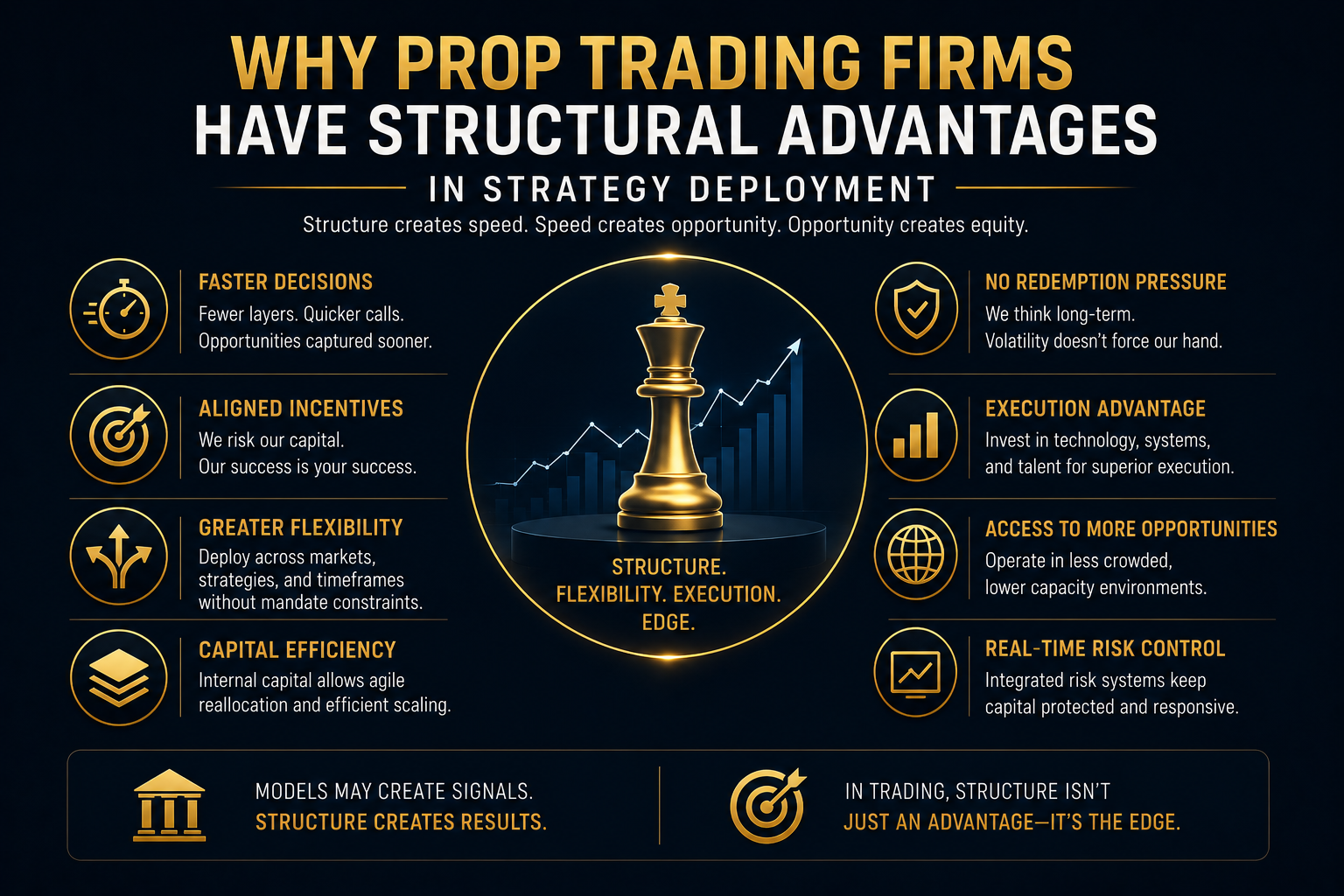
In trading, edge is often discussed in terms of:
- strategy
- models
- signals
- execution
But institutional performance is frequently determined by something deeper:
structure.
At Linitics, we believe many of the strongest advantages in modern markets do not come from:
- discovering better signals
But from:
- deploying capital more efficiently.
This is where proprietary trading firms possess significant structural advantages over many traditional investment structures.
1. Understanding Structural Advantage
A structural advantage is not:
- temporary alpha
- short-term market inefficiency
It is an advantage embedded into:
- organizational design
- capital structure
- operational flexibility
These advantages persist because they are:
- systemic
- operational
- difficult to replicate quickly
2. What Makes Prop Firms Different?
Prop trading firms primarily deploy:
- internal capital
This creates a fundamentally different operating environment compared to firms managing:
- external investor capital
The distinction affects:
- incentives
- execution speed
- risk tolerance
- decision-making architecture
3. No Redemption Pressure
One of the biggest structural advantages of prop firms is:
- the absence of redemption pressure
Traditional asset managers often must manage:
- investor expectations
- withdrawals
- liquidity obligations
Prop firms avoid many of these constraints.
This allows them to:
- maintain strategic patience
- tolerate short-term volatility
- optimize for long-term deployment efficiency
4. Faster Decision Cycles
Prop firms generally operate with:
- shorter operational chains
- fewer approval layers
- tighter execution loops
This enables:
- rapid adaptation
- faster deployment
- quicker strategy iteration
In modern markets:
speed compounds operationally.
5. Alignment Between Risk and Capital
In prop firms:
- risk is directly tied to internal capital
This creates stronger alignment between:
- decision-making
- survivability
- capital preservation
The feedback loop becomes:
- immediate
- operationally disciplined
6. Greater Strategy Flexibility
Institutional asset managers often face restrictions related to:
- mandates
- liquidity requirements
- benchmark constraints
- client expectations
Prop firms can deploy into:
- niche opportunities
- shorter-duration inefficiencies
- specialized strategies
This flexibility creates:
- broader strategic optionality
7. Ability to Operate in Smaller Capacity Environments
Large institutional funds frequently cannot deploy into:
- lower-capacity opportunities
Because the positions are:
- too small relative to fund size
Prop firms often retain the flexibility to exploit:
- smaller inefficiencies
- faster-moving opportunities
- specialized microstructure edges
8. Execution Infrastructure as Edge
Modern prop firms invest heavily in:
- execution systems
- low-latency infrastructure
- risk monitoring
- automation frameworks
Execution quality directly impacts:
- realized alpha
- deployment precision
- scalability
At scale:
infrastructure becomes part of the strategy itself.
9. Internal Capital Enables Faster Reallocation
External capital structures often slow down:
- capital rotation
- strategic repositioning
- portfolio adjustments
Prop firms can reallocate capital rapidly between:
- strategies
- markets
- volatility regimes
This improves:
- adaptability
- deployment efficiency
10. Reduced Benchmark Dependency
Traditional managers are frequently evaluated against:
- benchmarks
- peer performance
- short-term relative returns
Prop firms optimize for:
- absolute capital efficiency
This changes:
- incentive structures
- portfolio behavior
- risk management philosophy
11. Technology Integration Is Often Deeper
Many modern prop firms are fundamentally:
- technology organizations operating in financial markets
This enables tighter integration between:
- research
- execution
- infrastructure
- risk systems
The result is:
- faster innovation cycles
- stronger operational cohesion
12. Organizational Agility
Smaller, technology-driven prop firms often maintain:
- lean organizational structures
- high operational adaptability
This reduces:
- bureaucratic drag
- coordination overhead
- strategic inertia
Agility itself becomes:
- a deployable edge
13. Risk Systems Are Closer to Execution
In advanced prop firms:
- risk systems operate in real time
Risk is integrated directly into:
- execution architecture
- portfolio deployment
- capital allocation logic
This creates tighter control loops.
14. Why Structural Advantages Matter More Over Time
Signals decay.
Strategies crowd.
Markets adapt.
Structural advantages persist longer because they are embedded into:
- systems
- workflows
- capital architecture
This creates:
operational durability beyond individual strategies.
15. The Myth That Better Models Alone Win
Many traders believe:
- better prediction = sustainable edge
Institutional reality is more nuanced.
Often:
- two firms possess similar models
But the firm with superior:
- execution
- infrastructure
- capital flexibility
- deployment efficiency
Outperforms consistently.
16. Scale and Structural Efficiency
Prop firms can scale selectively.
Because they control:
- capital allocation internally
They can optimize for:
- deployment quality
instead of - asset gathering pressure
This preserves:
- strategy integrity
- operational flexibility
17. The Institutional Evolution of Prop Trading
Modern proprietary trading firms increasingly resemble:
- technology-driven capital systems
Rather than:
- traditional trading desks
Competitive advantage now emerges from the integration of:
- infrastructure
- research
- execution
- capital structure
- risk engineering
18. The Linitics Perspective
At Linitics, we believe:
- structure increasingly determines survivability
We view systematic trading as:
- an integrated operational framework
Not merely:
- a collection of strategies
The strongest firms are often those that optimize:
- deployment architecture
- capital efficiency
- infrastructure quality
- organizational agility
Because:
in modern markets, operational structure itself becomes alpha.
Final Thoughts
Most trading discussions focus on:
- prediction
- signals
- models
Institutional firms understand that:
- deployment quality matters equally—if not more.
Prop trading firms possess structural advantages because they optimize for:
- flexibility
- speed
- alignment
- execution precision
At Linitics, we believe the future of systematic trading belongs not merely to firms with better strategies—
But to firms with:
superior operational architecture for deploying them.