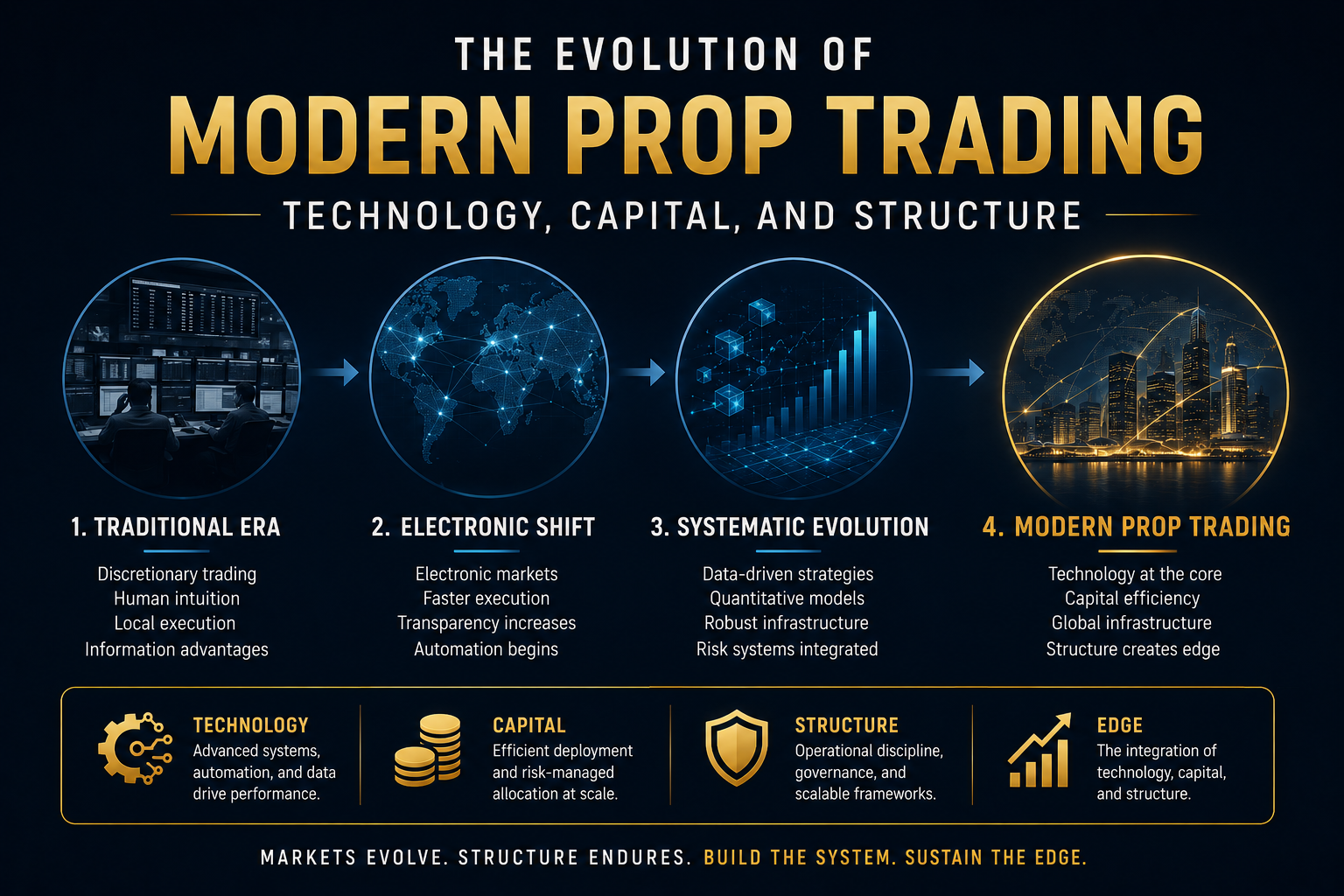
Prop trading has changed dramatically over the last two decades.
What was once dominated by:
- discretionary traders
- phone-based execution
- localized trading desks
Has evolved into:
- technology-driven capital systems
- globally connected infrastructure
- systematic execution frameworks
At Linitics, we believe modern proprietary trading is no longer defined solely by:
- trading skill
But by the integration of:
- technology
- capital architecture
- operational structure
- execution systems
Because increasingly:
the edge is embedded in the system—not the individual.
1. The Traditional Era of Prop Trading
Earlier generations of prop trading firms were largely centered around:
- human intuition
- discretionary execution
- localized market access
Advantages came from:
- trader instinct
- information asymmetry
- execution relationships
Technology existed—
But it was secondary.
2. The Rise of Electronic Markets
The transition to electronic trading fundamentally altered market structure.
Execution became:
- faster
- more transparent
- more competitive
As markets digitized:
- informational advantages compressed
- manual execution lost relevance
- automation became essential
This marked the beginning of:
infrastructure-driven trading.
3. From Traders to Systems
Modern firms increasingly shifted from:
- individual trader dependence
Toward:
- systematic operational frameworks
This changed organizational priorities from:
- intuition
to - repeatability
The modern prop firm became less like:
- a trading desk
And more like:
- a technology company operating in financial markets.
4. Technology Became the Core Edge
Today, competitive advantage often depends on:
- execution infrastructure
- automation systems
- data engineering
- research pipelines
Technology now influences:
- latency
- scalability
- monitoring
- capital efficiency
In many firms:
software architecture is as important as strategy logic.
5. The Data Explosion
Modern markets generate enormous amounts of:
- price data
- order flow data
- volatility information
- alternative datasets
This shifted the competitive landscape toward firms capable of:
- processing information efficiently
- building scalable research systems
- integrating real-time analytics
Data handling itself became:
- a strategic capability.
6. Capital Structure Evolved Alongside Technology
As firms became more systematic, capital deployment also evolved.
Modern prop firms increasingly optimize for:
- internal capital efficiency
- scalable deployment
- risk-adjusted allocation
The focus shifted from:
- maximizing activity
Toward:
- optimizing deployable capital.
7. The Rise of Quantitative Infrastructure
Quantitative trading now requires integrated systems for:
- research
- execution
- monitoring
- portfolio management
- risk control
This infrastructure operates continuously.
Modern firms compete not only on:
- signals
But on:
- operational precision.
8. Execution Became a Science
Earlier markets rewarded:
- directional accuracy
Modern markets increasingly reward:
- execution quality
Small differences in:
- slippage
- latency
- routing efficiency
- liquidity interaction
Can materially affect long-term performance.
Execution is no longer:
- operational support
It is:
part of alpha generation.
9. Real-Time Risk Systems Changed Firm Architecture
Modern prop firms increasingly integrate:
- automated risk engines
- exposure monitoring
- dynamic allocation systems
Risk is now embedded directly into:
- execution infrastructure
- portfolio logic
- capital deployment
This creates:
- tighter operational feedback loops.
10. Globalization of Trading Operations
Modern firms operate across:
- multiple exchanges
- global asset classes
- international jurisdictions
This requires:
- scalable infrastructure
- cross-border operational coordination
- sophisticated capital management systems
Trading is now:
- globally interconnected.
11. The Shift Toward Institutional Discipline
As firms matured, success increasingly depended on:
- process discipline
- operational resilience
- structured governance
This reduced dependency on:
- individual traders
- discretionary judgment
- concentrated decision-making
The industry evolved toward:
systems-based survivability.
12. Talent Composition Changed
Modern prop firms increasingly hire:
- engineers
- quantitative researchers
- data scientists
- systems architects
The modern edge is often built by:
- multidisciplinary teams
Not isolated traders.
13. Capital Efficiency Became a Competitive Advantage
Firms now compete on:
- how efficiently capital is deployed
This includes:
- portfolio construction
- leverage optimization
- execution efficiency
- infrastructure utilization
Capital itself became:
- an engineered resource.
14. Why Smaller Agile Firms Still Matter
Despite institutional growth, smaller firms retain advantages in:
- adaptability
- niche opportunities
- strategic flexibility
Large organizations often face:
- scaling friction
- coordination complexity
- reduced agility
Modern markets reward both:
- scale
and - flexibility.
15. The Convergence of Finance and Technology
The distinction between:
- trading firm
and - technology company
Is increasingly blurred.
The strongest modern firms integrate:
- software engineering
- quantitative research
- execution science
- capital management
Into a unified operating framework.
16. The New Competitive Landscape
Modern competition is no longer purely about:
- prediction accuracy
It increasingly depends on:
- infrastructure quality
- execution systems
- operational scalability
- organizational efficiency
The strongest firms optimize the entire stack.
17. Why Structure Matters More Than Ever
As alpha becomes more competitive:
- structural advantages compound
These include:
- better infrastructure
- stronger capital architecture
- operational resilience
- faster deployment capability
Because:
sustainable edge now emerges from integrated systems.
18. The Linitics Perspective
At Linitics, we believe modern prop trading represents the convergence of:
- technology
- capital engineering
- institutional structure
We do not view trading as:
- isolated prediction
But as:
- a coordinated operational ecosystem
The future belongs to firms capable of integrating:
- execution
- infrastructure
- capital allocation
- risk systems
- organizational agility
Into a single scalable framework.
Final Thoughts
The evolution of prop trading reflects a broader shift in finance itself.
Markets have become:
- faster
- more interconnected
- more competitive
- more technology-driven
Success increasingly depends not on:
- isolated strategies
But on:
- operational architecture.
At Linitics, we believe the next generation of trading firms will not merely be:
- better traders
They will be:
superior builders of integrated financial systems.