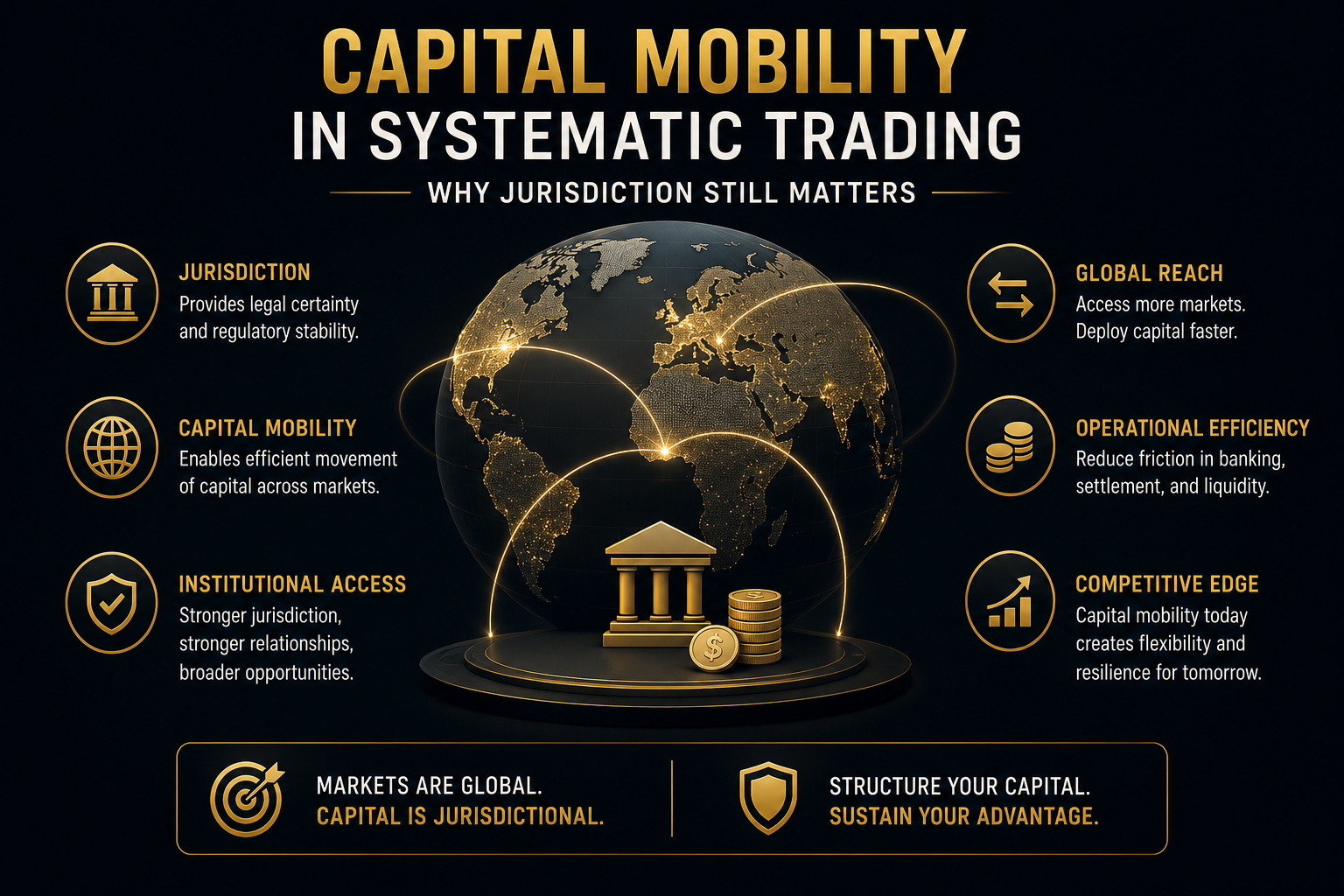
Modern trading is increasingly global.
A systematic trading firm in one country can:
- trade U.S. futures
- hedge in Europe
- allocate capital into Asian markets
- manage infrastructure across multiple regions
Execution may be digital.
But capital is still governed by:
- jurisdictions
- banking systems
- regulatory frameworks
- settlement infrastructure
At Linitics, we believe one of the most overlooked dimensions of systematic trading is:
capital mobility.
Because in institutional finance:
- the ability to move capital efficiently
can become a competitive advantage itself.
1. The Myth of Borderless Trading
Technology has created the illusion that:
- markets are fully borderless
In reality:
- capital movement still depends on legal and financial systems
Trading firms remain exposed to:
- jurisdictional friction
- banking dependencies
- settlement infrastructure
This means:
geography still matters—even in digital finance.
2. What Is Capital Mobility?
Capital mobility refers to:
- the ability to deploy, transfer, allocate, and access capital across markets efficiently
It affects:
- operational flexibility
- liquidity access
- portfolio deployment
- global scalability
Institutional firms optimize not only for:
- returns
But also for:
- capital movement efficiency.
3. Why Capital Mobility Matters in Systematic Trading
Systematic trading depends on:
- speed
- flexibility
- deployment efficiency
Capital trapped within inefficient structures creates:
- operational friction
- reduced adaptability
- execution delays
In fast-moving markets:
- friction compounds quickly.
4. Banking Infrastructure as Strategic Infrastructure
Most traders underestimate the importance of:
- banking relationships
- cross-border settlement capability
- multi-currency infrastructure
Institutional firms rely heavily on:
- efficient capital routing
- international payment systems
- operational liquidity management
Without strong banking infrastructure:
- scaling globally becomes difficult.
5. Cross-Border Capital Friction
Different jurisdictions create varying levels of:
- settlement friction
- compliance complexity
- capital transfer restrictions
This affects:
- deployment speed
- operational efficiency
- counterparty flexibility
Even profitable strategies can suffer from:
structural inefficiency in capital movement.
6. Settlement Systems Matter More Than Most Realize
Trading does not end at execution.
Capital must still:
- settle
- clear
- move between systems
Settlement infrastructure affects:
- liquidity access
- operational continuity
- counterparty efficiency
Poor settlement environments increase:
- hidden operational drag.
7. Currency & Multi-Market Operations
Global trading firms often manage:
- multiple currencies
- cross-market exposure
- international margin requirements
This creates additional considerations:
- FX conversion friction
- liquidity timing
- collateral optimization
Capital mobility directly impacts:
- operational precision.
8. Jurisdictional Stability & Capital Confidence
Capital prefers environments with:
- legal stability
- enforceable rights
- predictable frameworks
Unstable jurisdictions introduce:
- transfer uncertainty
- operational unpredictability
- elevated structural risk
This affects:
- investor confidence
- institutional relationships
- long-term scaling potential
9. Why Institutional Firms Diversify Jurisdictionally
Sophisticated firms diversify across:
- brokers
- custodians
- operational jurisdictions
Not merely to reduce market risk—
But to reduce:
- structural concentration risk.
10. The Relationship Between Jurisdiction and Counterparty Access
Institutional counterparties evaluate:
- jurisdiction quality
- regulatory credibility
- operational governance
Strong jurisdictions improve access to:
- banking
- prime brokerage
- institutional capital networks
This creates:
compounding operational advantages.
11. Capital Mobility and Strategic Flexibility
Efficient capital structures allow firms to:
- rotate capital globally
- deploy opportunities rapidly
- optimize collateral usage
This improves:
- responsiveness
- liquidity management
- portfolio adaptability
12. Hidden Costs of Poor Capital Mobility
Inefficient structures create:
- settlement delays
- higher financing costs
- operational overhead
- restricted deployment flexibility
These costs are often:
- invisible in backtests
- highly material in reality.
13. Why Jurisdiction Still Matters in Digital Markets
Markets may be electronic.
But capital still depends on:
- legal systems
- banking infrastructure
- regulatory frameworks
- operational trust
This means jurisdiction continues to shape:
- operational resilience
- institutional scalability
- capital durability
14. Institutional Thinking vs Retail Thinking
Retail operators often optimize for:
- broker convenience
- low fees
- platform features
Institutional operators optimize for:
- capital architecture
- movement efficiency
- jurisdictional resilience
Because:
capital mobility becomes increasingly important as scale increases.
15. The Linitics Perspective
At Linitics, we view capital mobility as:
- part of trading infrastructure itself
We believe sophisticated trading operations must think beyond:
- execution
- strategies
- signals
And instead design for:
- efficient capital movement
- jurisdictional resilience
- operational flexibility
Because:
The strongest firms are not merely those that generate returns—
But those capable of:
deploying capital globally with minimal friction.
Final Thoughts
Systematic trading is no longer constrained by geography.
But capital still is.
Jurisdiction continues to influence:
- access
- movement
- settlement
- operational trust
At Linitics, we believe the future belongs to firms that understand:
- trading is global
- but capital architecture remains jurisdictional
Because in institutional finance:
the ability to move capital efficiently is itself a strategic edge.