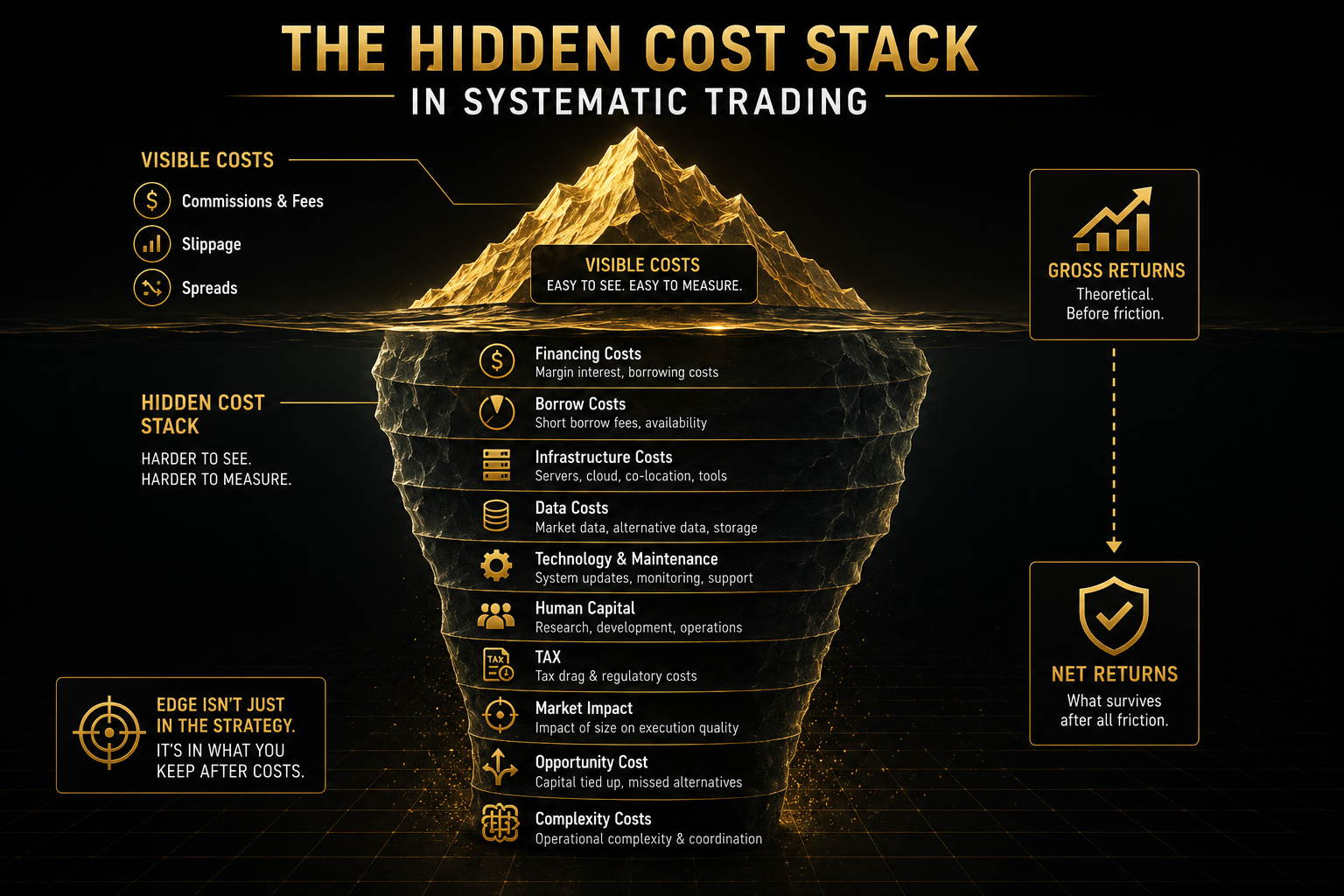
Most traders think trading costs are limited to:
- commissions
- slippage
- spreads
Institutional operators know the reality is far more complex.
Because in systematic trading:
The largest costs are often invisible.
At Linitics, we view cost structure as a core determinant of long-term alpha durability.
Not because costs reduce returns—
But because compounded friction eventually destroys edge.
1. The Illusion of Gross Returns
Backtests often present:
- gross profitability
- ideal execution
- clean compounding curves
Reality includes:
- infrastructure costs
- financing drag
- operational overhead
- hidden execution leakage
This creates a gap between:
- theoretical returns
and - deployable returns
2. Why Cost Structure Matters
Small recurring frictions compound aggressively over time.
A strategy generating:
- strong gross returns
Can still fail due to:
- structural inefficiency
Because:
alpha decays faster when friction compounds.
3. Transaction Costs: The Visible Layer
These include:
- commissions
- exchange fees
- clearing costs
Most traders understand these.
But they are often:
- the smallest component of total cost
4. Slippage: The Underestimated Drag
Slippage arises from:
- execution timing
- liquidity gaps
- market impact
It increases with:
- volatility
- order size
- urgency
Slippage compounds silently.
Especially in:
- high-frequency systems
- short-duration strategies
5. Spread Costs
Every trade crosses:
- bid/ask spread
This creates:
- immediate execution friction
Strategies with:
- high turnover
- lower holding periods
Experience disproportionate spread drag.
6. Financing Costs
Leveraged trading introduces:
- margin interest
- borrowing costs
- funding spreads
These costs fluctuate with:
- interest rates
- market stress
- broker conditions
In leveraged systems:
financing becomes a structural variable.
7. Borrow Costs & Short Exposure
Short-selling strategies may incur:
- stock borrow fees
- hard-to-borrow premiums
These costs can:
- spike unexpectedly
- distort expected returns
8. Infrastructure Costs
Professional trading requires:
- servers
- cloud systems
- execution infrastructure
- monitoring systems
Institutional-grade setups involve:
- recurring operational expenditure
Without infrastructure:
- execution quality deteriorates
9. Data Costs
Systematic trading depends heavily on:
- market data
- alternative data
- historical datasets
Professional-quality data is expensive.
Costs include:
- subscriptions
- licensing
- storage
- processing
Data quality affects:
- signal reliability
- execution precision
10. Technology Maintenance
Systems require:
- updates
- monitoring
- debugging
- redundancy
Technology debt accumulates over time.
Ignoring maintenance creates:
- operational fragility
11. Human Capital Costs
Even systematic firms require:
- developers
- researchers
- operations oversight
As firms scale:
- personnel costs increase
- coordination overhead grows
12. Tax Drag
Taxes create:
- compounding leakage
Especially in:
- high-turnover systems
- short-term strategies
Tax efficiency affects:
- net capital growth
Even when strategy performance remains unchanged.
13. Market Impact
Larger capital deployment creates:
- self-generated friction
As size increases:
- execution quality deteriorates
- alpha compresses
This becomes critical at scale.
14. Opportunity Cost
Capital allocated to one strategy:
- cannot be deployed elsewhere
Poor allocation decisions create:
- hidden performance drag
Institutional firms evaluate:
- capital efficiency continuously
15. Complexity Costs
As systems grow:
- operational complexity increases
This creates:
- slower adaptation
- coordination inefficiency
- execution friction
Complexity itself becomes:
- a hidden tax on performance
16. The Compound Effect of Friction
Individually:
- many costs appear manageable
Collectively:
- they materially alter outcomes
This is the hidden cost stack.
17. Why Many Backtests Fail in Reality
Backtests often underestimate:
- execution friction
- financing variability
- operational costs
This creates:
- inflated expectations
- unrealistic scalability assumptions
18. Institutional Perspective
Professional firms optimize for:
- net deployable returns
Not:
- theoretical alpha
This requires:
- cost-aware system design
- infrastructure optimization
- execution efficiency
19. The Linitics Perspective
At Linitics, we treat costs as:
- part of the strategy architecture
We focus on:
- execution efficiency
- infrastructure robustness
- capital efficiency
- friction-aware deployment
Because:
sustainable alpha survives after costs—not before them.
Final Thoughts
In systematic trading:
- returns attract attention
- cost structure determines survivability
The strongest firms are not those with:
- the highest gross returns
But those with:
- the most efficient net systems
At Linitics, we believe:
The real sophistication in trading is not merely generating alpha—
It is preserving it after every layer of friction is removed.