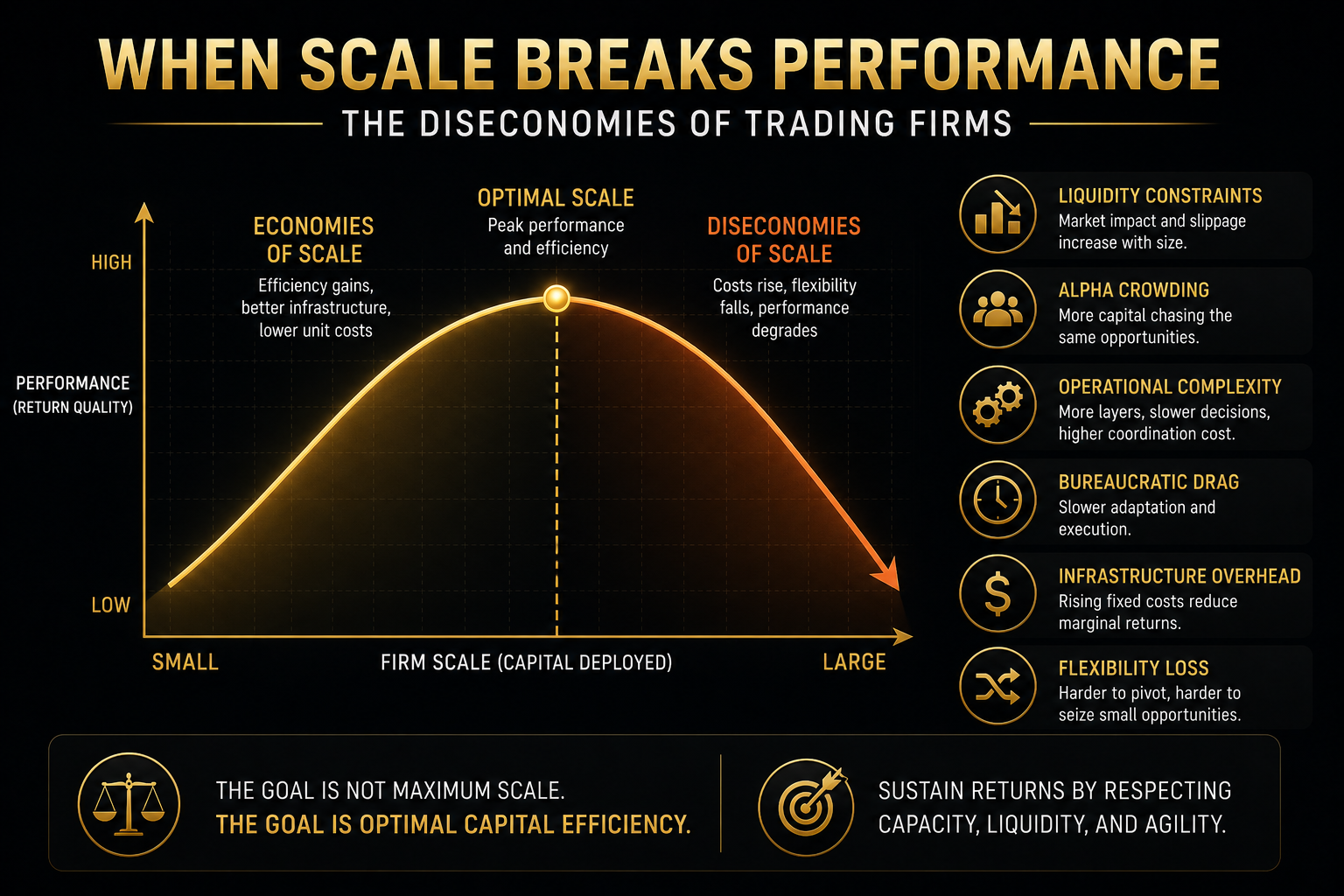
Most businesses benefit from scale.
Trading firms are different.
In systematic trading:
- scale can improve infrastructure efficiency
- but eventually destroys deployment efficiency
At Linitics, we view scale not as an automatic advantage—
But as a variable that must be managed carefully.
Because in trading:
Beyond a certain point, larger capital reduces flexibility, increases friction, and compresses alpha.
1. Understanding Diseconomies of Scale
Diseconomies of scale occur when:
- growth begins reducing efficiency instead of improving it
In trading, this happens when:
- capital size exceeds market capacity
- operational complexity grows faster than edge
2. The Early Benefits of Scale
Initially, scaling provides advantages:
- better infrastructure
- lower execution costs
- stronger technology investment
- diversified strategies
Small firms often lack:
- operational leverage
This creates an early scaling advantage.
3. The Turning Point
Eventually, scale introduces:
- liquidity constraints
- execution friction
- coordination overhead
At this stage:
adding capital no longer improves returns proportionally
4. Liquidity Constraints
Markets have finite liquidity.
Larger orders create:
- market impact
- slippage
- reduced execution quality
A strategy that performs well at:
- $1M
May deteriorate at:
- $100M
5. Market Impact as Self-Imposed Friction
As size grows:
- firms move markets against themselves
This creates:
- execution leakage
- alpha compression
The firm becomes:
part of the market environment it is trying to exploit
6. Alpha Crowding
Large firms often deploy:
- similar strategies
- correlated signals
- overlapping positioning
This leads to:
- crowded trades
- reduced edge persistence
Scale accelerates:
- competitive compression
7. Capacity Limits
Every strategy has:
- finite capacity
Capacity depends on:
- liquidity
- turnover
- volatility
- execution sensitivity
Ignoring capacity destroys:
- scalability assumptions
8. Complexity Explosion
As firms grow:
- systems multiply
- teams expand
- operational dependencies increase
This creates:
- coordination inefficiency
- slower adaptation
- decision bottlenecks
Complexity becomes:
- a hidden performance tax
9. Bureaucratic Drag
Larger organizations often develop:
- approval layers
- operational rigidity
- slower execution cycles
This reduces:
- agility
- strategic responsiveness
10. Infrastructure Overhead
Scaling requires:
- more servers
- more monitoring
- more compliance
- more operational control
These costs grow continuously.
At some point:
- operational expansion outpaces alpha growth
11. The Flexibility Problem
Small firms can:
- adapt quickly
- rotate strategies rapidly
- enter niche opportunities
Large firms often cannot.
Their size limits:
- maneuverability
- deployment flexibility
12. Talent Coordination Risk
As organizations scale:
- communication complexity rises
- incentive alignment weakens
- execution consistency declines
Human coordination becomes:
- a scaling bottleneck
13. Diversification vs Dilution
Scaling often forces firms to:
- deploy into weaker opportunities
This creates:
- edge dilution
Capital grows faster than:
- high-quality opportunities
14. Why Some Small Firms Outperform
Smaller firms often retain:
- speed
- flexibility
- niche focus
They can exploit:
- inefficiencies too small for institutions
This creates:
structural agility advantage
15. Institutional Awareness of Scale Risk
Sophisticated firms actively monitor:
- strategy capacity
- execution degradation
- liquidity stress
- correlation concentration
They understand:
- not all capital is deployable efficiently
16. The Myth of Infinite Scalability
Backtests often assume:
- infinite execution capacity
Reality does not.
Every strategy eventually encounters:
- diminishing returns to scale
17. Optimal Scale vs Maximum Scale
The goal is not:
- maximum capital deployment
It is:
- optimal capital efficiency
There is a difference.
Professional firms optimize for:
return quality per unit of deployed capital
18. The Linitics Perspective
At Linitics, we view scale as:
- a constrained engineering problem
We focus on:
- capacity-aware design
- liquidity-sensitive deployment
- scalable infrastructure
- controlled complexity
Because:
sustainable scaling requires preserving agility while expanding capital.
Final Thoughts
In trading:
- scale creates power
- but also friction
The strongest firms are not always the largest.
They are often the firms that understand:
- where scale helps
- where scale destroys edge
At Linitics, we believe:
The future belongs not to firms that maximize size—
But to firms that optimize:
capital efficiency, adaptability, and deployable alpha.