Most traders optimize for:
- short-term profitability
- account growth
- monthly returns
Institutional operators optimize for:
- capital durability
- reinvestment efficiency
- balance sheet expansion
Because in professional trading:
Growth comes not just from returns—
but from how retained capital is recycled.
At Linitics, we view retained earnings as one of the most underestimated structural advantages in systematic trading.
1. The Difference Between Income and Capital Growth
Individual traders often treat trading as:
- income generation
This leads to:
- frequent withdrawals
- interrupted compounding
- unstable capital base
Trading firms operate differently.
Profits become:
- retained capital
- strategic reserves
- future deployment capacity
2. What Are Retained Earnings?
Retained earnings are:
- profits kept within the entity
- rather than distributed externally
These retained profits increase:
- trading capital
- operational capacity
- resilience
Over time:
retained earnings become the engine of scale
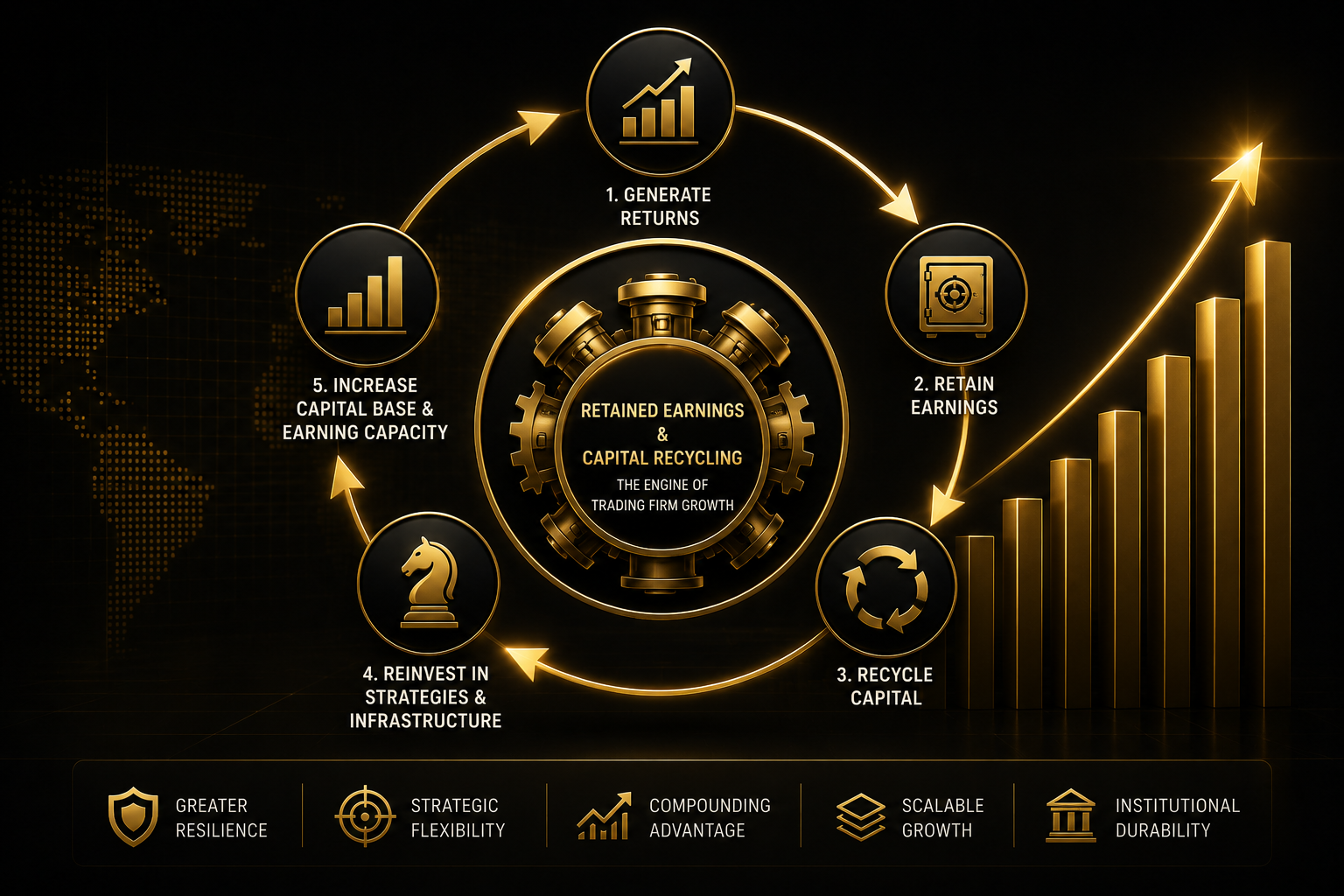
3. The Internal Compounding Loop
The process is simple—but powerful:
Step 1
Generate returns
Step 2
Retain a portion of profits
Step 3
Reallocate into strategies and infrastructure
Step 4
Increase earning capacity
This creates:
self-reinforcing capital growth
4. Capital Recycling Explained
Capital recycling refers to:
- redeploying realized profits into new opportunities
Examples include:
- expanding strategy allocation
- funding infrastructure
- increasing market capacity
Instead of capital leaving the system—
It compounds within it.
5. Why This Creates Structural Advantage
Firms with retained capital gain:
- greater flexibility
- stronger survivability
- scalable deployment capability
They are less dependent on:
- external funding
- capital inflows
- leverage expansion
6. The Hidden Power of Incremental Scaling
Small increases in retained capital can lead to:
- larger notional deployment
- broader diversification
- higher operational efficiency
This creates:
- non-linear growth over time
7. Capital Durability
A retained capital base provides:
- drawdown absorption
- operational continuity
- strategic patience
Without durable capital:
- firms become fragile during volatility
8. Reinvestment Beyond Trading
Institutional firms recycle profits into:
- technology
- data infrastructure
- execution systems
- research capability
This improves:
- long-term edge
- operational efficiency
9. The Psychological Difference
Individual traders often think:
- “How much can I withdraw?”
Professional firms think:
- “How much can the balance sheet compound?”
This mindset shift is fundamental.
10. External Capital vs Internal Growth
External capital introduces:
- expectations
- reporting pressure
- redemption risk
Internally compounded capital provides:
- autonomy
- stability
- alignment
This is why many prop firms prioritize:
- retained growth over external fundraising
11. Capital Recycling & Risk Management
Retained capital enables:
- controlled risk scaling
- diversified allocations
- reduced concentration
It allows growth without:
- excessive leverage
12. Compounding Efficiency
Compounding is strongest when:
- capital remains uninterrupted
Frequent withdrawals create:
- capital leakage
- reduced reinvestment base
Retained earnings maximize:
- compounding efficiency
13. The Institutional Time Horizon
Institutional firms optimize for:
- multi-year growth
- capital endurance
- long-duration scaling
This requires:
- patience
- disciplined reinvestment
- structured capital management
14. Why Most Traders Never Reach Scale
Most traders fail to scale because:
- profits leave the system
- capital base stagnates
- reinvestment is inconsistent
As a result:
- growth remains linear
15. The Linitics Perspective
At Linitics, we believe:
- capital should be treated as a productive asset
We focus on:
- reinvestment frameworks
- scalable capital deployment
- structured compounding systems
Because:
The objective is not merely:
- generating profits
It is:
building a self-expanding capital engine.
Final Thoughts
The long-term growth of trading firms rarely comes from:
- a single strategy
- aggressive leverage
- short-term outperformance
It comes from:
- retained capital
- disciplined recycling
- structured compounding
At Linitics, we believe:
The strongest firms are not those that extract the most capital—
But those that:
keep capital inside the system long enough for it to compound exponentially.