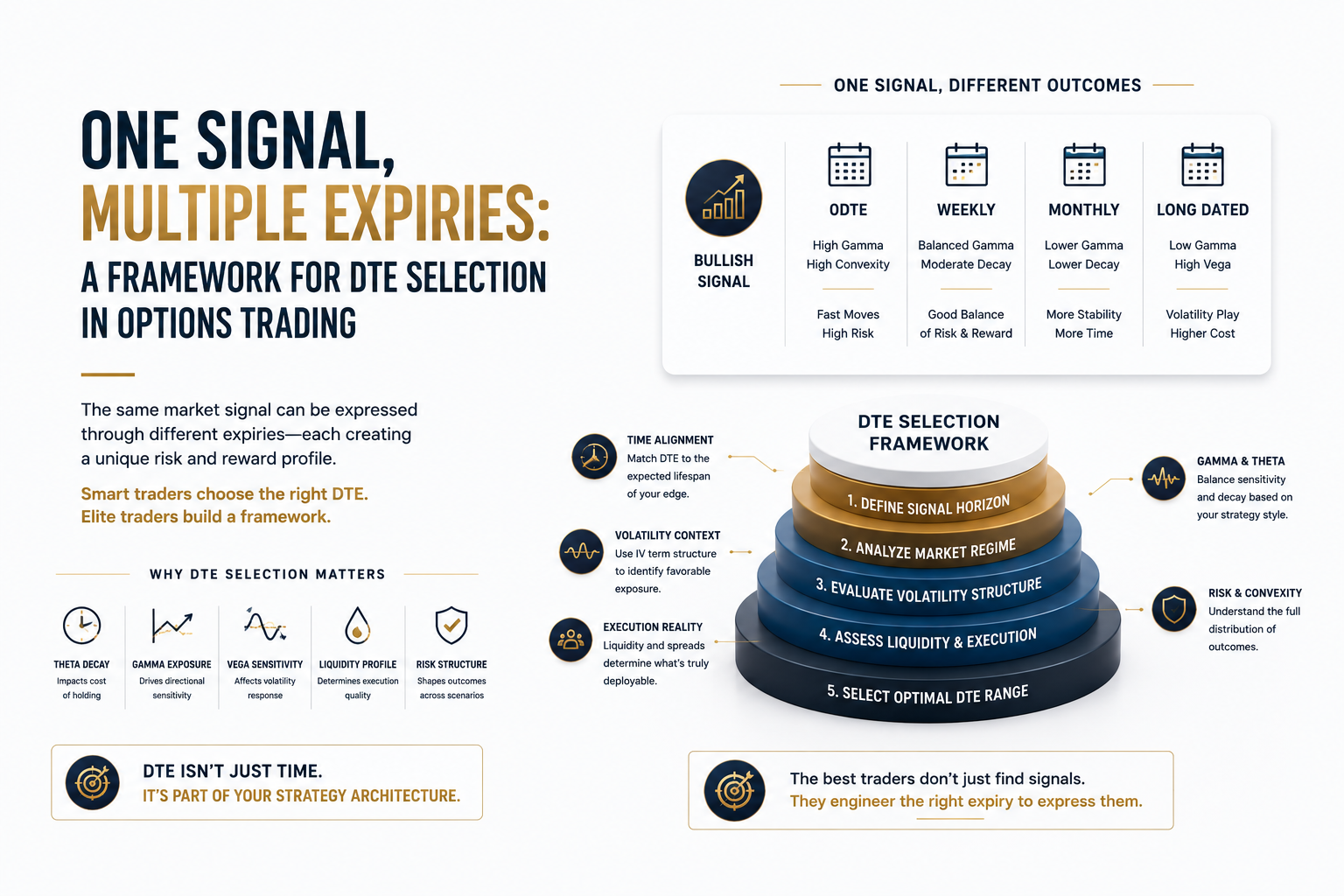
Most options traders focus heavily on:
- entry signals
- directional bias
- strike selection
But institutional options trading involves another critical layer:
DTE selection.
The same market signal can produce dramatically different outcomes depending on:
- expiry structure
- gamma exposure
- theta decay
- liquidity conditions
- volatility behavior
At Linitics, we believe many traders underestimate how important expiry selection is to:
- risk-adjusted performance
- convexity management
- deployable expectancy
Because in options trading:
expiry is not merely a timing choice—it is part of the strategy architecture itself.
1. What Is DTE?
DTE stands for:
- Days To Expiry.
It defines:
- how much time remains before an option contract expires.
This single variable influences nearly every aspect of option behavior, including:
- theta decay
- gamma sensitivity
- vega exposure
- liquidity dynamics
- risk asymmetry
2. One Signal Does Not Mean One Trade Structure
A bullish market signal can be expressed through:
- 0DTE options
- weekly expiries
- monthly expiries
- longer-duration contracts
Each structure creates:
- different payoff behavior
- different convexity exposure
- different execution characteristics
The signal may remain identical.
But the risk architecture changes completely.
3. DTE Determines Risk Compression
Short-duration options compress:
- risk
- decay
- convexity
Into smaller time windows.
Longer-duration options distribute these exposures across:
- broader time horizons.
This changes:
- trade stability
- sensitivity to noise
- probability distributions
4. Short DTE Structures
Short DTE trades typically offer:
- higher gamma
- faster convexity
- lower premium outlay
- rapid payoff acceleration
But they also introduce:
- extreme theta decay
- execution sensitivity
- unstable risk behavior
This creates:
high responsiveness but lower tolerance for error.
5. Longer DTE Structures
Longer-duration contracts generally provide:
- smoother delta behavior
- lower gamma instability
- slower decay
- more time for thesis development
This creates:
- greater resilience to short-term noise
But often reduces:
- payoff explosiveness.
6. Gamma Exposure Changes Across Expiries
Gamma behaves very differently depending on DTE.
Near expiry:
- gamma accelerates rapidly.
This creates:
- violent directional sensitivity
- unstable hedge dynamics
- nonlinear position behavior
Longer expiries maintain:
- smoother gamma exposure
- lower short-term instability.
7. Theta Is a Structural Variable
Theta decay increases aggressively as expiration approaches.
This means short-duration structures may require:
- faster directional accuracy
- tighter timing precision
Longer expiries reduce:
- immediate decay pressure
But involve:
- higher premium costs.
8. Vega Sensitivity Changes with DTE
Longer-duration options generally carry:
- greater vega exposure.
This means implied volatility changes can materially impact:
- option pricing
- portfolio behavior
Short-duration contracts are often more influenced by:
- realized intraday movement
rather than - volatility repricing.
9. Liquidity Profiles Differ Across Expiries
Liquidity is not uniform across the options curve.
Different expiries exhibit different:
- spreads
- market depth
- fill behavior
- execution stability
Institutional firms evaluate DTE partly through:
- deployable liquidity quality.
10. Event Risk Changes Expiry Selection
Macro events such as:
- CPI releases
- FOMC meetings
- earnings announcements
Can dramatically alter expiry behavior.
Short DTE structures may become:
- highly unstable around event windows.
Longer expiries may absorb volatility shocks more effectively.
11. Strategy Objectives Should Determine DTE
Different strategies require different expiry structures.
Examples:
Short-Term Momentum
May favor:
- short-duration gamma exposure
Swing Positioning
May favor:
- medium-duration convexity balance
Volatility Positioning
May prioritize:
- vega sensitivity
Mean Reversion
May require:
- slower decay environments
There is no universally “best” DTE.
12. The Relationship Between Timeframe and DTE
Trade duration should align with:
- expected signal persistence.
A multi-day thesis expressed through:
- 0DTE options
Creates structural mismatch.
Similarly:
- long-duration options may dilute short-term intraday signals.
Alignment matters.
13. Why Many Traders Misunderstand Convexity
Many traders optimize for:
- maximum payoff percentage
Without understanding:
- convexity instability
- probability compression
- decay acceleration
The highest theoretical payout often carries:
- the lowest structural stability.
14. Institutional Firms Think in Risk Architecture
Sophisticated firms evaluate DTE through:
- exposure engineering
- volatility structure
- liquidity quality
- execution efficiency
- scenario resilience
Not merely:
- payoff attractiveness.
15. The Hidden Cost of Wrong DTE Selection
Poor expiry selection creates:
- unnecessary decay
- unstable gamma exposure
- execution friction
- volatility mismatch
Even correct market direction may fail to generate profitability if:
- expiry structure is misaligned.
16. Why DTE Selection Is a Portfolio Decision
Institutional firms often treat expiry exposure as:
- portfolio architecture
Different expiries create different:
- risk distributions
- liquidity behavior
- convexity interactions
This becomes increasingly important in:
- multi-strategy systems.
17. DTE Selection Is Dynamic
Optimal expiry selection changes across:
- volatility regimes
- liquidity environments
- macro conditions
- market structure states
Static DTE frameworks often fail because:
- markets are non-stationary.
18. The Linitics Perspective
At Linitics, we view DTE selection as:
- a core component of options strategy design.
We believe expiry selection should integrate:
- signal horizon
- liquidity conditions
- volatility structure
- convexity management
- execution architecture
Because:
in professional options trading, the signal alone is never the full strategy.
Final Thoughts
The same market view can produce:
- completely different outcomes
Depending on:
- expiry selection.
DTE determines:
- convexity
- decay
- liquidity behavior
- risk asymmetry
- execution sensitivity
At Linitics, we believe sophisticated options trading is not merely about:
- finding directional edge
But about:
engineering the correct exposure structure around it