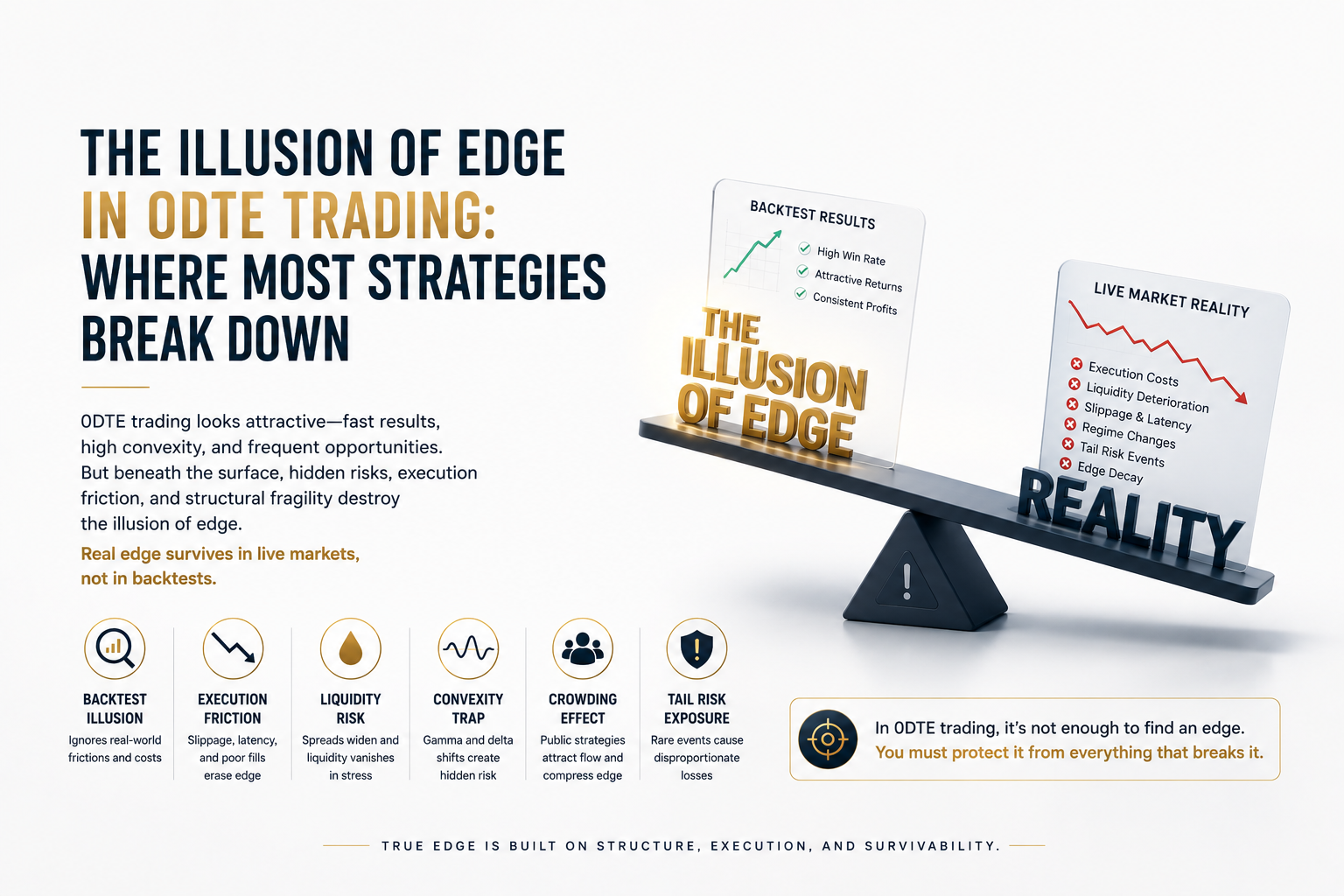
0DTE options trading has become one of the fastest-growing areas in modern derivatives markets.
The attraction is obvious:
- rapid payoff potential
- high convexity
- intraday leverage
- continuous market action
Social media and retail trading communities often portray 0DTE as:
- a repeatable edge engine
- a fast-compounding opportunity
- a scalable intraday strategy framework
But institutional reality is far less forgiving.
At Linitics, we believe many apparent 0DTE “edges” are not true structural advantages.
They are often:
- backtest artifacts
- execution illusions
- volatility regime dependencies
- hidden convexity exposures
Because in highly compressed markets:
what appears profitable in theory often collapses in live deployment.
1. Why 0DTE Feels Like High Edge Trading
0DTE trading creates powerful psychological reinforcement because:
- small moves create large percentage returns
- trades resolve quickly
- payoff asymmetry appears attractive
This creates the perception of:
- high predictive accuracy
- scalable opportunity
- repeatable intraday alpha
But fast feedback loops can create:
false confidence faster than durable edge.
2. Most 0DTE Edges Are Extremely Fragile
Many strategies rely on conditions that are:
- temporary
- liquidity dependent
- volatility sensitive
Small changes in:
- spreads
- execution timing
- market regime
- dealer positioning
Can completely alter expectancy.
This makes many systems:
- structurally unstable.
3. Backtests Often Ignore the Most Important Variables
Many 0DTE backtests underestimate or ignore:
- spread expansion
- fill quality
- execution latency
- partial fills
- liquidity deterioration
These variables matter enormously because:
- holding periods are extremely short.
Small execution inefficiencies can erase:
- theoretical edge entirely.
4. The Convexity Trap
0DTE options exhibit highly nonlinear behavior.
As expiration approaches:
- gamma accelerates
- delta changes rapidly
- option sensitivity becomes unstable
This creates situations where:
- risk expands faster than traders anticipate.
Convexity creates opportunity—
But also:
- hidden fragility.
5. Win Rate Often Masks Structural Weakness
Many 0DTE systems produce:
- high win rates
- attractive short-term equity curves
But still possess:
- negative tail asymmetry
- unstable expectancy
- catastrophic variance exposure
Small frequent gains can hide:
- rare but severe structural losses.
6. The Liquidity Illusion
During calm conditions:
- spreads appear tight
- fills appear efficient
- execution feels reliable
But under volatility stress:
- liquidity disappears rapidly
- spreads widen aggressively
- slippage becomes nonlinear
This is where many systems fail operationally.
7. Dealer Positioning Changes the Environment
0DTE dynamics are heavily influenced by:
- dealer gamma exposure
- hedging flows
- intraday positioning behavior
This creates environments where:
- price behavior changes structurally throughout the session.
Strategies that worked in one regime may collapse in another.
8. Small Timeframes Magnify Noise
Short-duration systems operate inside:
- highly noisy environments.
Signal quality deteriorates because:
- random intraday movement dominates behavior.
As timeframe compresses:
- execution precision matters more
- prediction reliability often decreases.
9. Retail Replication Compresses Edge Quickly
Publicly visible 0DTE strategies attract:
- rapid crowding
- copy trading
- social amplification
This accelerates:
- spread deterioration
- entry competition
- edge compression
The more visible a setup becomes:
- the less durable it often becomes.
10. Why Risk Management Fails in 0DTE
Many traders assume:
- small premium = controlled risk.
Institutional operators understand:
- liquidity risk
- execution failure risk
- gap behavior
- variance clustering
Can create losses beyond modeled expectations.
Defined premium does not eliminate:
structural instability.
11. Most Systems Are Overfit to Specific Regimes
Many profitable 0DTE backtests are unintentionally optimized for:
- narrow volatility conditions
- specific market environments
- temporary flow behavior
When market structure changes:
- expectancy collapses rapidly.
This is classic:
- non-stationarity risk.
12. The Psychological Feedback Problem
Fast trade resolution creates:
- dopamine reinforcement
- impulsive scaling
- overconfidence
This often leads traders to:
- increase size too quickly
- ignore variance
- underestimate tail exposure
The speed of 0DTE can distort:
- risk perception itself.
13. Why Institutional Firms Approach 0DTE Differently
Sophisticated firms rarely deploy 0DTE through:
- discretionary impulse
- oversized directional bets
- simplistic payoff assumptions
Instead they focus on:
- liquidity-aware execution
- systematic sizing
- flow analysis
- volatility structure
- controlled convexity exposure
The edge often exists in:
- structure and execution
not - prediction alone.
14. Execution Is the Real Battlefield
In 0DTE trading:
- milliseconds matter
- spread efficiency matters
- order routing matters
- fill quality matters
Two firms with identical signals can produce:
- dramatically different outcomes
Purely through execution quality.
15. The Capacity Problem Is Severe
Most 0DTE opportunities have:
- limited deployable size.
As capital increases:
- market impact rises
- fills deteriorate
- execution edge compresses rapidly
Many systems fail because traders confuse:
- theoretical scalability
with - deployable scalability.
16. Survivability Matters More Than Short-Term Gains
The true challenge in 0DTE trading is not:
- generating occasional outsized wins.
It is:
- surviving repeated convexity exposure over long periods.
Many strategies fail not because:
- they never work
But because:
- they eventually encounter structural stress they cannot survive.
17. Why Simplicity Often Hides Complexity
Many public 0DTE strategies appear:
- visually simple
- easy to execute
- mechanically repeatable
But underneath exist:
- highly complex liquidity dynamics
- nonlinear volatility interactions
- execution-sensitive risk structures
The apparent simplicity is often misleading.
18. The Linitics Perspective
At Linitics, we view 0DTE as:
- a specialized volatility environment
Not:
- a shortcut to rapid compounding.
We believe durable 0DTE deployment requires:
- institutional-grade execution
- volatility-aware risk systems
- liquidity-sensitive positioning
- strict convexity control
Because the greatest risk in 0DTE trading is often not:
- market direction
But:
misunderstanding the structural fragility of the edge itself.
Final Thoughts
0DTE trading creates the appearance of:
- speed
- precision
- opportunity
But beneath the surface lies:
- execution fragility
- convexity risk
- liquidity instability
- regime dependency
At Linitics, we believe the firms that survive in 0DTE markets will not be those chasing the highest payoff—
But those most capable of:
distinguishing true structural edge from temporary statistical illusion.