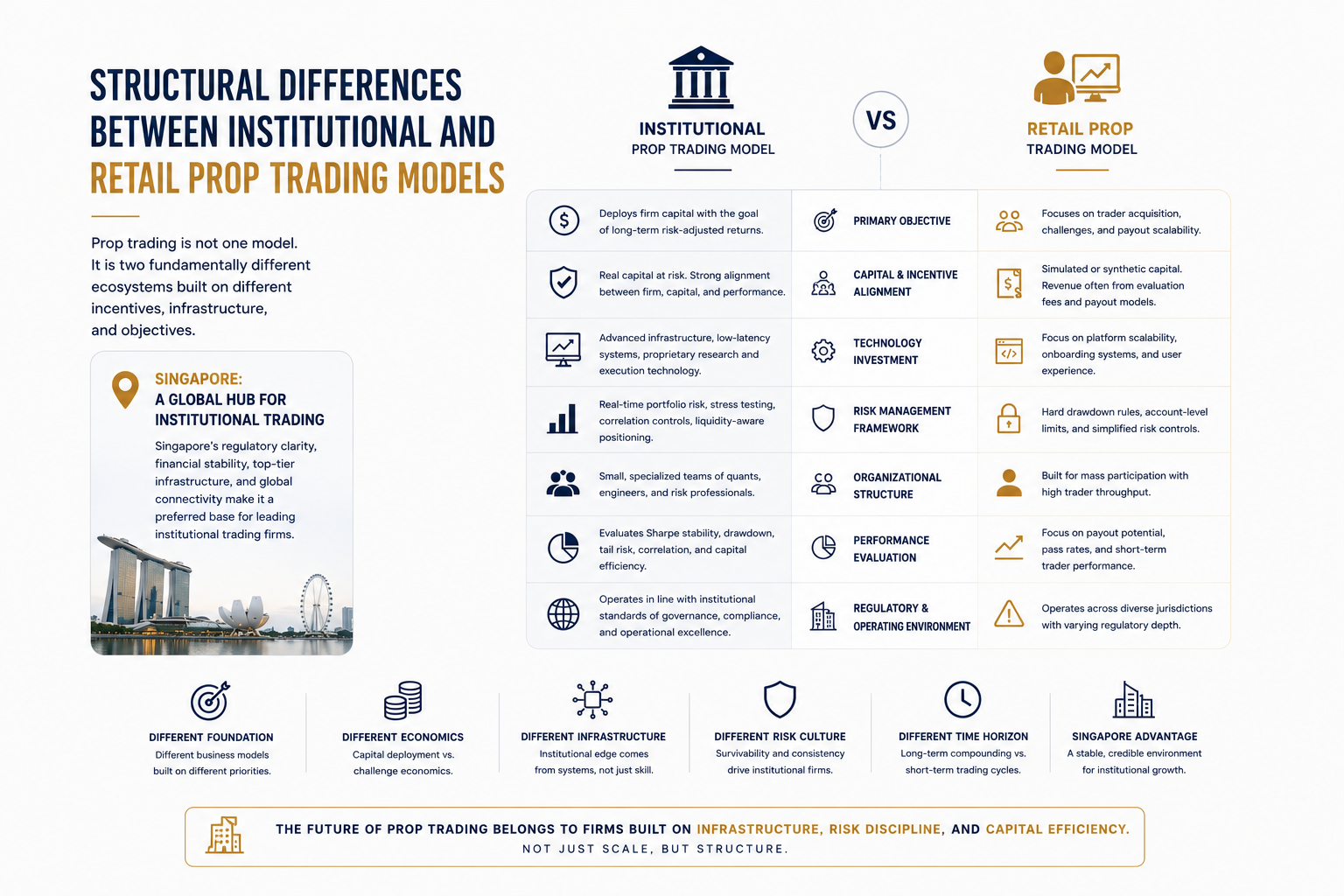
The term “prop trading” is used widely today.
But the industry now contains two very different ecosystems operating under the same label:
- institutional proprietary trading firms
and - retail-oriented prop trading models
On the surface, both appear connected through:
- leverage
- trading capital
- performance-based outcomes
But structurally, they are fundamentally different.
At Linitics, we believe understanding this distinction is increasingly important—particularly in financial hubs like Singapore, where professional quantitative trading infrastructure continues to evolve rapidly.
Because modern institutional prop trading is not merely:
- funded trading
It is:
a capital, technology, and risk-engineering business.
1. The Rise of Retail Prop Trading Models
Over the last few years, retail-oriented prop trading programs expanded rapidly through:
- evaluation challenges
- funded account models
- simulated capital frameworks
- trader onboarding platforms
These businesses primarily target:
- individual traders seeking leverage access.
The model is largely structured around:
- trader acquisition
- evaluation fees
- scalable retail participation
2. Institutional Prop Trading Operates Differently
Institutional proprietary trading firms deploy:
- internal balance sheet capital
Their objective is not:
- maximizing trader signups
But:
- generating risk-adjusted returns through scalable infrastructure.
This changes everything about:
- incentives
- technology investment
- operational structure
- risk management architecture
3. Singapore’s Emerging Role in Institutional Trading
Singapore has increasingly become a preferred hub for:
- quantitative trading firms
- multi-asset systematic operators
- cross-border trading infrastructure
This is driven by several factors:
- regulatory clarity
- banking stability
- institutional credibility
- global market connectivity
As a result:
- institutional trading firms in Singapore tend to prioritize operational durability over retail scale.
4. Retail Prop Models Are Often Distribution Businesses
Many retail prop firms primarily optimize for:
- trader throughput
- challenge participation
- platform scalability
The economic engine is frequently tied to:
- evaluation model economics
rather than - proprietary balance sheet deployment.
This creates a fundamentally different business structure from institutional prop firms.
5. Institutional Firms Optimize for Capital Efficiency
Institutional prop firms focus heavily on:
- deployable capital quality
- infrastructure efficiency
- portfolio construction
- execution precision
The core objective becomes:
maximizing long-term capital compounding.
This leads to significantly different operational priorities.
6. Risk Management Architecture Differs Dramatically
Retail prop models often rely on:
- hard drawdown limits
- account-level constraints
- simplified exposure controls
Institutional firms deploy:
- real-time portfolio risk systems
- correlation management
- liquidity-aware sizing
- stress testing frameworks
- cross-strategy exposure monitoring
Risk management becomes:
- systemic infrastructure.
7. Technology Investment Is Not Comparable
Many institutional firms operate as:
- technology-first organizations.
They invest heavily in:
- execution systems
- low-latency infrastructure
- quantitative research platforms
- data engineering
- automated monitoring systems
Retail models typically prioritize:
- platform scalability
- user onboarding
- challenge operations
The technology stack serves very different purposes.
8. Capital Ownership Changes Incentives
Institutional firms deploy:
- internal capital.
This creates direct alignment between:
- survivability
- risk discipline
- deployment quality
Retail prop models frequently involve:
- simulated capital structures
- payout frameworks
- synthetic risk environments
The economic incentives differ substantially.
9. Institutional Trading Is Infrastructure Driven
Modern institutional prop firms increasingly compete through:
- execution quality
- operational efficiency
- infrastructure integration
- portfolio engineering
The edge often exists in:
- systems architecture
not merely - trader prediction ability.
10. Singapore Favors Institutional Discipline
Singapore’s financial ecosystem naturally rewards firms emphasizing:
- governance
- operational clarity
- risk controls
- structured scalability
This environment is highly compatible with:
- institutional quantitative trading operations.
The emphasis tends to be on:
- durability
rather than - speculative expansion.
11. Organizational Structure Is Different
Retail prop models are often structured around:
- mass participation systems.
Institutional firms usually operate through:
- smaller specialized teams
- quantitative researchers
- engineers
- risk specialists
- infrastructure operators
The operational density per employee is significantly higher.
12. Liquidity Considerations Differ
Institutional firms must evaluate:
- deployable liquidity
- market impact
- execution scalability
- portfolio capacity
Retail trading models often operate at:
- much smaller effective capital scale
This creates different constraints around:
- strategy deployment.
13. Time Horizon Differences
Retail environments frequently encourage:
- short-term trading activity
- rapid evaluation cycles
- high turnover behavior
Institutional firms often optimize for:
- long-term survivability
- scalable deployment
- capital durability
The operating philosophy differs materially.
14. Performance Metrics Are Evaluated Differently
Retail prop models often emphasize:
- payout potential
- challenge pass rates
- trader growth narratives
Institutional firms evaluate:
- Sharpe stability
- drawdown control
- correlation efficiency
- tail-risk resilience
- portfolio-level robustness
Performance is viewed through:
balance sheet survivability.
15. Why Infrastructure Matters More Institutionally
As markets become more competitive:
- infrastructure increasingly determines edge persistence.
Institutional firms invest heavily in:
- monitoring systems
- execution optimization
- operational automation
- data pipelines
- quantitative tooling
This creates advantages difficult to replicate through:
- discretionary trading skill alone.
16. The Misunderstanding Around “Funded Trading”
Many traders assume institutional prop trading is simply:
- larger-scale funded retail trading.
In reality:
- institutional firms operate as integrated capital systems.
The difference is structural—not merely capital size.
17. Why Singapore Continues Attracting Institutional Operators
Singapore provides several characteristics highly attractive to institutional trading firms:
- regulatory clarity
- stable banking infrastructure
- strong legal framework
- cross-border capital connectivity
- institutional credibility
This environment supports:
- scalable global operations.
18. The Linitics Perspective
At Linitics, we believe the future of institutional prop trading belongs to firms built around:
- infrastructure
- systematic risk management
- operational resilience
- capital efficiency
- technology integration
We view modern prop trading as:
- a multidisciplinary institutional framework
Not merely:
- leveraged speculative activity.
Singapore increasingly represents an ideal environment for this evolution because it combines:
- structural stability
with - global market accessibility.
Final Thoughts
Retail and institutional prop trading models may appear similar externally.
But beneath the surface, they operate under entirely different:
- incentive systems
- infrastructure requirements
- capital frameworks
- operational objectives
At Linitics, we believe understanding these structural differences is essential for understanding where the industry itself is heading.
Because the future of professional trading will increasingly belong not to:
- firms with the loudest marketing
But to:
firms with the strongest operational architecture.