Most people imagine successful trading firms as:
- massive organizations
- crowded trading floors
- large analyst teams
- complex management hierarchies
Modern elite prop firms increasingly look very different.
Many of the highest-performing firms operate through:
- compact teams
- highly specialized talent
- tightly integrated workflows
At Linitics, we believe this shift is not accidental.
Because in modern systematic trading:
edge increasingly comes from depth of expertise—not organizational size.
1. The Evolution of Competitive Advantage
Earlier eras of finance rewarded:
- information access
- market presence
- distribution scale
Modern electronic markets changed this.
Today:
- information is widely available
- execution is automated
- infrastructure is global
This shifted the competitive advantage toward:
- specialization
- systems integration
- execution precision
As a result:
smaller expert teams became structurally efficient.
2. Why Large Organizations Become Slower
As organizations expand:
- communication complexity rises
- decision chains lengthen
- operational coordination weakens
This creates:
- slower iteration cycles
- reduced agility
- strategic inertia
In fast-moving markets:
- latency is not only technological
- it is organizational.
3. Elite Firms Optimize for Cognitive Efficiency
Modern prop firms increasingly optimize for:
- decision quality per person
Not:
- headcount scale
Small expert teams reduce:
- communication friction
- internal bureaucracy
- coordination overhead
This creates:
- tighter operational loops
- faster adaptation
- cleaner execution pipelines
4. Domain Expertise Is Increasingly Specialized
Modern trading is no longer a single discipline.
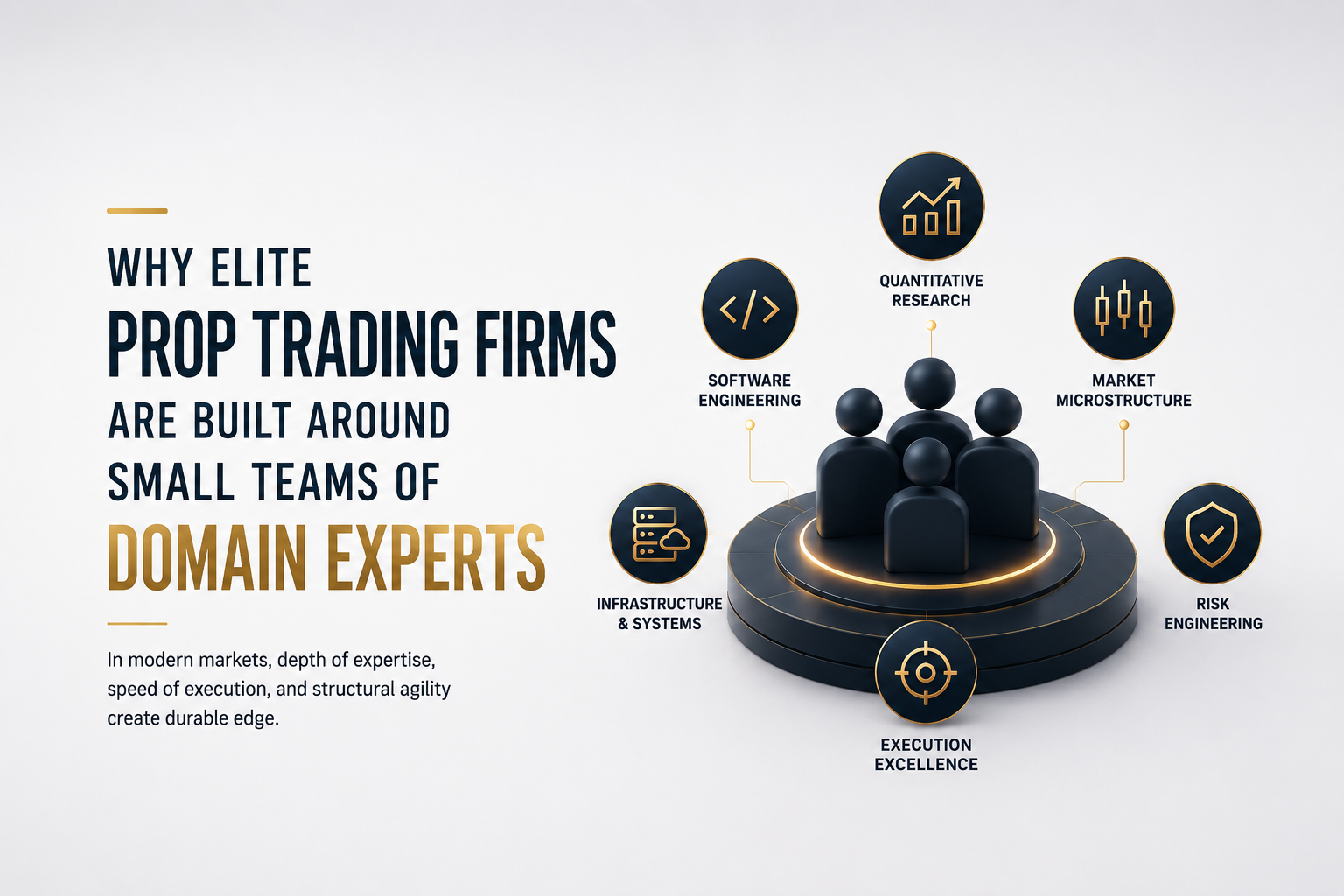
Elite firms combine expertise across:
- quantitative research
- software engineering
- execution systems
- market microstructure
- risk engineering
- infrastructure architecture
Each domain is highly technical.
Generalized teams often struggle to compete against:
- highly specialized operators.
5. The Rise of Builder-Operators
Many elite firms are increasingly built around individuals who combine:
- research capability
- engineering capability
- trading understanding
These hybrid operators create advantages because they can:
- move faster
- integrate systems directly
- reduce translation friction between teams
6. Small Teams Create Faster Iteration Cycles
Systematic trading depends heavily on:
- continuous refinement
- rapid experimentation
- infrastructure adaptation
Smaller teams can:
- test faster
- deploy faster
- modify systems faster
This accelerates:
- research velocity
- operational responsiveness
7. Why Communication Overhead Becomes a Hidden Cost
Large organizations create hidden friction through:
- meetings
- approvals
- coordination layers
- reporting structures
Over time:
- operational complexity compounds
Small expert teams avoid much of this drag.
8. Alpha Often Exists in Narrow Domains
Modern alpha is frequently:
- highly localized
- capacity constrained
- structurally niche
Capturing these opportunities requires:
- deep specialization
rather than - broad organizational scale
9. The Technology Advantage of Lean Teams
Modern infrastructure enables small firms to access capabilities previously limited to large institutions.
Cloud systems, APIs, automation frameworks, and scalable tooling allow lean teams to build:
- sophisticated trading infrastructure
- global execution systems
- institutional-grade monitoring frameworks
This changes the economics of scale.
10. Operational Alignment Improves in Smaller Teams
Smaller teams often maintain:
- stronger ownership mentality
- tighter incentive alignment
- clearer accountability
This improves:
- execution discipline
- risk awareness
- strategic cohesion
11. Why Elite Firms Avoid Excessive Visibility
Many successful prop firms intentionally remain:
- operationally quiet
- structurally lean
- selectively scaled
Because:
- preserving edge matters more than public visibility
This is particularly important in:
- capacity-sensitive strategies
- execution-sensitive environments
12. The Relationship Between Size and Fragility
Larger organizations often introduce:
- bureaucracy
- scaling friction
- strategic dilution
At a certain point:
- organizational complexity becomes a liability
Elite firms frequently prioritize:
precision over expansion.
13. Infrastructure Replaced Traditional Scale
Historically, large firms possessed advantages through:
- physical presence
- exchange relationships
- execution access
Modern firms increasingly gain leverage through:
- software infrastructure
- automation systems
- quantitative tooling
This enables smaller expert teams to compete globally.
14. Why Talent Density Matters More Than Headcount
Elite firms optimize for:
- talent density
Not:
- organizational size
A small group of deeply capable specialists can outperform:
- much larger generalized organizations
Especially in:
- systematic trading
- quantitative research
- execution engineering
15. Institutional Secrecy as Structural Protection
Sophisticated firms rarely publicize:
- core infrastructure
- execution methods
- research architecture
Because:
operational opacity protects edge durability.
This is one reason many elite firms remain:
- relatively unknown publicly
despite - exceptional performance internally.
16. The Shift from “Trading Desks” to Integrated Systems Teams
Modern elite prop firms increasingly resemble:
- engineering-focused research organizations
Rather than:
- traditional trading floors
The competitive advantage now lies in integrating:
- technology
- execution
- research
- infrastructure
- risk systems
Into a unified operating framework.
17. Why Smaller Teams Scale Better Operationally
Lean organizations often scale more effectively because they maintain:
- agility
- tighter communication
- cleaner infrastructure integration
This allows firms to grow without:
- excessive operational entropy
18. The Linitics Perspective
At Linitics, we believe the future of elite trading firms belongs to:
- small, highly specialized teams
- integrated builder-operators
- infrastructure-first organizations
We believe sustainable edge increasingly depends on:
- talent density
- execution cohesion
- structural agility
Not:
- organizational size alone
Because in modern markets:
the strongest firms are often the most focused—not the largest.
Final Thoughts
The image of the giant trading floor is increasingly outdated.
Modern elite prop firms operate differently.
They optimize for:
- expertise
- speed
- integration
- operational precision
The future of systematic trading is likely to belong not to:
- the firms with the most employees
But to:
the firms with the highest concentration of specialized capability.