Returns attract attention.
Drawdowns determine survival.
In quantitative trading, performance is not defined by peak returns — but by the ability to endure adverse sequences without irreversible capital impairment.
At Linitics, we treat drawdown control, leverage discipline, and convexity awareness as the core pillars of systematic survival.
1. Drawdowns Are Not Linear Problems
A drawdown is not just a percentage loss.
It is a nonlinear recovery problem.
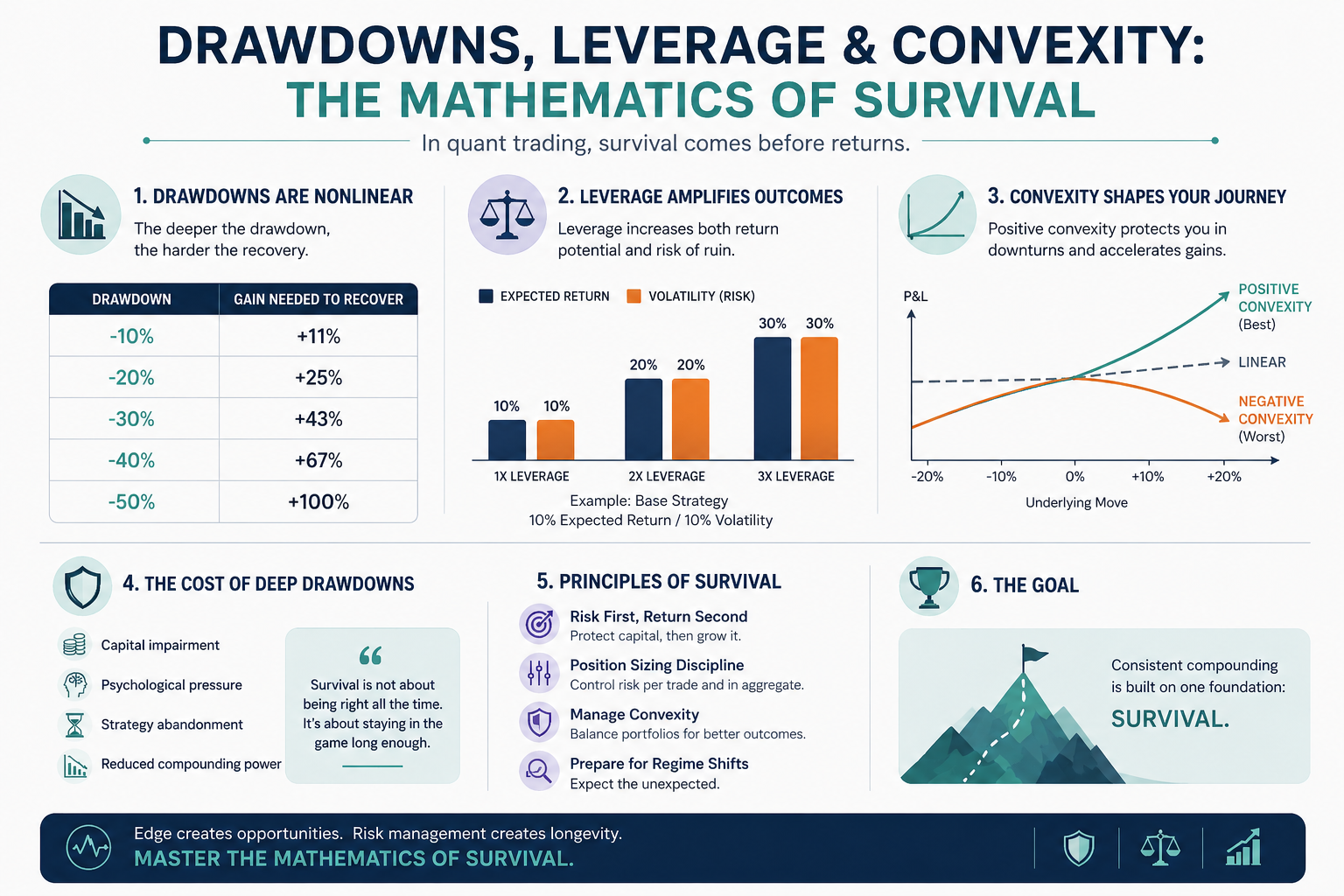
- A 10% loss requires ~11% gain to recover
- A 30% loss requires ~43% gain
- A 50% loss requires 100% gain
As drawdowns deepen, recovery becomes exponentially harder.
This creates a structural asymmetry:
Losses compound faster than gains recover.
2. The Hidden Cost of Deep Drawdowns
Beyond mathematics, drawdowns introduce:
- Capital impairment
- Reduced compounding base
- Psychological stress
- Strategy abandonment risk
Even a statistically sound strategy can fail if:
- Drawdowns exceed tolerance
- Capital is withdrawn
- Execution discipline breaks
Survival is not purely mathematical.
It is behavioral.
3. Leverage: Amplifier of Both Edge and Error
Leverage increases:
- Return potential
- Drawdown magnitude
- Sensitivity to volatility
- Risk of ruin
A strategy with:
- 10% expected return
- 10% volatility
Becomes, under 3× leverage:
- 30% expected return
- 30% volatility
But drawdowns scale as well — often faster due to volatility clustering.
Leverage does not create edge.
It magnifies outcomes.
4. Volatility Clustering & Leverage Risk
Markets exhibit volatility clustering:
- Calm periods → sudden expansion
- Low risk → abrupt high risk
Leverage applied during low volatility often leads to:
- Overexposure
- Sudden drawdown spikes
- Forced deleveraging
This is a common failure mode:
Leverage increases when risk appears low — precisely before it rises.
5. Convexity: The Shape of Risk
Convexity describes how returns respond to changes in underlying conditions.
Positive Convexity:
- Gains accelerate during favorable moves
- Losses are limited during adverse moves
Negative Convexity:
- Small consistent gains
- Occasional large losses
Many strategies (especially short volatility or premium-selling) exhibit negative convexity:
- Frequent small profits
- Rare but severe drawdowns
This creates misleading performance:
High win rate ≠ low risk.
6. The Trap of Smooth Equity Curves
Strategies with:
- High win rates
- Low volatility
- Smooth equity curves
Often hide:
- Tail risk
- Negative convexity
- Fragile assumptions
These strategies appear stable — until they fail suddenly.
The absence of volatility is not safety.
It is often delayed risk.
7. Risk of Ruin
Risk of ruin is the probability of losing enough capital to:
- Prevent recovery
- Force strategy shutdown
It depends on:
- Win rate
- Payoff ratio
- Position sizing
- Drawdown tolerance
Even profitable strategies can have high risk of ruin if:
- Position sizing is aggressive
- Drawdowns are large
- Losses cluster
Survival requires controlling tail risk — not just average outcomes.
8. Position Sizing as a Survival Tool
Position sizing determines:
- Drawdown depth
- Volatility of returns
- Longevity of strategy
Common frameworks:
- Fixed fractional risk
- Volatility scaling
- Kelly fraction (often reduced for safety)
Over-sizing is the fastest path to failure.
Under-sizing preserves optionality.
9. Convexity Engineering
Institutional portfolios manage convexity intentionally:
- Combine strategies with different payoff profiles
- Include tail-risk hedges
- Balance negative convexity with positive convexity
Examples:
- Trend-following (positive convexity)
- Options hedging structures
- Dynamic exposure reduction
The goal is not eliminating drawdowns.
It is controlling their shape.
10. The Role of Diversification
Diversification is not just about:
- Different assets
It is about:
- Different behaviors under stress
- Different convexity profiles
- Different regime responses
True diversification reduces:
- Tail risk
- Drawdown clustering
- Correlation spikes
But only if correlations are not assumed static.
11. Psychological Limits Define Practical Limits
Mathematical drawdown tolerance is not enough.
If a strategy has:
- 40% expected drawdown
But the operator can tolerate only:
- 15%
The strategy is not viable.
Practical survivability depends on:
- Behavioral discipline
- Capital structure
- Investor expectations
The best strategy is one that can be executed consistently.
12. The Institutional Perspective
Professional firms focus on:
- Drawdown control over return maximization
- Dynamic leverage adjustment
- Convexity balancing
- Stress testing across extreme scenarios
Because:
Survival is the prerequisite for compounding.
Final Thoughts
In quantitative trading:
- Returns determine attractiveness
- Risk determines sustainability
Drawdowns, leverage, and convexity define whether a strategy:
- Compounds capital
or - Terminates prematurely
At Linitics, we design strategies with survival as the primary constraint — ensuring that capital endures long enough for edge to compound.
Because in markets:
You do not fail because you were wrong.
You fail because you could not survive being wrong.