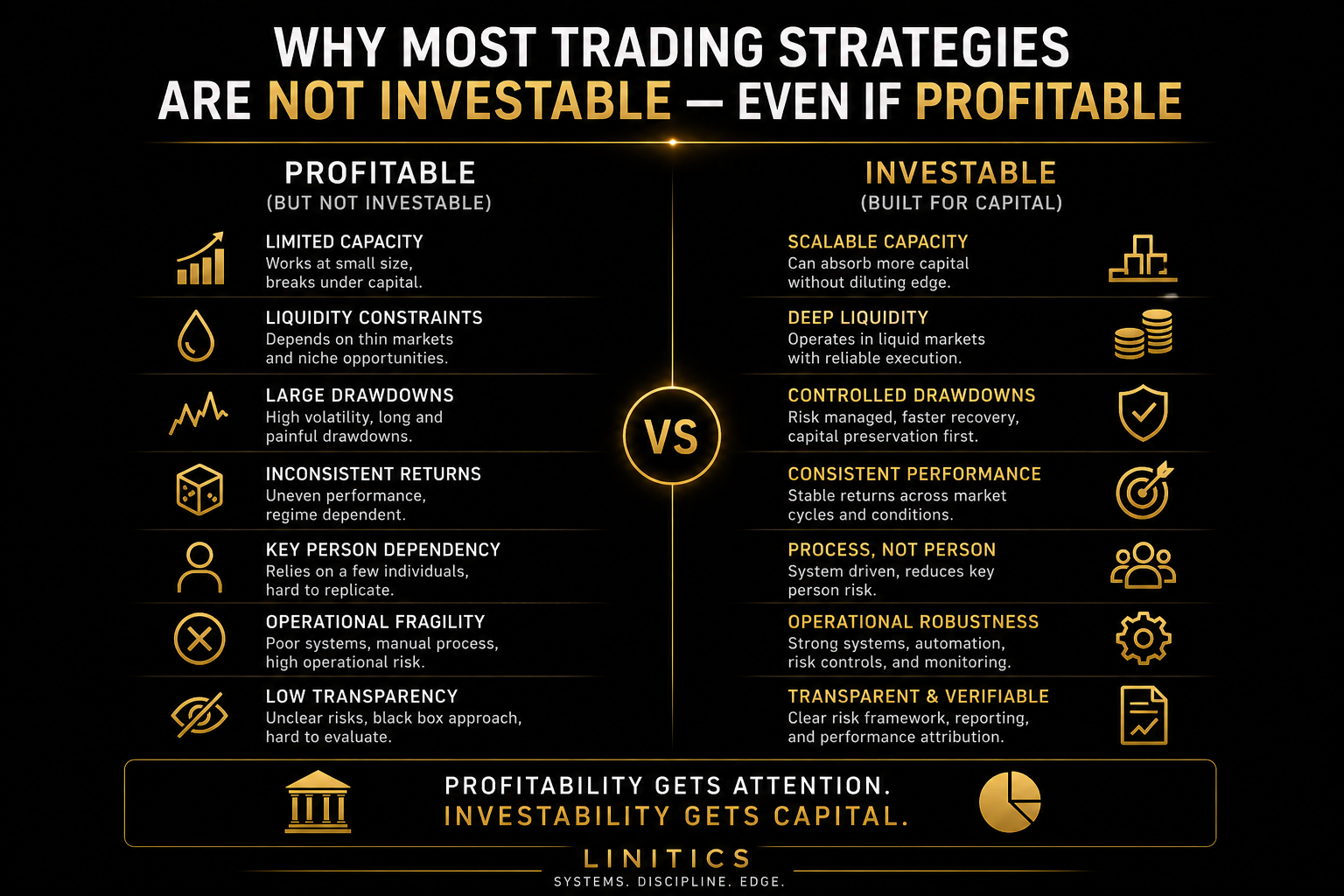
A strategy can be profitable.
That does not make it investable.
This distinction is often overlooked by:
- Individual traders
- Strategy developers
- Early-stage trading firms
But it is fundamental in institutional finance.
At Linitics, we view investability as a separate dimension—one that determines whether capital can be:
- Allocated
- Scaled
- Sustained
Because:
Markets reward returns.
Institutions allocate to structure.
1. Profitability vs Investability
A profitable strategy answers:
- Does it make money?
An investable strategy answers:
- Can capital be deployed into it reliably?
These are different questions.
A strategy may:
- Generate high returns
- Show strong backtests
- Perform well in small size
Yet fail when evaluated for:
- Scale
- risk
- operational robustness
2. Capacity Constraints
Many strategies fail due to limited capacity.
Examples:
- Niche inefficiencies
- Low-liquidity instruments
- High-turnover systems
As capital increases:
- Slippage increases
- Market impact rises
- Edge disappears
Implication:
If a strategy cannot absorb capital, it cannot attract it.
3. Liquidity Requirements
Institutional capital requires:
- Deep markets
- Consistent execution
- Reliable exits
Strategies dependent on:
- Thin liquidity
- Wide spreads
- Limited order book depth
Are structurally constrained.
Liquidity is not optional.
It is a prerequisite.
4. Drawdown Profile
Institutions evaluate:
- Maximum drawdown
- Drawdown duration
- Recovery behavior
A strategy with:
- High returns
- Large drawdowns
Is often rejected.
Because:
- Capital is sensitive to volatility
- Large drawdowns trigger redemptions
Implication:
Return without control is not acceptable.
5. Consistency vs Variability
Investable strategies exhibit:
- Stable performance
- Predictable behavior
- Controlled variance
Non-investable strategies often show:
- Highly uneven returns
- Regime dependency
- Performance clustering
Consistency enables:
- Capital allocation
- Confidence
- scaling
6. Risk Transparency
Institutions require:
- Clear risk frameworks
- Defined exposure limits
- Measurable risk metrics
Strategies lacking:
- Documentation
- risk attribution
- exposure clarity
Cannot be evaluated properly.
Opaque strategies are unallocatable.
7. Operational Robustness
A strategy must exist within:
- Reliable systems
- Execution infrastructure
- Monitoring frameworks
Without:
- Automated processes
- risk controls
- continuity planning
Performance becomes:
- Inconsistent
- fragile
Investability requires operational maturity.
8. Key Person Risk
Many profitable strategies depend on:
- A single individual
- Discretionary decisions
- Manual execution
This introduces:
- Continuity risk
- scalability limitations
- institutional hesitation
Institutions prefer:
- System-driven processes
- repeatable execution
- reduced dependency
9. Execution Sensitivity
Some strategies are:
- Highly dependent on execution precision
Small deviations lead to:
- Loss of edge
- performance degradation
Institutional capital prefers:
- Execution-resilient strategies
- Lower sensitivity to slippage
Because:
Perfect execution does not scale.
10. Regulatory & Structural Considerations
Investable strategies must fit within:
- Legal frameworks
- compliance structures
- reporting standards
Strategies that:
- Cannot be structured properly
- Lack transparency
- Operate in grey areas
Are excluded.
11. Capital Stability Requirements
Institutional capital requires:
- Stable deployment
- predictable behavior
- controlled risk
Strategies that:
- Require constant adjustment
- depend on timing
- lack stability
Are difficult to allocate to.
12. Behavioral Compatibility
Investable strategies must be:
- Understandable
- explainable
- defensible
If investors cannot:
- Understand risk
- Trust the process
They will not allocate capital.
13. The Illusion of High Returns
Many high-return strategies:
- Work at small scale
- Collapse under capital
Examples:
- High-frequency inefficiencies
- niche arbitrage
- aggressive leverage strategies
These are:
- Profitable
- but not scalable
14. The Institutional Filter
Before allocating capital, institutions evaluate:
- Capacity
- Liquidity
- Drawdowns
- Risk framework
- Operational setup
- governance
Most strategies fail this filter.
Not because they lose money—
But because they cannot hold capital responsibly.
15. The Linitics Perspective
At Linitics, we design strategies with:
- Investability in mind
- Risk-first frameworks
- Liquidity awareness
- execution robustness
We do not optimize for:
- Maximum returns
We optimize for:
- Deployable, scalable capital
Because:
The goal is not to create a strategy.
It is to create a system that capital can trust.
Final Thoughts
In trading:
- Profitability is the entry point
- Investability is the objective
Most strategies never transition from:
- Personal success
to - Institutional allocation
Because they are not built for:
- Scale
- stability
- structure
At Linitics, we believe:
The real edge is not in finding profitable strategies.
It is in building strategies that capital can stay with.