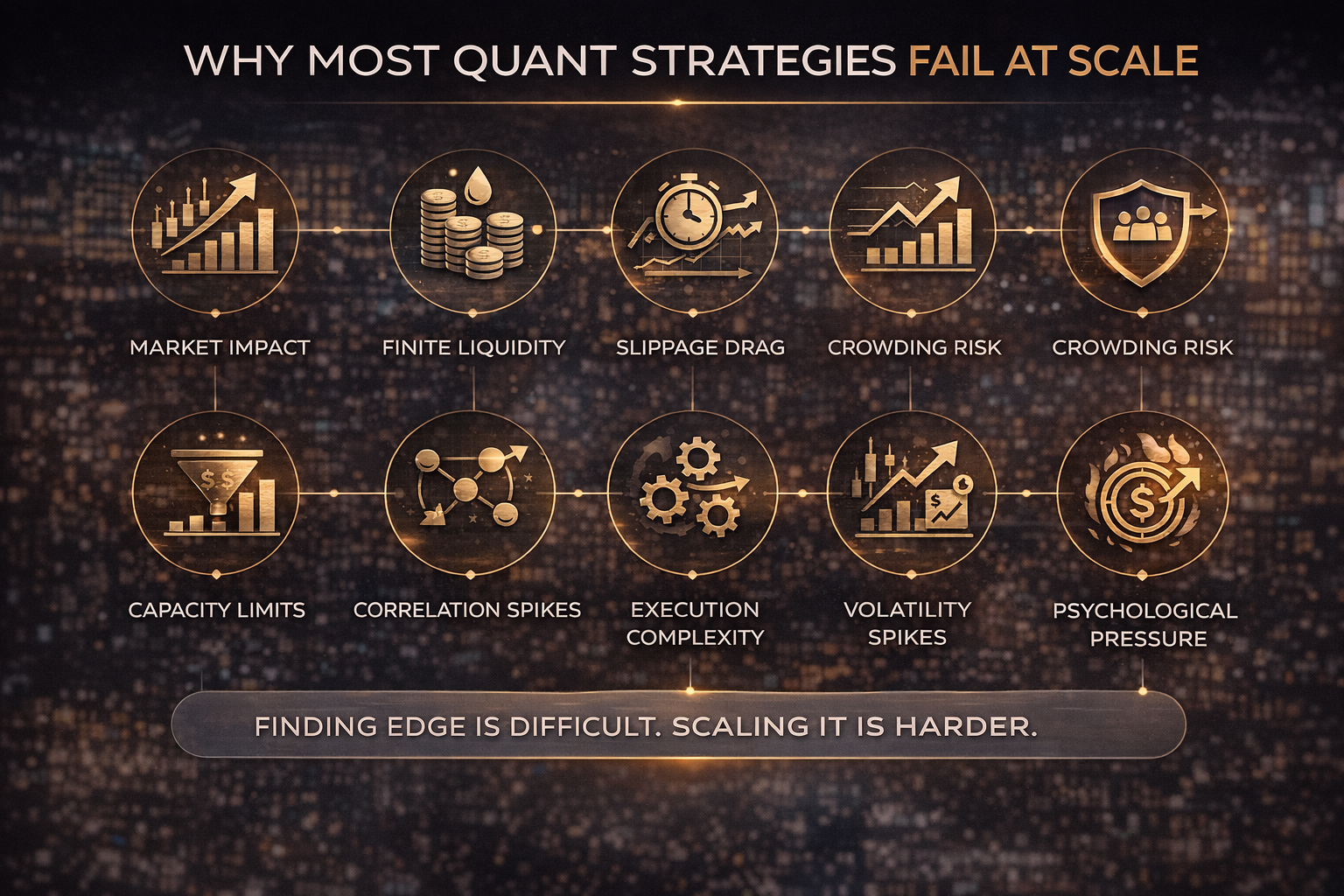
A quant strategy working at small capital is not proof of edge.
It is proof of possibility.
The real test begins when capital increases.
At scale, markets respond.
Liquidity shifts. Costs rise. Alpha compresses.
At Linitics, we view scalability as the defining constraint of systematic trading — not signal discovery.
1. The Illusion of Backtest Scalability
Backtests assume:
- Infinite liquidity
- Instant execution
- Constant spreads
- No market impact
These assumptions are acceptable at small size.
They collapse at scale.
A strategy generating strong returns at $100K may degrade materially at $10M — and break entirely at $100M.
Scalability is not linear.
It is constrained.
2. Market Impact: The Invisible Cost
As position size increases:
- Orders move the market
- Execution occurs across price levels
- Entry and exit prices deteriorate
This is market impact.
Impact is nonlinear:
- Small trades → negligible effect
- Large trades → self-defeating
The paradox:
The more capital you deploy, the more you destroy your own edge.
3. Liquidity Is Finite
Every strategy operates within a liquidity envelope.
Constraints include:
- Daily traded volume
- Order book depth
- Bid–ask spread
- Market participation rates
Institutional frameworks often cap:
- Participation rate (e.g., ≤ 5–10% of volume)
- Position size relative to ADV
Ignoring liquidity leads to:
- Slippage spikes
- Execution delays
- Inability to exit positions
Liquidity is not a detail.
It is a hard constraint.
4. Slippage Compounds with Scale
Slippage is often underestimated.
At scale:
- Entry slippage increases
- Exit slippage increases
- Stop-loss slippage increases
For high-turnover strategies:
Slippage can consume a large portion of gross alpha.
Even small increases in slippage can:
- Destroy Sharpe ratio
- Extend drawdowns
- Reduce consistency
Gross returns are irrelevant.
Net execution determines reality.
5. Capacity Limits Every Strategy
Every quant strategy has a capacity ceiling.
Capacity depends on:
- Asset class
- Liquidity
- Turnover
- Signal frequency
- Holding period
Examples:
- High-frequency strategies → very low capacity
- Intraday mean reversion → limited capacity
- Medium-term trend → higher capacity
Beyond capacity:
- Returns flatten
- Risk increases
- Execution quality deteriorates
Scaling beyond capacity is structural overfitting.
6. Crowding Accelerates Decay
Successful strategies attract capital.
As capital flows in:
- Signals become crowded
- Entry becomes early
- Exit becomes crowded
- Edge compresses
This is observable in:
- Factor investing cycles
- Volatility strategies
- Arbitrage trades
Crowding turns alpha into beta.
7. Correlation Increases Under Stress
At small scale:
Strategies may appear uncorrelated.
At scale:
- Liquidity shocks align behavior
- Risk-off events increase correlation
- Forced unwinds synchronize trades
Diversification breaks when it is needed most.
Portfolio-level risk increases.
8. Execution Complexity Increases
Scaling introduces operational challenges:
- Order slicing
- Smart routing
- Execution algorithms
- Timing optimization
Execution becomes a system:
Not a button click.
Without infrastructure:
- Costs rise
- Errors increase
- Performance drifts
At scale, execution is part of alpha.
9. Volatility Regime Sensitivity
Large capital exposure increases sensitivity to:
- Volatility spikes
- Liquidity contraction
- Gap risk
Strategies that work in stable regimes may fail in:
- High-volatility environments
- Crisis conditions
- Structural transitions
Scaling amplifies exposure to regime risk.
10. Psychological Pressure Increases
At scale:
- Drawdowns become larger in absolute terms
- Decision pressure increases
- Risk tolerance shrinks
Common responses:
- Premature de-risking
- Strategy abandonment
- Over-adjustment
The strategy may remain valid.
The operator does not.
11. Institutional Solutions to Scaling Problems
Professional firms address scaling constraints through:
A. Liquidity-Aware Design
Strategies built for liquid instruments.
B. Capacity Modeling
Estimating maximum deployable capital.
C. Multi-Strategy Portfolios
Diversifying across independent signals.
D. Execution Optimization
Reducing impact and slippage.
E. Capital Allocation Frameworks
Dynamic sizing based on performance and capacity.
Scaling is engineered — not assumed.
12. What This Means for Individual Traders
Retail traders often assume:
“If it works small, it will work big.”
Reality:
- Many strategies are optimal at smaller scale
- Scaling requires structural adjustments
- Some strategies should not be scaled aggressively
The advantage of smaller capital:
- Flexibility
- Lower impact
- Access to niche inefficiencies
Small can be efficient.
Final Thoughts
Most quant strategies fail at scale not because they lack intelligence.
But because they violate structural constraints.
Markets are adaptive.
Liquidity is finite.
Alpha is fragile.
At Linitics, scalability is treated as a first-order design constraint — not a post-success consideration.
Because in systematic trading:
Finding edge is difficult.
Scaling it is harder.
Preserving it is rare.