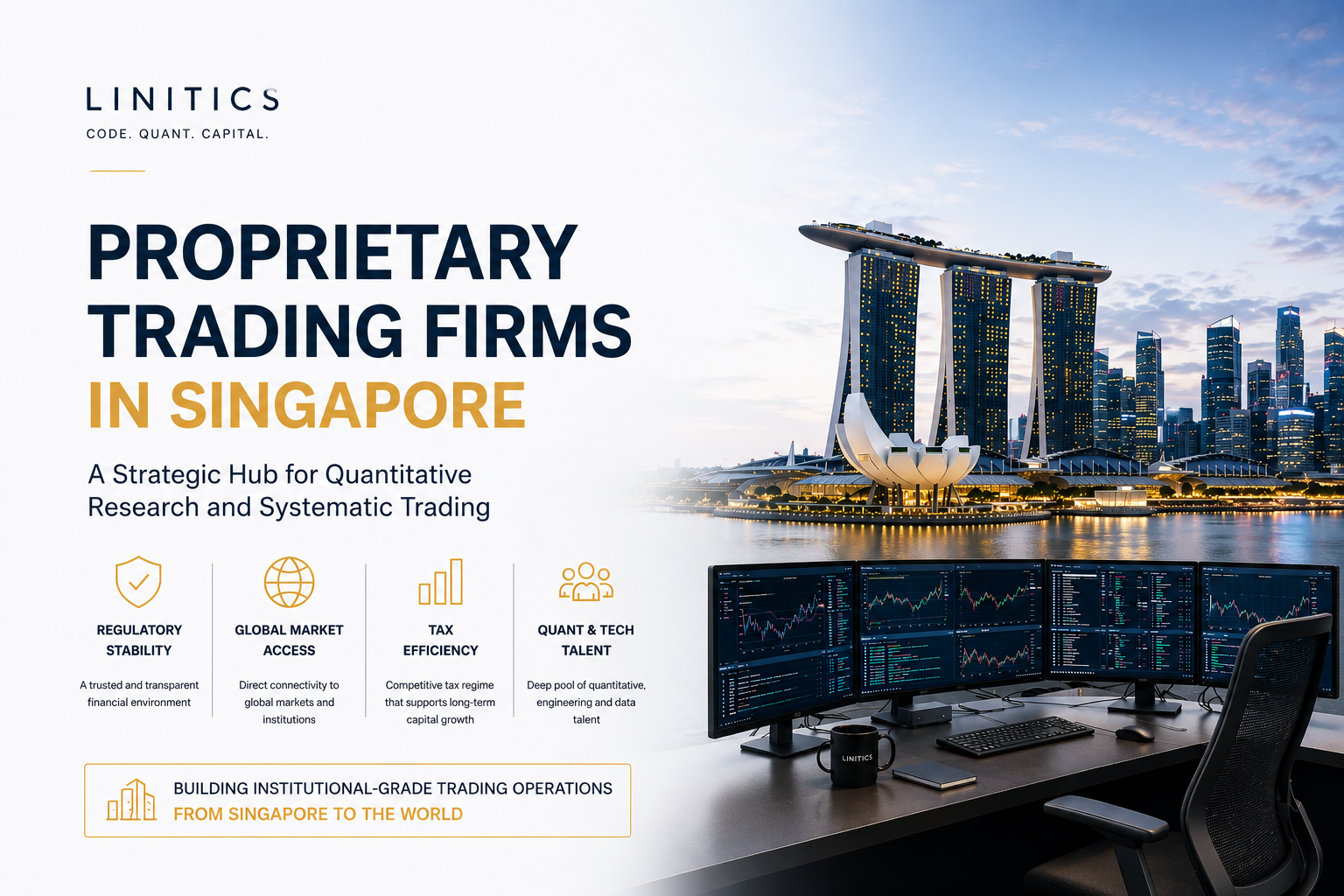
Why Singapore Has Become a Strategic Base for Modern Proprietary Trading Operations
Singapore has evolved into one of the world’s most strategically important jurisdictions for proprietary trading firms, quantitative investment organizations, and systematic trading operations. Over the past two decades, the city-state has steadily positioned itself at the intersection of institutional finance, global market infrastructure, and engineering-intensive capital markets operations.
Today, many modern proprietary trading firms operating from Singapore increasingly resemble multidisciplinary quantitative technology organizations rather than traditional discretionary trading businesses. Competitive advantage is no longer derived solely from directional market insight. Instead, sustainable edge increasingly emerges from the integration of:
- quantitative research frameworks,
- execution engineering,
- data infrastructure,
- automation systems,
- and institutional-grade risk governance.
This structural evolution has materially increased the importance of operational environment selection. For globally diversified systematic trading firms, jurisdictional stability, infrastructure reliability, and institutional connectivity now directly influence execution quality, scalability, and long-term survivability.
Singapore has become one of the few global financial centres capable of supporting this transition at institutional scale.
The Structural Evolution of Modern Proprietary Trading Firms
Historically, proprietary trading firms were primarily centered around discretionary traders operating manually across relatively fragmented market structures. Decision-making was often highly individualistic, with performance driven by trader intuition, localized market knowledge, and human execution capabilities.
Modern proprietary trading organizations operate under an entirely different paradigm.
Today’s leading firms increasingly deploy:
- systematic research pipelines,
- automated execution infrastructure,
- machine learning-assisted signal generation,
- real-time portfolio risk systems,
- and engineering-driven operational frameworks.
As financial markets have become increasingly electronic, fragmented, and latency-sensitive, execution integrity and infrastructure sophistication have become structurally important sources of competitive advantage.
The most advanced firms now function through deeply integrated teams spanning:
- quantitative researchers,
- software engineers,
- data engineers,
- infrastructure architects,
- and risk management specialists.
This multidisciplinary convergence reflects a broader industrialization of modern trading operations, where institutional robustness increasingly matters as much as alpha generation itself.
Regulatory Stability as a Strategic Institutional Asset
One of Singapore’s most significant advantages for proprietary trading organizations is the jurisdiction’s long-standing reputation for regulatory stability, legal predictability, and institutional credibility.
Financial supervision is centralized under the Monetary Authority of Singapore, which combines central banking responsibilities with prudential financial oversight. This integrated framework has historically contributed to a highly stable operating environment for institutional market participants.
For modern trading firms, regulatory consistency is not merely a compliance consideration. It directly affects:
- counterparty relationships,
- banking access,
- capital deployment confidence,
- operational continuity,
- and long-duration infrastructure investment decisions.
Systematic trading organizations frequently invest heavily in infrastructure, research systems, and operational engineering with multi-year investment horizons. Jurisdictional uncertainty can materially impair long-term strategic planning and increase operational fragility.
Singapore’s reputation for institutional continuity therefore becomes strategically valuable for firms seeking durable operating environments capable of supporting scalable quantitative investment operations.
Tax Efficiency and Capital Retention Dynamics
Singapore’s tax environment is frequently viewed favorably by proprietary trading firms, quantitative investment partnerships, and research-intensive financial organizations.
The jurisdiction’s relatively competitive corporate tax structure, combined with long-term policy consistency, supports more efficient capital retention and reinvestment dynamics. For systematic trading firms, retained capital often functions as a core operational resource rather than simply distributable earnings.
This is particularly important for organizations investing continuously into:
- research infrastructure,
- execution systems,
- market data architecture,
- low-latency connectivity,
- and computational scalability.
Modern quantitative trading operations increasingly require persistent reinvestment into technology infrastructure to maintain execution competitiveness and operational resilience. Capital efficiency therefore directly influences organizational scalability and long-term survivability.
From an allocator perspective, jurisdictions supporting efficient reinvestment can materially improve the compounding characteristics of research-driven trading businesses over extended operational cycles.
Strategic Access to Global Financial Markets
Singapore’s geographic positioning provides meaningful advantages for globally diversified trading organizations operating across multiple liquidity regimes and market sessions.
Firms based in Singapore frequently trade and research:
- global equities,
- futures,
- foreign exchange,
- options markets,
- volatility products,
- and multi-asset systematic portfolios.
The jurisdiction’s alignment between Asian and Western trading hours creates operational flexibility for organizations managing globally distributed execution and monitoring frameworks.
Equally important is Singapore’s integration into international financial infrastructure networks, including:
- exchange connectivity,
- institutional-grade market data systems,
- cross-border clearing access,
- and high-performance communications infrastructure.
In increasingly electronic financial markets, physical and infrastructural proximity to liquidity venues can materially affect:
- execution latency,
- spread capture,
- slippage characteristics,
- and intraday risk transfer efficiency.
For systematic trading firms operating high-frequency or execution-sensitive strategies, infrastructure quality becomes inseparable from trading performance itself.
Institutional Brokerage and Clearing Infrastructure
Singapore hosts a mature ecosystem of institutional financial service providers supporting sophisticated trading operations.
This includes:
- prime brokerage platforms,
- clearing institutions,
- execution technology providers,
- market connectivity specialists,
- and institutional custody infrastructure.
For modern proprietary trading firms, infrastructure dependency extends far beyond strategy logic. Operational robustness increasingly depends on the reliability and integration quality of external counterparties across the broader trading stack.
Institutional-grade infrastructure supports:
- execution reliability,
- collateral efficiency,
- operational redundancy,
- real-time risk synchronization,
- and scalable portfolio management.
As systematic trading operations scale, infrastructure fragility can become a larger risk factor than market volatility itself. Many institutional firms therefore evaluate counterparties not only on pricing or access, but on resilience, uptime reliability, operational transparency, and systems integration quality.
Operational resilience has increasingly become a defining component of institutional credibility.
The Expansion of Quantitative and Systematic Trading Operations
Singapore has experienced substantial growth in quantitative finance and systematic trading activity as global capital markets continue transitioning toward automation-driven execution environments.
Many modern firms operating within the region increasingly focus on:
- quantitative signal research,
- algorithmic execution,
- machine learning applications,
- portfolio optimization systems,
- and real-time data engineering.
This reflects broader structural changes across global financial markets, including:
- increasing electronic market participation,
- declining discretionary execution share,
- expanding alternative data usage,
- and rising computational intensity within investment processes.
Institutional trading organizations increasingly compete through their ability to:
- process information efficiently,
- adapt models dynamically,
- manage execution quality,
- and maintain robust infrastructure during periods of market stress.
As a result, trading firms are progressively allocating larger portions of operational expenditure toward engineering, infrastructure, and computational scalability.
Singapore’s Engineering and Quantitative Talent Ecosystem
Singapore has also cultivated a highly favorable environment for quantitative research and financial technology development.
The city-state benefits from a growing concentration of:
- applied mathematics talent,
- software engineering expertise,
- infrastructure engineering specialists,
- and quantitative finance professionals.
Its international orientation further enables trading firms to recruit globally across disciplines critical to modern systematic trading operations.
This increasingly supports the formation of multidisciplinary organizations capable of integrating:
- research engineering,
- execution infrastructure,
- distributed systems architecture,
- and institutional portfolio management.
For advanced trading firms, talent acquisition is no longer limited to finance professionals alone. Competitive organizations increasingly recruit from:
- computer science,
- distributed systems engineering,
- applied statistics,
- machine learning,
- and data infrastructure domains.
The convergence between financial markets and computational engineering continues accelerating across the broader quantitative finance ecosystem.
Proprietary Trading Is Increasingly an Infrastructure Business
One of the most important structural developments within modern proprietary trading is the increasing centrality of infrastructure engineering.
Sustainable trading performance increasingly depends on:
- execution system reliability,
- market data integrity,
- infrastructure observability,
- synchronization accuracy,
- and operational fault tolerance.
This transition is especially visible within systematic and automated trading environments where production instability can rapidly propagate into execution degradation, portfolio misalignment, or uncontrolled risk exposure.
As a result, many institutional trading organizations now invest heavily into:
- real-time monitoring systems,
- distributed execution frameworks,
- automated reconciliation pipelines,
- research compute environments,
- and operational resilience engineering.
In modern quantitative finance, operational maturity increasingly functions as a core component of structural edge.
The firms most likely to achieve long-duration survivability are often those capable of balancing:
- research innovation,
- execution quality,
- infrastructure scalability,
- and disciplined governance frameworks.
Why Singapore Continues to Attract Institutional Trading Firms
Singapore’s long-term attractiveness stems from the convergence of several structurally important characteristics:
- regulatory clarity,
- institutional trust,
- infrastructure quality,
- global market connectivity,
- and financial system stability.
For proprietary trading firms focused on:
- systematic research,
- execution engineering,
- quantitative investing,
- and scalable infrastructure,
Singapore continues to provide one of the most operationally efficient financial jurisdictions globally.
As financial markets continue evolving toward:
- automation-driven execution,
- AI-assisted research systems,
- engineering-intensive investment processes,
- and institutional risk governance,
the strategic importance of stable and globally connected financial centres is likely to increase further.
Jurisdictions capable of supporting operational resilience, infrastructure scalability, and institutional capital efficiency will remain disproportionately attractive to advanced quantitative trading organizations.
Final Thoughts
Modern proprietary trading increasingly operates at the intersection of:
- quantitative research,
- software engineering,
- market infrastructure,
- and institutional risk management.
The industrialization of systematic trading has fundamentally altered how competitive advantage is created within global financial markets. Sustainable edge increasingly depends not only on strategy development, but also on execution architecture, infrastructure resilience, and operational discipline.
Within this evolving landscape, Singapore has established itself as one of the world’s most strategically important hubs for institutional proprietary trading and quantitative investment operations.
For firms seeking:
- institutional credibility,
- infrastructure reliability,
- operational scalability,
- and globally connected market access,
Singapore remains exceptionally well positioned to support the next generation of systematic trading organizations.
As quantitative finance continues maturing into a deeply engineering-driven industry, the role of stable institutional jurisdictions will likely become even more central to the future structure of global capital markets.
The modern proprietary trading landscape increasingly favors firms capable of integrating quantitative research, execution infrastructure, automation, and institutional risk governance within a scalable operational framework. Research-driven firms such as Linitics prioritize systematic execution integrity, infrastructure resilience, and disciplined capital deployment across global financial markets.