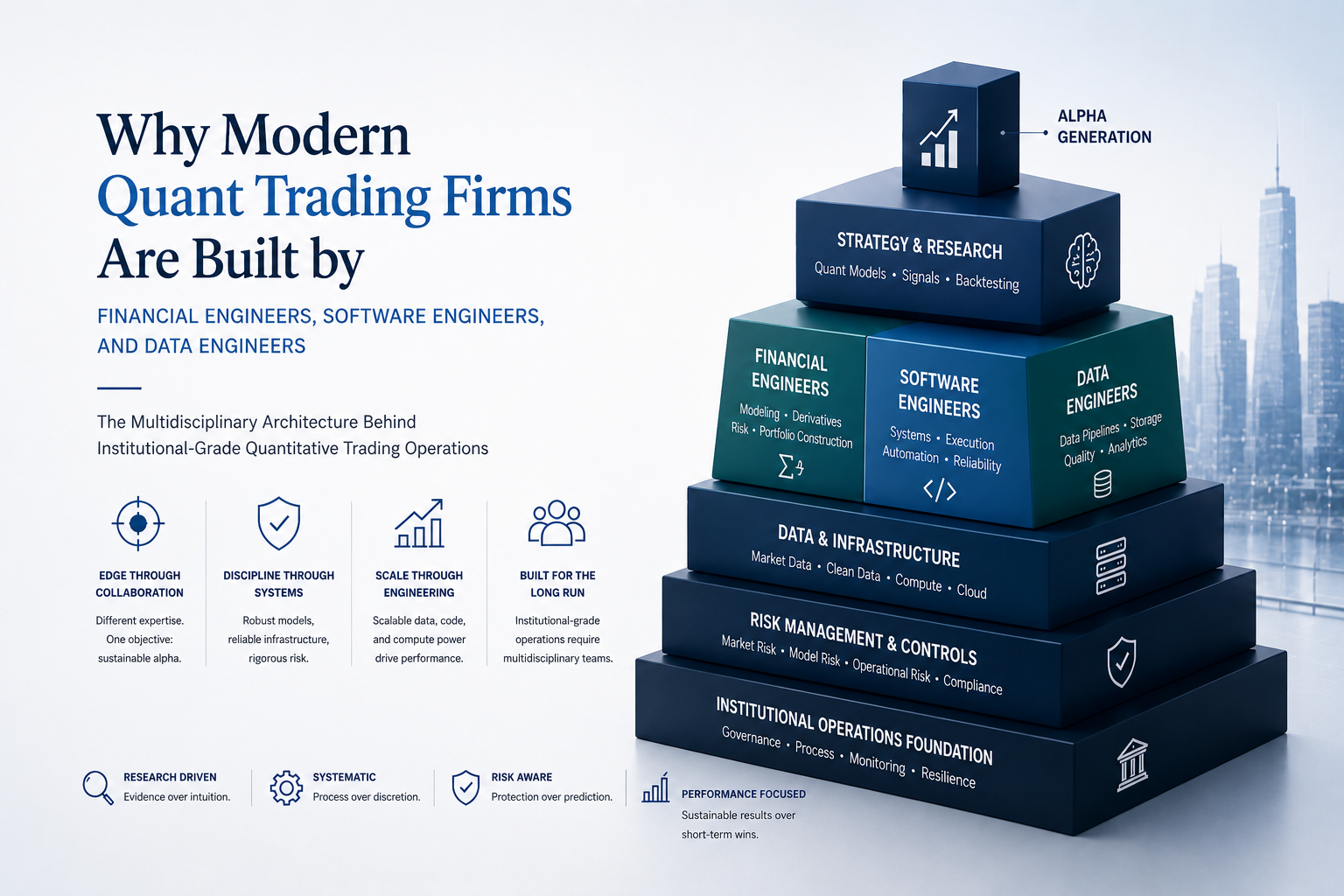
The Multidisciplinary Architecture Behind Institutional-Grade Quantitative Trading Operations
Modern quantitative trading firms no longer operate as traditional trading organizations centered around individual market intuition. Over the past two decades, the industry has evolved into a highly specialized intersection of:
- quantitative finance,
- software engineering,
- data engineering,
- infrastructure architecture,
- and operational risk management.
In many institutional trading firms today, the sustainable competitive advantage is no longer derived solely from trading strategies themselves, but from the integration of research systems, data pipelines, execution infrastructure, and engineering reliability.
This structural evolution has fundamentally transformed how modern proprietary trading firms, quantitative hedge funds, and systematic investment organizations are designed and operated.
The result is a new operating reality:
Modern quant trading firms increasingly resemble engineering organizations as much as financial institutions.
This article explores why financial engineers, software engineers, and data engineers have become indispensable to institutional quantitative trading businesses — and why the future of systematic trading belongs to multidisciplinary organizations capable of integrating research, infrastructure, automation, and operational resilience at scale.
The Evolution of Quantitative Trading Firms
Historically, trading firms were often centered around discretionary traders, market intuition, and manual execution. Success depended heavily on:
- individual decision-making,
- experience,
- market interpretation,
- and behavioral discipline.
While these elements still exist in parts of modern financial markets, systematic trading has dramatically altered the competitive landscape.
As electronic markets expanded and market data became increasingly accessible, quantitative firms began shifting toward:
- statistical modeling,
- automated execution,
- algorithmic portfolio construction,
- and infrastructure-driven decision systems.
This transformation accelerated further with:
- lower-latency market access,
- cloud computing,
- advances in distributed systems,
- artificial intelligence,
- and large-scale financial data availability.
Today, many institutional trading firms operate less like traditional trading desks and more like:
- technology organizations,
- research laboratories,
- and infrastructure-intensive capital allocation businesses.
The modern competitive edge increasingly emerges from the ability to:
- process massive datasets,
- engineer reliable execution systems,
- automate decision frameworks,
- manage operational complexity,
- and continuously adapt models to changing market regimes.
In this environment, engineering quality becomes inseparable from trading quality.
Financial Engineering: Translating Market Complexity Into Structured Models
At the core of every quantitative trading operation lies financial engineering.
Financial engineers bridge the gap between:
- market behavior,
- mathematics,
- portfolio theory,
- derivatives pricing,
- and risk management.
Their role extends far beyond simply designing trading signals.
Modern financial engineering involves:
- portfolio optimization,
- factor modeling,
- volatility analysis,
- correlation structure evaluation,
- derivatives risk modeling,
- scenario testing,
- and probabilistic decision frameworks.
Institutional quantitative firms rely heavily on financial engineering to answer critical questions such as:
- How does a strategy behave under stress?
- What are the hidden sources of portfolio concentration?
- How sensitive is the system to volatility expansion?
- What happens when liquidity conditions deteriorate?
- How does correlation change during crises?
In sophisticated systematic trading environments, the objective is not merely generating alpha.
The objective is constructing investment systems capable of:
- surviving regime shifts,
- controlling drawdowns,
- maintaining capital efficiency,
- and operating consistently across changing market environments.
This is why financial engineering remains foundational to institutional trading organizations.
Without rigorous quantitative modeling, trading systems often become fragile, overfitted, and structurally unstable.
Software Engineering: The Infrastructure Layer Behind Modern Trading Firms
If financial engineering defines the logic of a quantitative trading business, software engineering defines its operational reality.
Modern systematic trading increasingly depends on:
- automated execution,
- real-time processing,
- distributed systems,
- infrastructure reliability,
- and production-grade operational controls.
In institutional environments, software engineering is not a support function.
It is part of the core trading edge.
Many retail trading systems fail not because the strategy itself is invalid, but because the operational infrastructure surrounding the strategy lacks reliability.
Common operational failure points include:
- execution desynchronization,
- duplicated orders,
- stale data,
- broker API instability,
- network interruptions,
- race conditions,
- incomplete position reconciliation,
- and failure-handling gaps.
Backtests rarely model these operational realities.
However, institutional firms understand that production environments behave very differently from research environments.
As a result, serious quantitative organizations invest heavily in:
- infrastructure resilience,
- observability systems,
- logging frameworks,
- automated monitoring,
- deployment controls,
- redundancy,
- and defensive system design.
In modern quantitative trading firms, software engineers increasingly work on:
- low-latency systems,
- execution architecture,
- internal research platforms,
- portfolio management systems,
- risk monitoring frameworks,
- cloud infrastructure,
- distributed compute systems,
- and operational automation.
The quality of this engineering infrastructure directly impacts:
- execution integrity,
- operational reliability,
- scalability,
- and ultimately long-term survivability.
In many institutional firms today, operational robustness is treated as seriously as alpha generation itself.
Data Engineering: The Hidden Infrastructure of Quantitative Trading
In systematic trading, data is not merely an input.
It is production infrastructure.
Quantitative firms increasingly compete on:
- data quality,
- data availability,
- data normalization,
- and data processing efficiency.
This has elevated data engineering into a critical institutional capability.
The effectiveness of a quantitative trading system depends heavily on the integrity of:
- historical datasets,
- market feeds,
- corporate action adjustments,
- derivatives chain data,
- volatility surfaces,
- alternative datasets,
- and execution records.
Poor data engineering creates hidden fragility.
Even highly sophisticated models become unreliable when:
- datasets contain survivorship bias,
- timestamps are inconsistent,
- missing values are improperly handled,
- instruments are misaligned,
- or normalization procedures break.
Institutional trading firms therefore devote significant resources toward:
- data pipeline design,
- ETL infrastructure,
- historical data integrity,
- real-time feed monitoring,
- storage architecture,
- and data governance.
Data engineers increasingly play a central role in ensuring that:
- research environments remain reliable,
- production systems remain synchronized,
- and model outputs remain trustworthy.
As financial markets become increasingly data-intensive, this engineering discipline becomes a structural advantage.
In many cases, firms with superior data infrastructure outperform firms with superior standalone models.
The Convergence of Engineering Disciplines in Modern Quant Trading
One of the defining characteristics of modern quantitative trading firms is the convergence of multiple engineering disciplines.
Historically, financial firms operated in siloed structures where:
- traders traded,
- technologists built systems,
- and operations teams managed infrastructure.
Modern systematic firms increasingly integrate these functions.
Today, successful organizations often operate through tightly connected multidisciplinary teams involving:
- quantitative researchers,
- financial engineers,
- software engineers,
- data engineers,
- infrastructure specialists,
- and risk professionals.
This convergence creates several institutional advantages:
Faster Research-to-Production Cycles
Integrated engineering environments reduce the gap between:
- research,
- validation,
- deployment,
- and live monitoring.
This accelerates iteration while improving operational control.
Greater Operational Resilience
Cross-functional collaboration improves:
- failure detection,
- recovery systems,
- monitoring,
- and defensive infrastructure design.
This becomes critical during periods of market stress.
Better Risk Governance
Engineering integration allows firms to build:
- portfolio-level controls,
- exposure monitoring,
- automated risk throttling,
- and system-wide operational safeguards.
Infrastructure Scalability
As firms grow, scalable engineering systems become essential for:
- multi-strategy deployment,
- larger datasets,
- global market access,
- and portfolio expansion.
Without engineering scalability, strategy scalability often collapses.
Why Modern Quant Firms Increasingly Resemble Technology Companies
The structural evolution of quantitative trading has gradually blurred the boundaries between:
- financial institutions,
- software companies,
- and engineering organizations.
Many leading systematic trading firms now invest heavily in:
- internal tooling,
- proprietary infrastructure,
- cloud systems,
- machine learning frameworks,
- distributed compute environments,
- and engineering automation.
Their competitive advantage increasingly emerges from:
- operational efficiency,
- infrastructure reliability,
- data processing capabilities,
- and engineering execution quality.
In many institutional environments, technology infrastructure itself becomes a form of alpha.
This explains why modern quantitative firms actively recruit:
- software engineers,
- distributed systems specialists,
- cloud architects,
- data infrastructure experts,
- and reliability engineers.
The future of quantitative trading increasingly belongs to organizations capable of combining:
- financial research,
- engineering discipline,
- operational resilience,
- and scalable automation.
The Institutional Importance of Operational Resilience
One of the most overlooked realities in systematic trading is that operational failure often destroys more firms than poor strategy design.
Institutional firms understand that:
- infrastructure outages,
- execution breakdowns,
- data corruption,
- monitoring failures,
- and uncontrolled automation
can create catastrophic consequences.
As a result, institutional organizations increasingly prioritize:
- redundancy,
- defensive coding,
- observability,
- system reconciliation,
- kill switches,
- deployment governance,
- and operational controls.
This operational mindset fundamentally separates institutional trading firms from fragile retail systems.
In modern quantitative trading, reliability is not merely a technical concern.
It is a capital preservation mechanism.
The Future of Quantitative Trading Is Multidisciplinary
The future of quantitative trading is unlikely to be dominated by isolated traders operating independently.
Instead, the industry increasingly favors multidisciplinary organizations capable of integrating:
- quantitative research,
- software engineering,
- data infrastructure,
- automation systems,
- and institutional risk governance.
As markets become:
- more competitive,
- more data-intensive,
- more automated,
- and more infrastructure-driven,
sustainable edge will increasingly emerge from organizational quality rather than isolated strategy ideas.
This is one of the defining shifts in modern finance.
Quantitative trading is no longer simply a finance discipline.
It is increasingly an engineering discipline operating within capital markets.
Conclusion
Modern quantitative trading firms are no longer built solely around traders or market predictions.
They are increasingly built around:
- financial engineering,
- software infrastructure,
- data architecture,
- operational resilience,
- and multidisciplinary systems design.
The most durable institutional trading organizations understand that sustainable performance is not generated by strategies alone.
It emerges from the integration of:
- research,
- infrastructure,
- execution,
- engineering discipline,
- and risk governance.
As systematic finance continues evolving, the firms most likely to survive and scale will be those capable of operating simultaneously as:
- research organizations,
- engineering organizations,
- and capital allocation businesses.
Because in modern markets, competitive edge increasingly belongs to those who can engineer reliability, scalability, and disciplined decision systems at institutional scale