Most traders believe:
- Returns attract capital
Institutional investors know:
- Structure retains capital
This is a critical distinction.
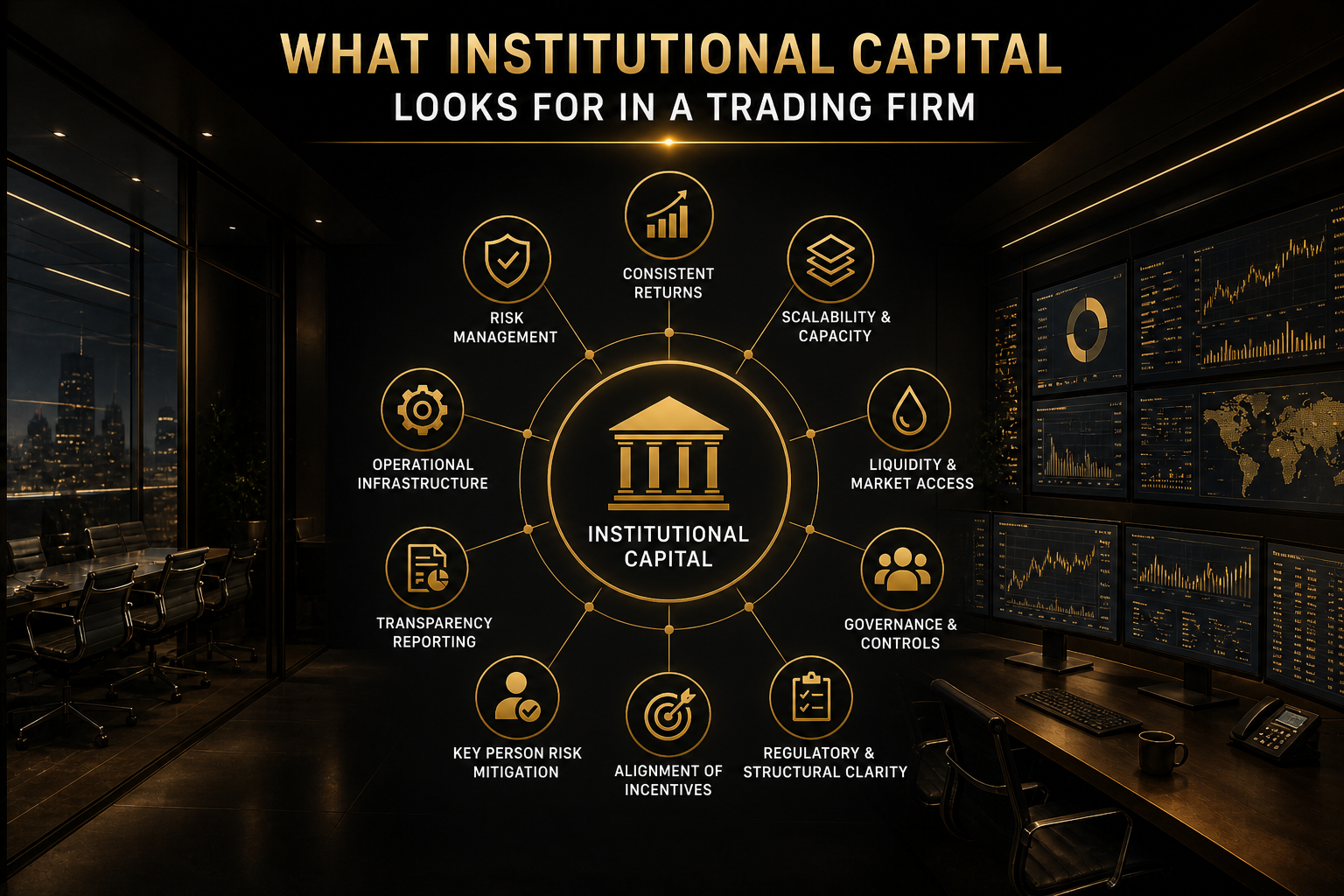
At Linitics, we view capital allocation as a multi-dimensional evaluation problem, where returns are only one component.
Because:
Institutions are not investing in trades.
They are investing in systems.
1. Returns Are the Entry Ticket — Not the Decision
Strong performance is necessary.
But it is not sufficient.
Institutional capital asks:
- Are returns repeatable?
- Are they scalable?
- Are they controlled?
A high-return strategy with:
- poor structure
- unstable risk
- weak execution
Will not attract serious capital.
2. Risk Framework Is the Core Evaluation Layer
Institutional investors focus heavily on:
- Drawdown control
- volatility management
- exposure limits
- tail risk
They evaluate:
- How risk is defined
- How it is monitored
- How it is controlled
Because:
Risk determines whether capital survives long enough to compound.
3. Consistency Over Peak Performance
Institutions prefer:
- Stable returns
- controlled volatility
- predictable behavior
Over:
- high but erratic returns
Consistency enables:
- allocation confidence
- capital scaling
- long-term relationships
4. Drawdown Behavior Matters More Than Returns
Key metrics evaluated:
- Maximum drawdown
- Time to recovery
- drawdown frequency
A strategy that:
- loses 30% quickly
Is less attractive than one that:
- compounds steadily
Because:
- large drawdowns trigger capital exits
5. Capacity & Scalability
Institutional capital requires:
- ability to deploy size
- minimal performance degradation
- stable execution
Questions asked:
- How much capital can this strategy absorb?
- What happens when size increases?
Strategies that:
- break under scale
Are not allocatable.
6. Liquidity & Market Access
Institutions require:
- liquid markets
- reliable execution
- exit certainty
They avoid strategies that:
- depend on thin liquidity
- rely on niche inefficiencies
- cannot handle large orders
Liquidity is a structural requirement.
7. Operational Infrastructure
Institutions evaluate:
- execution systems
- data pipelines
- monitoring tools
- failure handling
They ask:
- Is this operation robust?
- Can it handle stress scenarios?
Manual, fragile setups are rejected.
8. Governance & Control
Institutional capital looks for:
- defined decision processes
- risk oversight
- accountability
This includes:
- internal controls
- structured workflows
- auditability
Because:
Governance reduces operational uncertainty.
9. Transparency & Reporting
Investors require:
- clear reporting
- performance attribution
- risk visibility
They expect:
- consistent updates
- measurable metrics
- understandable processes
Opaque systems create distrust.
10. Key Person Risk Mitigation
Institutions avoid dependence on:
- a single trader
- discretionary decision-making
They prefer:
- system-driven strategies
- team-based processes
- documented workflows
Because:
Capital should not depend on one individual.
11. Alignment of Incentives
Investors evaluate:
- how the firm makes money
- how risks are shared
- how incentives are structured
They prefer:
- alignment between manager and capital
- performance-driven outcomes
Misaligned incentives reduce trust.
12. Capital Stability
Institutional capital prefers:
- stable deployment environments
- low structural risk
- controlled exposure
They avoid setups where:
- capital must move frequently
- strategies require constant adjustment
Stability enables compounding.
13. Regulatory & Structural Clarity
Institutions require:
- legal clarity
- compliance readiness
- proper structuring
This includes:
- jurisdiction
- entity design
- operational legality
Because:
- regulatory uncertainty is risk
14. Longevity & Survivability
The most important question:
- Will this system survive?
Institutions evaluate:
- robustness across cycles
- adaptability
- resilience
Because:
Capital compounds only if it survives.
15. The Institutional Evaluation Stack
Before allocating capital, institutions effectively assess:
- Returns
- Risk
- Consistency
- Capacity
- Liquidity
- Infrastructure
- Governance
- Transparency
- Incentives
Most trading operations fail not at returns—
But at structure.
16. The Linitics Perspective
At Linitics, we design systems that are:
- risk-first
- structure-driven
- execution-aware
- capital-efficient
We focus on:
- building trust in capital
- not just generating returns
Because:
The goal is not to:
- impress with performance
But to:
- sustain capital over time
Final Thoughts
Institutional capital does not chase the highest return.
It allocates to:
- stability
- discipline
- structure
- survivability
Because:
- returns attract attention
- structure retains capital
At Linitics, we believe:
The future of trading belongs to firms that are not just profitable—
But allocatable.