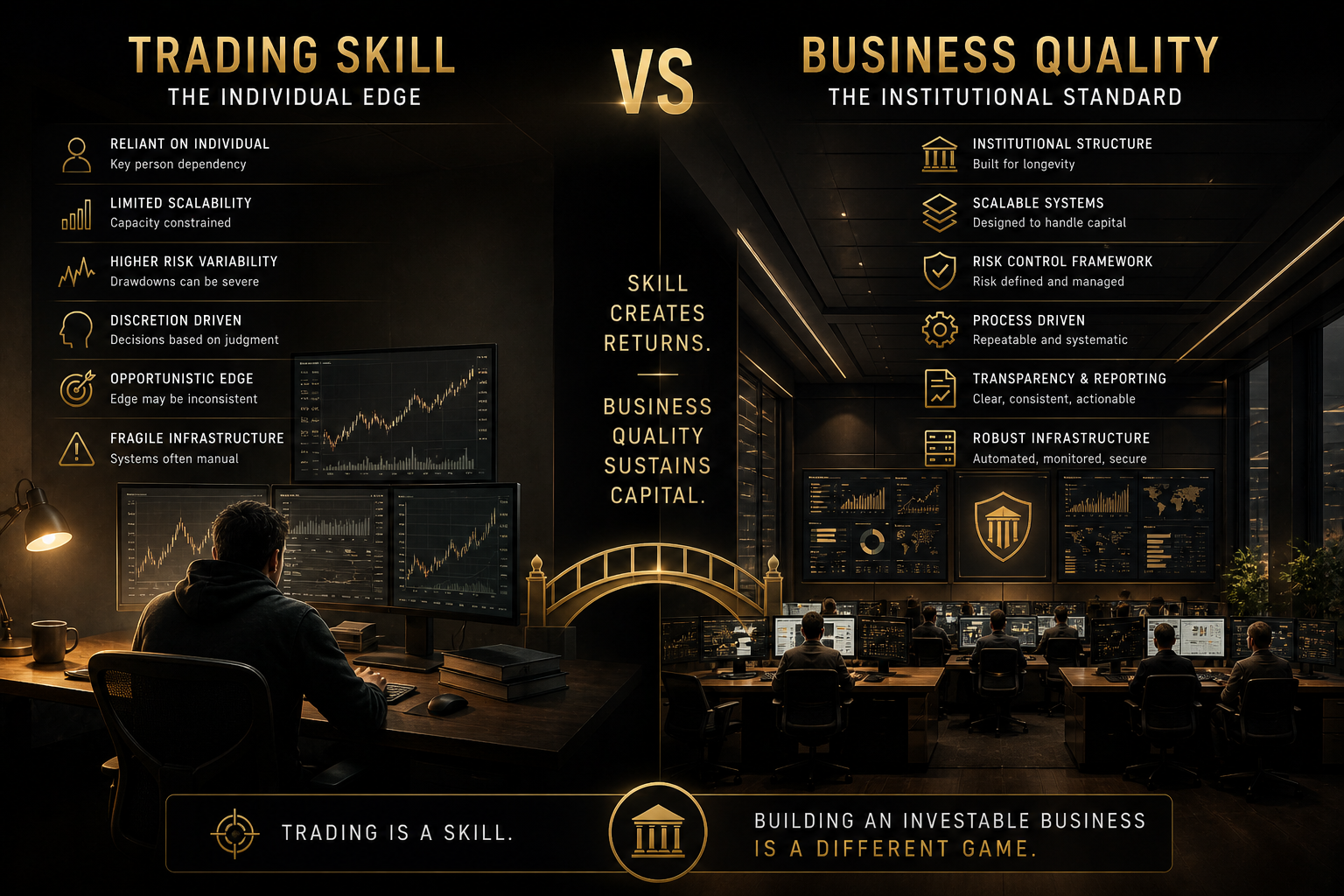
A trader can be highly profitable.
That does not make them investable.
This is one of the most important—and least understood—distinctions in systematic trading.
At Linitics, we define this as the gap between:
- Trading Skill
and - Business Quality
Institutions do not allocate capital based on skill alone.
They allocate to structures that can carry capital responsibly.
1. What Is Trading Skill?
Trading skill refers to the ability to:
- Generate alpha
- Identify opportunities
- Execute strategies effectively
It is measured by:
- Returns
- Sharpe ratio
- consistency (at small scale)
Skill is necessary.
But it is not sufficient.
2. What Is Business Quality?
Business quality refers to the ability to:
- Manage capital at scale
- Control risk
- Maintain operational stability
- Sustain performance over time
It includes:
- Infrastructure
- governance
- capital structure
- process discipline
Business quality determines:
Whether capital can stay.
3. The Core Disconnect
Many traders assume:
- High returns → capital inflows
Institutional reality:
- High returns → initial interest
- Business quality → actual allocation
This is where most fail.
4. Why Skill Alone Is Not Enough
A skilled trader may still lack:
- Risk frameworks
- scalability
- operational systems
- reporting discipline
This creates:
- instability
- unpredictability
- allocation risk
From an institutional perspective:
Skill without structure is fragile.
5. Scalability as a Filter
Trading skill often exists at:
- Small capital
- Limited exposure
- High flexibility
Business quality requires:
- scalability
- consistency under size
- liquidity awareness
Many strategies:
- Work at $100K
- Break at $10M
This is not a skill issue.
It is a structural limitation.
6. Risk Management as a Differentiator
Skilled traders may:
- Take concentrated risks
- Operate with discretion
- Accept large drawdowns
Institutional capital requires:
- defined risk limits
- controlled exposure
- drawdown discipline
Risk is not optional.
It is foundational.
7. Consistency vs Opportunism
Trading skill often relies on:
- opportunistic setups
- flexible decision-making
- adaptive execution
Business quality requires:
- repeatable processes
- systematic frameworks
- predictable behavior
Because:
Capital prefers reliability over brilliance.
8. Key Person Dependency
A skilled trader is often:
- the system
This creates:
- single point of failure
- continuity risk
- scaling limitations
Business quality reduces this through:
- systems
- processes
- documentation
9. Operational Infrastructure
Trading skill can exist with:
- minimal infrastructure
Business quality requires:
- execution systems
- data pipelines
- monitoring frameworks
- fail-safes
Without infrastructure:
- performance cannot scale
- risk cannot be controlled
10. Transparency & Reporting
Institutions require:
- performance breakdown
- risk attribution
- consistent reporting
Skilled traders often lack:
- structured reporting
- data transparency
Opacity reduces:
- trust
- capital allocation
11. Incentive Alignment
Business quality includes:
- aligned incentives
- controlled risk-taking
- capital preservation
Skill alone may lead to:
- aggressive positioning
- short-term focus
Misalignment creates:
- instability
- capital withdrawal
12. Stability of Capital
Skilled traders may operate with:
- volatile capital
- inconsistent sizing
Business quality requires:
- stable capital base
- structured deployment
- controlled scaling
Stability enables compounding.
13. The Institutional Evaluation Lens
Institutions evaluate:
| Dimension | Trading Skill | Business Quality |
|---|---|---|
| Returns | High | Consistent |
| Risk | Variable | Controlled |
| Scale | Limited | Expandable |
| Process | Flexible | Structured |
| Dependency | Individual | System |
Most traders excel in the first column.
Capital allocates to the second.
14. Why the Gap Exists
The gap exists because:
- Trading and business building require different skill sets
- Markets reward performance
- Institutions reward stability
Bridging this gap requires:
- structural thinking
- process discipline
- long-term design
15. The Linitics Perspective
At Linitics, we focus on:
- converting trading skill into business quality
- designing systems that scale
- embedding risk into structure
- building institutional-grade frameworks
We do not optimize for:
- short-term outperformance
We optimize for:
- long-term allocatability
Final Thoughts
In systematic trading:
- Skill creates opportunity
- Structure creates sustainability
A trader may be:
- profitable
But not:
- investable
The real transition is not:
- improving strategy
It is:
transforming trading into a capital system.
At Linitics, we believe:
The future belongs to those who can bridge:
- performance
and - structure
Because that is where:
- capital stays
- systems scale
- businesses endure