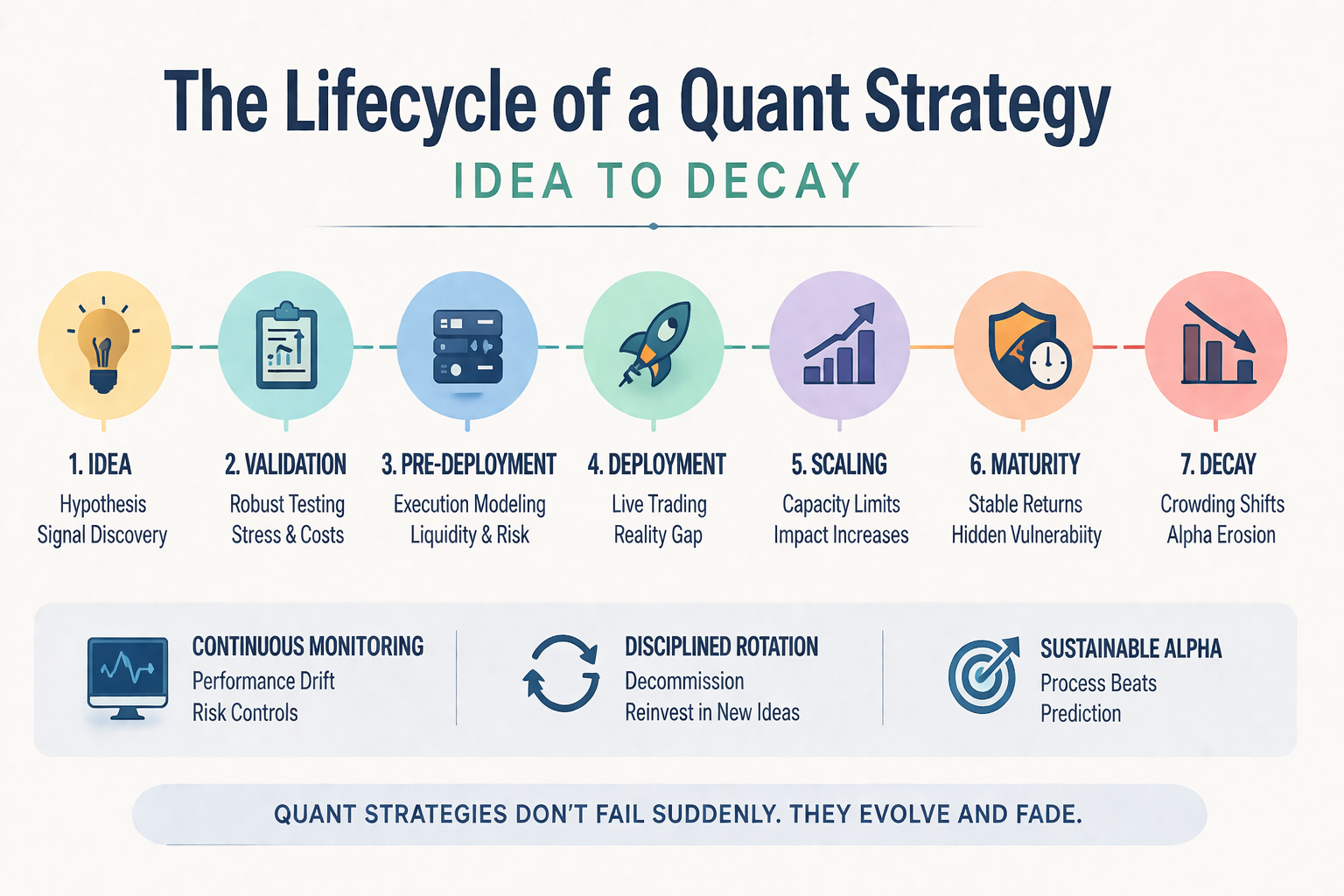
Quantitative strategies do not fail suddenly.
They evolve — and eventually decay.
Understanding this lifecycle is essential for anyone attempting to build systematic trading systems that survive beyond short-term success.
At Linitics, strategies are treated not as static models, but as dynamic capital assets that move through identifiable stages—each with distinct risks, constraints, and failure modes.
1. Idea: Signal Discovery vs Signal Illusion
Every strategy begins with a hypothesis.
Examples include:
- Momentum persistence
- Mean reversion
- Volatility expansion
- Cross-asset relationships
- Behavioral inefficiencies
However, most “ideas” originate from:
- Data mining
- Parameter exploration
- Accidental correlations
The key distinction:
Signal vs coincidence
Institutional-grade idea generation requires:
- Economic rationale
- Behavioral or structural explanation
- Cross-market plausibility
Without this, the strategy is not an idea — it is a statistical accident.
2. Validation: Destroying False Confidence
Validation is not about proving a model works.
It is about attempting to prove it does not.
Core validation principles:
- Out-of-sample testing
- Parameter robustness (not precision)
- Cross-asset validation
- Regime diversity testing
- Transaction cost integration
A critical insight:
If performance survives aggressive degradation assumptions, it is likely real.
If it collapses under minor perturbation, it was never robust.
Most strategies fail here — but many are mistakenly promoted forward.
3. Pre-Deployment: The Reality Filter
Before live capital, a professional process introduces friction:
- Slippage assumptions
- Latency considerations
- Liquidity constraints
- Execution modeling
- Capital scaling tests
This stage answers:
“Does this survive the real world?”
Many strategies that pass validation fail at this stage because:
- Costs were underestimated
- Liquidity was assumed infinite
- Turnover was unrealistic
The difference between a model and a business emerges here.
4. Deployment: The Reality Gap
Live trading introduces what is often called the reality gap:
Backtest performance ≠ Live performance
Common causes:
- Microstructure noise
- Spread variation
- Partial fills
- Execution delay
- Regime mismatch at launch
Institutional deployment is gradual:
- Reduced capital allocation
- Monitoring windows
- Performance benchmarking vs expectation
Deployment is not confirmation.
It is probation.
5. Scaling: Where Most Strategies Break
Scaling introduces nonlinear effects:
- Market impact increases
- Slippage widens
- Alpha compresses
- Execution quality deteriorates
A strategy that performs at small scale may fail at institutional size.
Key constraints:
- Liquidity
- Capacity
- Turnover
- Correlation with market structure
Scaling is not growth.
It is stress.
6. Maturity: Stable but Vulnerable
At maturity, the strategy:
- Produces consistent returns
- Has known risk characteristics
- Is integrated into capital allocation
This is the most deceptive phase.
Because:
- Confidence is highest
- Risk appears controlled
- Capital allocation increases
Yet beneath stability:
- Crowding may be building
- Edge may be compressing
- Regime dependency may be forming
Mature strategies fail when treated as permanent.
7. Decay: The Inevitable Phase
All quant strategies decay.
Drivers include:
A. Crowding
Capital flows into successful signals.
B. Structural Market Change
Regulation, technology, liquidity evolution.
C. Regime Shifts
Interest rates, volatility cycles, macro transitions.
D. Information Diffusion
Edge becomes widely known.
Empirical research shows even well-known factors experience multi-year underperformance cycles.
Decay is not a failure.
It is a certainty.
8. Detection of Decay
Institutional monitoring focuses on:
- Rolling Sharpe degradation
- Increasing drawdown frequency
- Correlation instability
- Execution cost drift
- Volatility mismatch
The challenge is not detecting collapse.
It is detecting early deterioration.
Early detection allows controlled de-risking.
9. Decommissioning: A Professional Discipline
Retail traders hold on too long.
Institutional firms define exit rules:
- Performance below threshold
- Risk-adjusted deterioration
- Structural break detection
A strategy is retired not when it loses money —
but when it loses statistical validity.
Capital is reallocated.
Emotion is removed.
10. The Portfolio of Strategies Approach
No serious quant operation depends on a single strategy.
Instead, they operate:
- Multiple strategies
- Across lifecycle stages
- With varying correlations
- With staggered decay timelines
This creates:
- Stability
- Diversification
- Continuous alpha pipeline
The system survives even when individual strategies fail.
11. The Continuous Research Flywheel
Institutional survival depends on:
Idea → Validation → Deployment → Monitoring → Decay → Replacement
This loop never stops.
Research is not a phase.
It is infrastructure.
12. Where Most Practitioners Fail
Common mistakes:
- Treating backtest as truth
- Over-allocating early
- Ignoring costs
- Scaling too quickly
- Holding decaying strategies
- Lack of pipeline
The issue is not intelligence.
It is process absence.
Final Thoughts
A quant strategy is not an asset.
It is a temporary edge.
Understanding its lifecycle transforms trading from:
Model building → Capital engineering
At Linitics, strategies are:
- Continuously validated
- Carefully deployed
- Actively monitored
- Systematically replaced
Because long-term success in quant trading does not come from finding one great strategy.
It comes from managing many imperfect ones — over time.