Overfitting is the silent killer of quantitative trading.
Most failed strategies do not collapse because the idea was flawed.
They collapse because the model was tuned to the past rather than engineered for the future.
At Linitics, we view robustness — not performance — as the defining feature of a professional quantitative model.
The objective is not to maximize backtest returns.
The objective is to minimize false confidence.
1. What Overfitting Actually Means
Overfitting occurs when a model captures:
- Noise instead of signal
- Random historical quirks
- Regime-specific anomalies
- Parameter coincidences
Financial data is:
- Non-stationary
- Regime-dependent
- Limited in true sample size
- Prone to structural shifts
The more parameters introduced, the easier it becomes to “explain” the past.
The easier it becomes to fail in the future.
2. Warning Signs of Overfitting
Institutional red flags include:
- Excessive parameter optimization
- Sharp performance degradation out-of-sample
- High sensitivity to minor parameter changes
- Exceptional Sharpe ratios with small datasets
- Strategy performance concentrated in one market regime
If a model’s performance depends on precise parameter values, it is fragile.
Robust models tolerate imprecision.
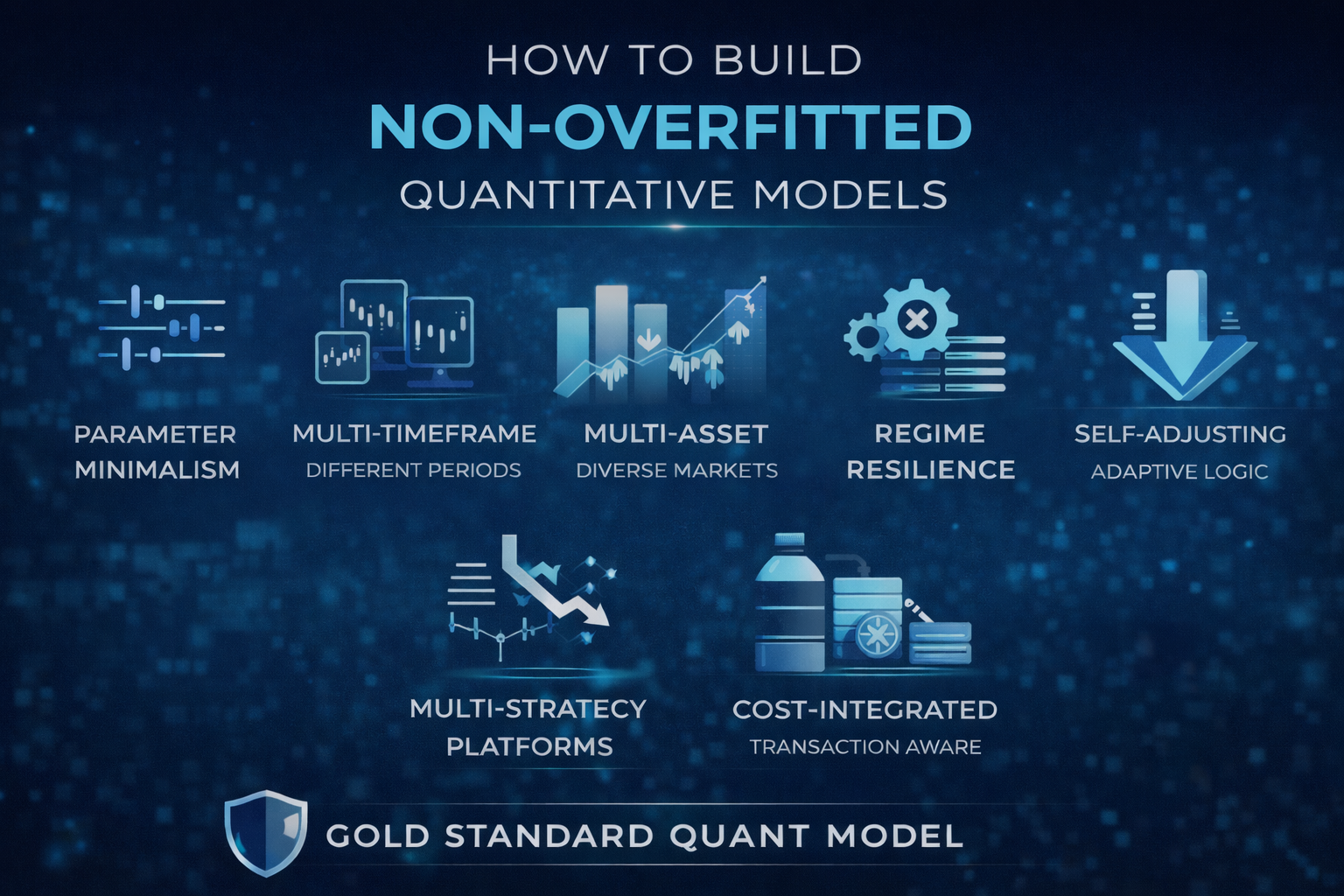
3. The Gold Standard Quant Model
While perfection is unattainable, institutional practice converges toward a benchmark profile — a “gold standard” architecture.
A robust quantitative model ideally exhibits:
1. Parameter Minimalism
Fewer tunable variables reduce overfit probability.
In extreme cases, parameterless or rule-based adaptive systems are preferred.
2. Multi-Timeframe Stability
The signal behaves consistently across:
- Daily
- Weekly
- Monthly resolutions
True edge does not vanish when timeframe shifts moderately.
3. Multi-Asset Robustness
A valid structural inefficiency often appears across:
- Equities
- Futures
- Indices
- FX
- Commodities
If a strategy works only in one narrow instrument, skepticism is warranted.
4. Regime Resilience
Test across:
- High-volatility regimes
- Low-volatility regimes
- Bull markets
- Bear markets
- Rate tightening cycles
A strategy that thrives only in one macro environment is not durable.
5. Self-Adjusting Mechanisms
Robust models often include:
- Volatility scaling
- Adaptive position sizing
- Dynamic exposure constraints
Rather than fixed thresholds, adaptive logic accommodates structural change.
6. Cost Awareness
Transaction costs are embedded from inception — not added as an afterthought.
7. Capacity Consideration
Liquidity constraints are modeled before scaling assumptions.
This is the difference between a research artifact and a deployable capital engine.
4. Institutional Validation Framework
Professional validation includes:
A. Strict Out-of-Sample Testing
Clear temporal separation between training and test datasets.
B. Walk-Forward Validation
Rolling recalibration across multiple windows. Though this is widely adopted, Linitics never recalibrate as we see there is an element of overfitting by this approach
C. Monte Carlo Simulation
Reshuffling trade sequences to stress-test path dependency.
D. Parameter Perturbation
Vary parameters within reasonable ranges and observe stability.
E. Cross-Market Replication
Test the same logic across related instruments.
The goal is not to prove profitability.
The goal is to attempt to disprove it.
5. The Role of Simplicity
There is a structural trade-off:
Complexity increases in-sample fit.
Simplicity increases out-of-sample survival.
Many of the most durable quantitative systems share traits:
- Transparent logic
- Clear economic rationale
- Limited degrees of freedom
- Robust across decades
A slightly inferior Sharpe ratio with structural stability is preferable to a spectacular but fragile one.
6. Multi-Timeframe & Multi-Asset Confirmation
One powerful robustness test:
If a momentum-based strategy works on:
- U.S. equities
- Global indices
- Liquid futures
Across:
- Daily
- Weekly
It likely captures structural behavior rather than noise.
If it works only on:
- One ETF
- One narrow time window
- One crisis period
It likely captures randomness.
Robust signals generalize.
7. Regime Awareness Without Regime Curve-Fitting
Many attempt to fix overfitting by adding regime filters.
Ironically, this often introduces new overfitting.
Institutional-grade regime handling:
- Uses objective volatility measures
- Applies simple macro state filters
- Avoids excessive conditional branching
The more conditional logic added, the greater the fragility.
8. Performance Degradation as a Positive Sign
A professional validation process should reduce:
- Expected return
- Sharpe ratio
- Win rate
If rigorous testing leaves performance unchanged, skepticism is appropriate.
Robust testing trims optimism.
Fragile testing preserves fantasy.
9. The Psychological Trap
Overfitting is often driven by:
- Ego attachment
- Desire for perfection
- Competitive Sharpe comparison
- Backtest aesthetic appeal
Institutional governance mitigates this through:
- Independent validation
- Predefined thresholds
- Deployment committees
- Decommission criteria
Discipline protects capital from intellectual bias.
10. The Linitics Philosophy
At Linitics, we prioritize:
- Cross-asset validation
- Parameter stability
- Liquidity discipline
- Cost integration
- Regime robustness
- Adaptive risk frameworks
We do not optimize for beauty.
We optimize for survivability.
Because in systematic markets, a modest but durable model outperforms a brilliant but fragile one.
Final Thoughts
Overfitting is not a technical error.
It is a structural temptation.
The gold standard quantitative model is not the one with the highest backtest return.
It is the one that:
- Requires minimal tuning
- Generalizes across markets
- Adapts to volatility
- Survives regime shifts
- Preserves capital
In quantitative trading, robustness is the real alpha.