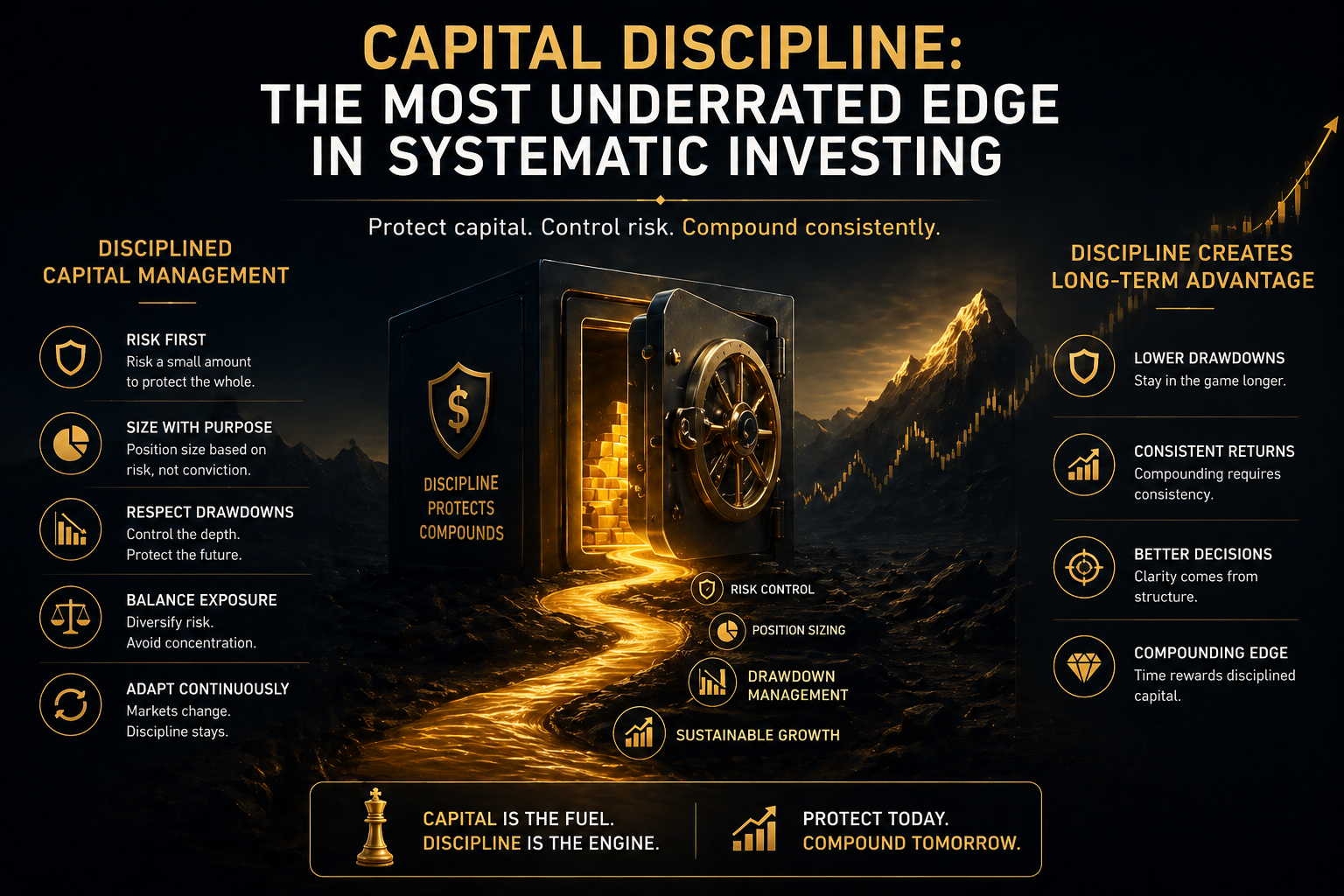
Most investors focus on:
- Finding better strategies
- Improving signals
- Increasing returns
Professionals focus on:
- Preserving capital
- Controlling risk
- Managing exposure
Because in systematic investing:
The difference between survival and failure is not strategy quality.
It is capital discipline.
At Linitics, capital discipline is treated as the foundation of long-term compounding.
1. Capital Is the Only Irreplaceable Asset
Strategies can be rebuilt.
Models can be improved.
Capital, once impaired, is difficult to recover.
A 50% drawdown requires 100% return to break even.
This asymmetry defines:
- Risk management
- Position sizing
- Portfolio design
Without capital discipline:
Edge cannot compound.
2. The Illusion of Strategy Superiority
Investors often believe:
- Better models → better returns
Reality:
- Poor capital management destroys good strategies
- Strong capital discipline improves average strategies
A mediocre strategy with disciplined capital:
Outperforms a strong strategy with poor capital control.
3. Position Sizing Is the Core Lever
Position sizing determines:
- Drawdown magnitude
- Portfolio volatility
- Risk of ruin
Common failures:
- Oversizing after wins
- Underestimating risk
- Ignoring volatility
Institutional approach:
- Size based on risk, not conviction
- Adjust exposure dynamically
Position sizing is where discipline becomes measurable.
4. Drawdown Management Defines Longevity
Drawdowns are inevitable.
The key is:
- Limiting depth
- Controlling duration
Without discipline:
- Losses escalate
- Recovery becomes difficult
- Behavior deteriorates
Capital discipline ensures:
Drawdowns remain survivable—not destructive.
5. Leverage Requires Discipline
Leverage is not inherently risky.
Undisciplined leverage is.
Problems arise when:
- Exposure exceeds risk tolerance
- Volatility is underestimated
- Positions are not adjusted
Disciplined use of leverage involves:
- Clear limits
- Dynamic adjustment
- Scenario awareness
Leverage amplifies discipline—or lack of it.
6. Scaling Must Be Controlled
Scaling capital too quickly leads to:
- Larger drawdowns
- Psychological pressure
- Execution inefficiencies
Disciplined scaling involves:
- Gradual increases
- Performance validation
- Capacity awareness
Growth without discipline leads to instability.
7. Capital Allocation Across Strategies
A portfolio is not just:
- Multiple strategies
It is:
- Structured capital allocation
Key considerations:
- Risk contribution
- Correlation
- Regime behavior
Without disciplined allocation:
- Concentration risk increases
- Diversification fails
Capital must be distributed intelligently.
8. Behavioral Discipline
Capital discipline is not purely quantitative.
It is behavioral.
Common breakdowns:
- Increasing size after losses
- Reducing exposure after drawdowns
- Chasing recent performance
These behaviors:
- Destroy statistical edge
- Increase variance
- Lead to inconsistent outcomes
Discipline ensures consistency.
9. Volatility as a Sizing Input
Volatility is dynamic.
Ignoring it leads to:
- Overexposure during risk expansion
- Underutilization during stability
Disciplined systems:
- Scale exposure based on volatility
- Maintain consistent risk levels
This stabilizes:
- Returns
- Drawdowns
- Portfolio behavior
10. Capital Efficiency vs Capital Preservation
There is a balance between:
- Deploying capital efficiently
- Protecting capital from loss
Over-aggressive deployment:
- Increases drawdown risk
Over-conservative deployment:
- Reduces compounding
Capital discipline finds the balance.
11. Institutional Perspective
Professional firms prioritize:
- Risk-adjusted returns
- Drawdown limits
- Exposure control
- Capital preservation
Because they understand:
The objective is not maximum return.
It is sustainable return.
12. The Linitics Perspective
At Linitics, capital discipline is embedded in:
- Position sizing frameworks
- Portfolio allocation
- Risk systems
- Execution processes
We treat capital not as a resource to deploy aggressively—
But as an asset to manage intelligently.
Final Thoughts
In systematic investing:
- Strategy creates opportunity
- Execution realizes performance
- Risk defines outcomes
But capital discipline determines:
Whether the system survives long enough to matter.
Because:
A strategy without discipline is unstable.
A disciplined system—even with average signals—
Can compound consistently.
At Linitics, we believe:
The most underrated edge is not prediction.
It is restraint.