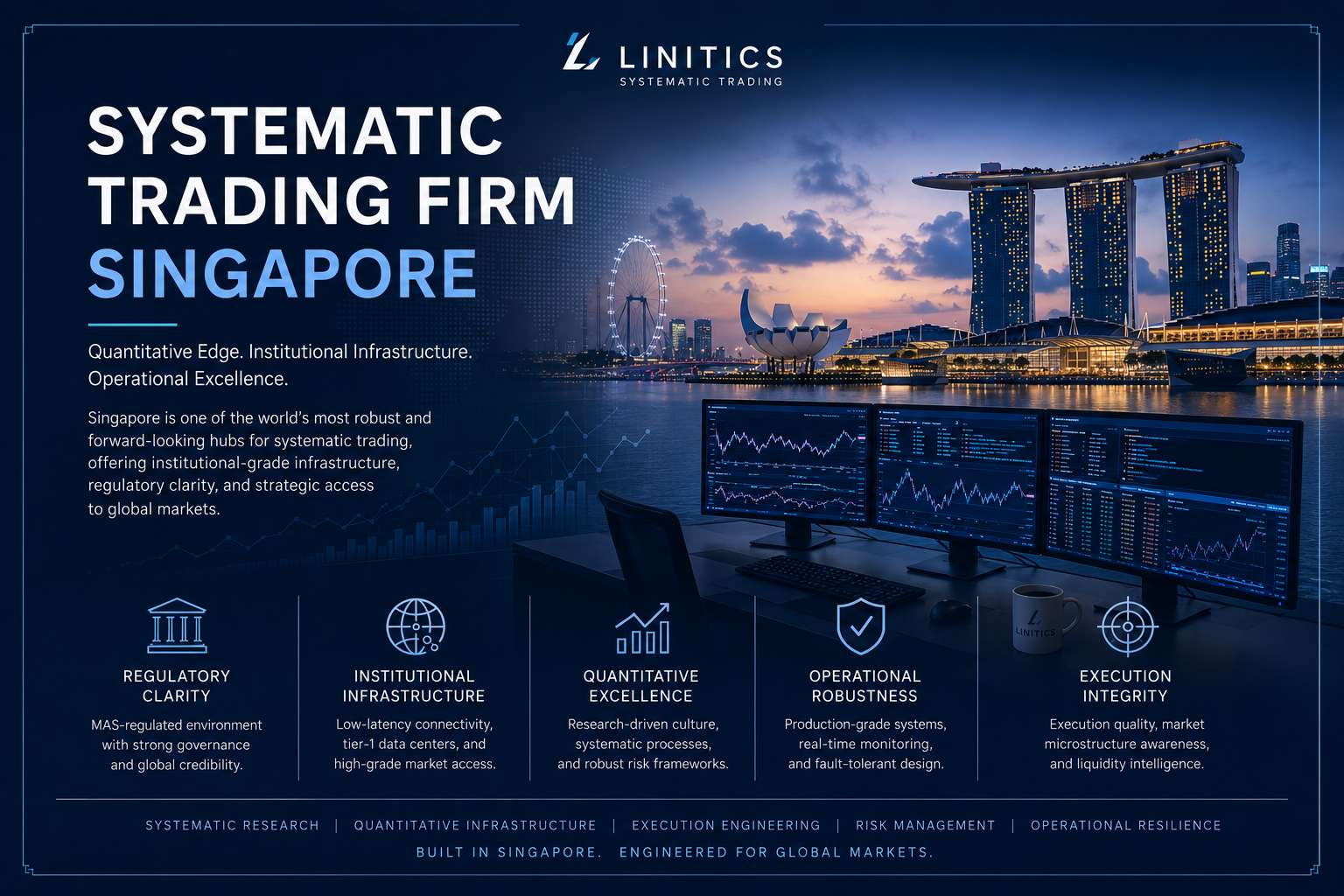
Infrastructure, Regulation, and Institutional Scalability
Over the past decade, Singapore has increasingly positioned itself as one of the most operationally attractive jurisdictions for quantitative trading firms, proprietary trading organizations, and institutional investment platforms operating across Asia-Pacific markets. While much of the public discussion surrounding systematic trading tends to focus on alpha generation, machine learning, or high-frequency execution, the institutional reality is considerably more infrastructure-intensive.
Building a systematic trading firm in Singapore is not fundamentally a technology startup exercise. It is an organizational engineering problem involving regulatory structure, operational resilience, execution quality, capital efficiency, infrastructure reliability, governance maturity, and survivability under stressed market conditions.
Institutional allocators evaluating quantitative trading organizations increasingly focus less on headline performance metrics and more on operational robustness. Questions surrounding execution integrity, model governance, monitoring systems, disaster recovery, counterparty diversification, and infrastructure observability now sit alongside traditional portfolio analytics.
Singapore’s attractiveness emerges not merely from tax efficiency or geographical location, but from the broader institutional ecosystem:
- regulatory clarity under the Monetary Authority of Singapore (MAS)
- strong banking and capital infrastructure
- proximity to major Asian liquidity centers
- sophisticated telecommunications and colocation capabilities
- deep institutional services ecosystem
- legal stability and enforceability
- cross-border capital mobility
However, operating a systematic trading organization from Singapore also introduces structural realities often underestimated by emerging firms:
- escalating infrastructure costs
- regional liquidity fragmentation
- talent concentration challenges
- execution complexity across Asian markets
- jurisdictional reporting obligations
- scalability constraints in niche alpha strategies
- growing institutional compliance expectations
The modern systematic trading firm is ultimately an integrated production environment. Alpha research alone is insufficient. Long-term durability increasingly depends on organizational resilience, execution engineering discipline, and infrastructure maturity.
This article examines the institutional realities of establishing and operating a systematic trading firm in Singapore from the perspective of infrastructure, regulation, execution systems, operational design, and long-term scalability.
Structural Background
Singapore’s Evolution as a Quantitative Trading Hub
Singapore’s rise as a quantitative finance and systematic trading jurisdiction reflects broader structural changes within global capital markets.
Historically, many proprietary trading organizations concentrated operations in Chicago, London, New York, or Amsterdam due to exchange proximity and derivatives market development. However, as Asian liquidity expanded across equities, futures, FX, commodities, and options markets, firms increasingly required operational presence within APAC time zones.
Singapore emerged as a preferred regional base due to several institutional advantages:
Regulatory Credibility
The MAS has cultivated a reputation for pragmatic but credible financial regulation. Unlike jurisdictions where regulatory ambiguity creates operational uncertainty, Singapore generally provides clearer institutional pathways for:
- fund management structures
- proprietary trading entities
- exempt fund managers
- variable capital company (VCC) frameworks
- family office structures
- cross-border institutional operations
For quantitative organizations, regulatory predictability reduces operational friction and long-term jurisdictional uncertainty.
Infrastructure Density
Systematic trading firms depend heavily on:
- exchange connectivity
- low-latency telecommunications
- cloud infrastructure
- colocation environments
- resilient power systems
- institutional-grade data providers
Singapore’s role as a regional connectivity hub materially benefits firms requiring stable and redundant infrastructure architecture.
Latency-sensitive firms operating across CME, SGX, HKEX, JPX, and regional FX venues often leverage Singapore as an execution coordination hub despite exchange infrastructure residing across multiple jurisdictions.
Banking and Counterparty Access
Institutional trading firms require reliable access to:
- prime brokerage
- clearing relationships
- custody services
- banking infrastructure
- OTC derivative counterparties
- treasury management
Singapore’s financial ecosystem supports these operational requirements more effectively than many emerging regional jurisdictions.
Capital Mobility and Institutional Confidence
Institutional allocators frequently prioritize jurisdictions with strong legal systems, enforceability standards, and governance transparency.
For systematic trading firms seeking external capital, jurisdictional credibility materially impacts allocator perception. Operational due diligence teams increasingly assess:
- jurisdictional risk
- governance structures
- operational controls
- reporting standards
- business continuity planning
- cybersecurity maturity
Singapore scores favorably across many of these dimensions.
Institutional Analysis
The Operational Architecture of a Systematic Trading Firm
Retail narratives often portray systematic trading as algorithm deployment combined with statistical modeling. Institutional reality is considerably broader.
A mature systematic trading organization typically operates across several tightly integrated functional layers.
Research Infrastructure
Quantitative research infrastructure forms the intellectual foundation of the organization.
This includes:
- historical market data management
- tick-level storage systems
- simulation frameworks
- portfolio construction engines
- volatility modeling systems
- factor research pipelines
- machine learning experimentation environments
- alternative data ingestion architecture
Institutional-grade research environments must prioritize reproducibility.
A common failure point among emerging systematic firms is inadequate research governance:
- inconsistent datasets
- non-versioned experiments
- survivorship bias contamination
- execution assumption distortions
- overfitted strategy development
- unstable deployment pipelines
Sophisticated organizations increasingly treat research infrastructure similarly to software engineering environments.
Core institutional practices include:
- version-controlled research environments
- deterministic backtesting
- centralized feature stores
- research auditability
- deployment approval workflows
- strategy lifecycle governance
This becomes particularly important as organizations scale across multiple researchers and strategy teams.
Execution Engineering
Execution quality is often one of the most underestimated components of systematic trading operations.
Many theoretical strategies fail not because alpha disappears entirely, but because real-world execution friction invalidates simulated assumptions.
Execution engineering increasingly represents a structural edge.
Critical execution considerations include:
- market impact
- queue positioning
- order book dynamics
- spread behavior
- exchange-specific matching logic
- hidden liquidity interaction
- latency variability
- order throttling limits
- routing optimization
- intraday liquidity regimes
For options-focused systematic firms, execution complexity becomes significantly greater.
SPX, index options, and volatility-sensitive products exhibit highly nonlinear execution behavior during stressed volatility environments.
Operationally sophisticated firms therefore invest heavily in:
- smart order routing systems
- execution simulation frameworks
- microstructure analytics
- fill quality monitoring
- real-time slippage analysis
- liquidity fragmentation detection
- exchange-specific execution models
Institutional organizations increasingly view execution engineering not as a support function but as a direct contributor to infrastructure alpha.
Production Infrastructure
A systematic trading firm is fundamentally a real-time distributed systems organization.
Production infrastructure typically includes:
- market data handlers
- strategy engines
- order management systems
- risk gateways
- reconciliation systems
- monitoring infrastructure
- observability frameworks
- alerting systems
- disaster recovery environments
- failover execution architecture
Operational fragility often emerges from infrastructure synchronization failures rather than outright software crashes.
Examples include:
- timestamp desynchronization
- stale market data propagation
- partial order acknowledgment failures
- inconsistent portfolio state calculations
- dropped exchange sessions
- clock drift between systems
- silent risk gateway degradation
Institutional firms therefore prioritize:
- redundancy
- deterministic recovery behavior
- infrastructure observability
- real-time telemetry
- chaos testing
- rollback procedures
- infrastructure-as-code discipline
- operational playbooks
Production-grade reliability increasingly differentiates institutional organizations from smaller discretionary technology operations.
Risk Infrastructure
Risk management within systematic trading firms extends well beyond position limits.
Institutional risk architecture typically includes:
- intraday exposure monitoring
- concentration analytics
- liquidity stress modeling
- volatility regime detection
- scenario analysis
- counterparty exposure monitoring
- operational risk controls
- infrastructure risk assessment
- execution anomaly detection
- portfolio convexity analysis
The collapse of many leveraged trading firms historically reflected operational risk failures rather than pure strategy deterioration.
Examples of institutional vulnerabilities include:
- correlated strategy crowding
- liquidity evaporation during stress
- hidden leverage exposure
- model instability under regime shifts
- counterparty concentration
- infrastructure outages during volatility spikes
- inadequate kill-switch architecture
Modern systematic firms increasingly embed real-time risk recalculation directly into execution infrastructure.
This reflects the reality that risk cannot be treated as an end-of-day process in high-velocity markets.
Singapore-Specific Operational Considerations
MAS Regulatory Environment
Singapore’s regulatory environment remains one of the primary reasons institutional firms establish regional operations there.
However, regulatory credibility comes with increasing operational expectations.
Systematic trading organizations operating under MAS oversight may encounter obligations surrounding:
- compliance infrastructure
- AML/KYC controls
- cybersecurity governance
- technology risk management
- outsourcing oversight
- operational continuity
- reporting obligations
- auditability requirements
Technology risk management has become particularly important.
As algorithmic execution systems become more complex, regulators increasingly focus on:
- deployment controls
- access management
- incident reporting
- recovery procedures
- vendor risk oversight
- infrastructure resilience
Firms that underestimate operational governance requirements often encounter scaling bottlenecks later during institutionalization.
Talent Concentration and Competition
Singapore possesses a highly sophisticated financial talent ecosystem, but quantitative trading talent remains globally competitive.
Competition exists across:
- hedge funds
- proprietary trading firms
- market makers
- investment banks
- technology firms
- crypto trading organizations
- AI startups
This creates structural compensation pressure, particularly for:
- low-latency engineers
- quantitative researchers
- options traders
- distributed systems engineers
- machine learning specialists
- execution engineers
As a result, many firms increasingly adopt hybrid organizational models combining:
- Singapore headquarters
- distributed research teams
- remote infrastructure engineering
- global execution coverage
Operational cohesion becomes critical in distributed organizational structures.
Exchange and Market Access
Singapore provides strategic proximity to:
- SGX
- HKEX
- JPX
- ASX
- regional FX markets
- global derivatives venues
However, APAC trading introduces fragmentation challenges.
Compared with US markets, Asian markets often exhibit:
- varying liquidity profiles
- inconsistent trading hours
- heterogeneous market structures
- fragmented settlement systems
- differing regulatory frameworks
- localized operational constraints
This increases operational complexity for multi-market systematic organizations.
Institutional firms therefore invest heavily in:
- exchange abstraction layers
- regional risk normalization
- multi-venue execution infrastructure
- timezone-aware operational monitoring
- regional compliance coordination
Operational Implications
The Cost Structure of Institutional Systematic Trading
A common misconception is that systematic trading firms scale cheaply because algorithms replace labor.
In reality, institutional systematic trading can become operationally expensive.
Major cost centers include:
Market Data
Institutional-grade market data is expensive.
Costs may include:
- depth-of-book feeds
- historical tick datasets
- options surface data
- alternative data subscriptions
- exchange redistribution fees
- derived analytics infrastructure
Data quality directly impacts research validity and execution accuracy.
Connectivity and Infrastructure
Low-latency infrastructure requires:
- cross-connects
- colocation services
- premium telecommunications
- hardware acceleration
- failover environments
- cloud redundancy
- real-time monitoring systems
Infrastructure spending often scales disproportionately as firms pursue lower execution latency.
Compliance and Governance
As firms institutionalize, non-investment operational costs expand materially:
- legal infrastructure
- compliance staffing
- cybersecurity systems
- audit processes
- vendor governance
- operational controls
- reporting frameworks
Many emerging firms underestimate the fixed operational burden required to attract institutional capital.
Scalability Constraints in Quantitative Strategies
One of the most important institutional realities is that alpha capacity is finite.
Strategies exhibiting strong backtested performance often deteriorate when:
- capital size increases
- execution footprint expands
- liquidity regimes shift
- market participants adapt
- volatility compresses
Institutional firms therefore constantly balance:
- capacity utilization
- Sharpe optimization
- execution impact
- strategy diversification
- turnover constraints
- infrastructure complexity
This creates a structural tension between:
- maximizing short-term profitability
- preserving long-term scalability
Sophisticated organizations increasingly optimize for organizational durability rather than peak short-term returns.
Reliability as Competitive Advantage
In mature quantitative markets, reliability increasingly becomes a differentiator.
Many firms possess competent quantitative models.
Fewer possess:
- stable production systems
- resilient deployment pipelines
- operational discipline
- robust observability frameworks
- institutional governance maturity
Operational consistency matters significantly during:
- volatility spikes
- exchange outages
- liquidity dislocations
- macroeconomic shocks
- options expiry events
- geopolitical stress periods
Infrastructure fragility often becomes visible precisely when markets become most profitable.
As a result, institutional firms increasingly treat engineering reliability as an alpha preservation mechanism.
Strategic Trade-Offs
Speed Versus Robustness
Systematic firms constantly navigate the trade-off between rapid iteration and operational stability.
Faster deployment cycles may improve research velocity but increase:
- production instability
- governance risk
- execution errors
- monitoring complexity
Institutional organizations increasingly implement layered deployment frameworks including:
- paper trading environments
- shadow execution systems
- limited-capital staging
- automated rollback systems
- pre-trade validation controls
The objective is not merely innovation speed but controlled innovation survivability.
Specialization Versus Diversification
Firms must decide whether to specialize deeply in:
- market making
- statistical arbitrage
- options volatility
- macro systematic trading
- intraday execution
- medium-frequency equities
Or diversify across multiple strategy verticals.
Specialization may improve:
- execution sophistication
- domain expertise
- infrastructure efficiency
- research depth
However, concentration also increases:
- regime dependency
- liquidity exposure
- strategy cyclicality
- allocator concentration risk
Institutional organizations often evolve toward modular diversification architectures rather than fully centralized monolithic systems.
Internalization Versus Vendor Dependence
Systematic firms must also determine which infrastructure components should be built internally.
Typical trade-offs include:
Internal Development
Advantages:
- greater control
- execution customization
- infrastructure optimization
- proprietary edge preservation
Disadvantages:
- higher engineering cost
- operational maintenance burden
- slower deployment timelines
- staffing dependence
Vendor Infrastructure
Advantages:
- faster implementation
- reduced maintenance burden
- operational standardization
Disadvantages:
- vendor dependency
- reduced differentiation
- integration limitations
- operational concentration risk
Institutional maturity often involves selectively internalizing components directly linked to execution quality or research edge while externalizing commoditized infrastructure.
Long-Term Industry Perspective
The Institutionalization of Quantitative Trading
Systematic trading is increasingly converging with institutional software engineering.
Future competitive advantages are likely to emerge less from isolated signals and more from integrated organizational capability:
- research discipline
- execution quality
- infrastructure resilience
- governance maturity
- operational scalability
- capital efficiency
The era of lightly structured quantitative operations generating sustainable excess returns from isolated inefficiencies is gradually narrowing.
Competitive markets increasingly compress purely informational advantages.
This elevates the importance of:
- operational robustness
- execution integrity
- organizational coordination
- infrastructure sophistication
- institutional survivability
Singapore’s Long-Term Positioning
Singapore is likely to remain strategically important within APAC quantitative finance due to:
- political stability
- regulatory credibility
- infrastructure density
- capital market connectivity
- institutional services depth
- regional accessibility
However, competition will intensify.
Emerging hubs across:
- Dubai
- Hong Kong
- Tokyo
- Sydney
- Abu Dhabi
continue investing heavily in institutional trading ecosystems.
Singapore’s long-term competitive advantage will likely depend on maintaining:
- regulatory pragmatism
- talent attraction
- infrastructure competitiveness
- innovation support
- institutional credibility
For trading firms themselves, survivability will increasingly depend on organizational quality rather than isolated strategy brilliance.
AI and Automation in Quantitative Organizations
Artificial intelligence will likely reshape systematic trading infrastructure in several areas:
- signal generation
- anomaly detection
- execution optimization
- operational monitoring
- infrastructure observability
- compliance automation
- portfolio risk diagnostics
However, AI adoption also introduces:
- model interpretability challenges
- governance complexity
- operational unpredictability
- infrastructure scaling burdens
- regulatory scrutiny
Institutional firms adopting AI aggressively without corresponding governance maturity may increase operational fragility rather than reduce it.
The long-term winners will likely combine:
- disciplined research processes
- robust engineering systems
- institutional governance
- scalable operational infrastructure
rather than relying solely on model sophistication.
Final Thoughts
Building a systematic trading firm in Singapore is fundamentally an exercise in institutional systems design.
While public attention frequently centers on quantitative models or algorithmic strategies, durable systematic organizations are ultimately defined by:
- infrastructure resilience
- execution engineering
- operational robustness
- governance maturity
- organizational scalability
- risk discipline
Singapore offers substantial structural advantages for firms operating across APAC markets:
- regulatory clarity
- institutional credibility
- infrastructure density
- financial ecosystem maturity
- regional connectivity
Yet these advantages do not eliminate the realities of institutional trading operations.
Modern systematic firms operate within increasingly competitive and infrastructure-intensive environments where:
- execution quality matters materially
- operational failures can become existential
- scalability constraints are unavoidable
- governance expectations continue rising
- infrastructure reliability becomes strategic
As quantitative markets mature, sustainable advantage increasingly emerges not from isolated alpha discovery alone, but from the integration of:
- research rigor
- execution sophistication
- engineering discipline
- operational resilience
- institutional coordination
The systematic trading firm of the future will resemble a hybrid between:
- a quantitative research institution
- a distributed systems engineering organization
- a risk management platform
- an institutional capital allocator
Organizations capable of integrating these disciplines cohesively will likely define the next generation of institutional quantitative trading.
Modern systematic trading firms increasingly operate as technology and infrastructure organizations as much as investment operations. Firms such as Linitics focus on execution engineering, infrastructure reliability, automation, and risk-integrated system design to support scalable quantitative trading across institutional market environments.