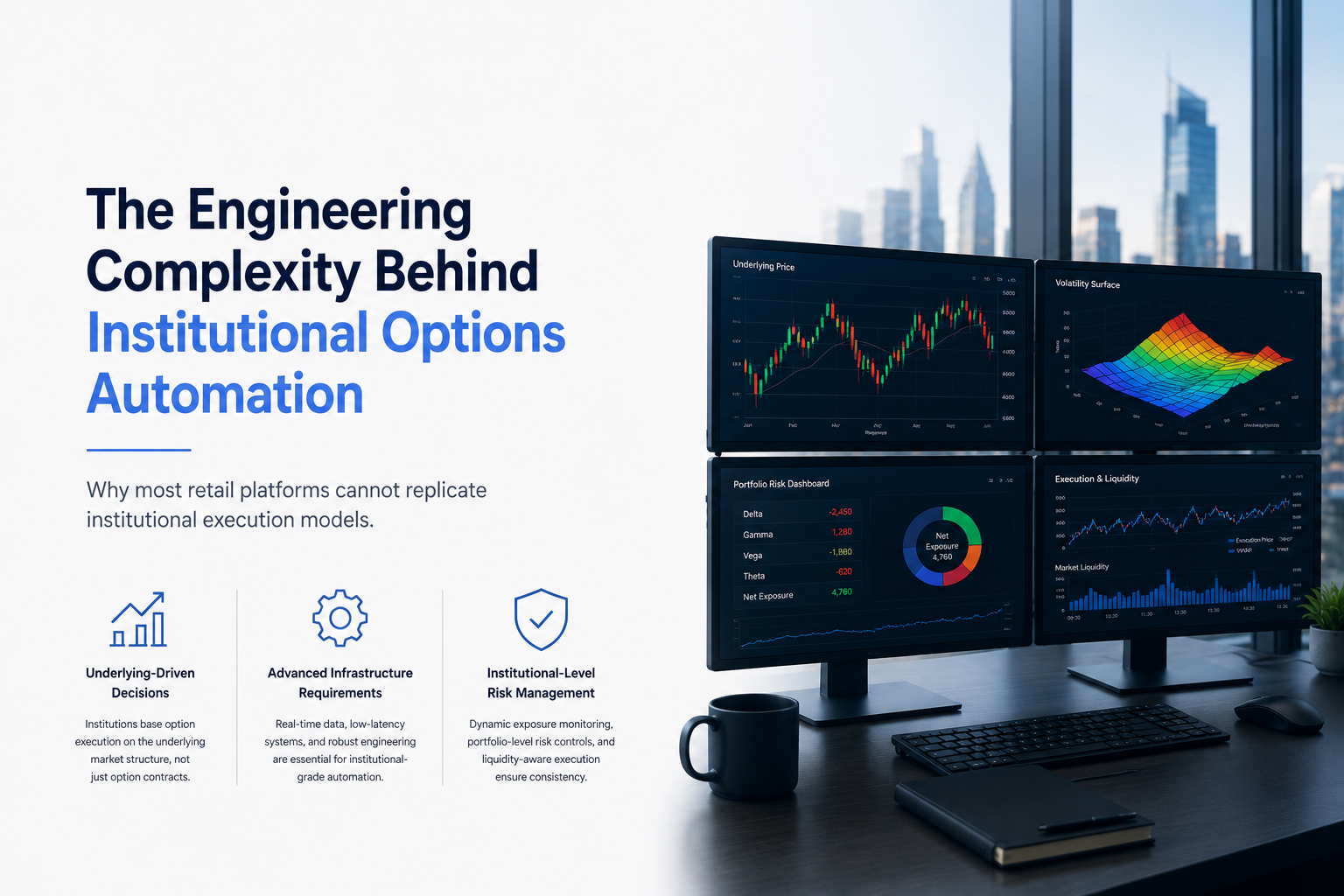
The Engineering, Infrastructure, and Execution Complexity Behind Modern Systematic Options Trading
Retail options automation platforms have grown rapidly over the past decade, offering traders the ability to automate entries, exits, alerts, and basic execution workflows without requiring deep programming expertise.
However, despite these advancements, a major structural gap still exists between:
- retail automation platforms and
- institutional-grade options execution systems.
The difference is not simply about strategy sophistication.
It is fundamentally about:
- infrastructure architecture,
- execution design,
- engineering capability,
- real-time data processing,
- and operational resilience.
Many institutional options trading systems are not primarily driven by the option contract itself. Instead, they frequently make decisions based on:
- the underlying asset,
- volatility structure,
- liquidity conditions,
- portfolio-level exposure,
- and execution state across multiple systems.
This creates a level of engineering complexity that most retail automation platforms were never designed to support.
Retail Options Automation Was Built Around Simplicity
Most retail options automation tools are designed around accessibility and ease of use.
Typical retail automation workflows focus on:
- option premium triggers,
- predefined stop-loss rules,
- Greeks-based conditions,
- simple spreads,
- and fixed entry or exit criteria.
These systems are generally optimized for:
- ease of deployment,
- low-code automation,
- visual strategy builders,
- and broker-level execution integration.
For many retail traders, this functionality is sufficient.
However, institutional options trading environments operate very differently.
Institutional Systems Often Trade the Underlying — Not the Option
One of the biggest misconceptions in options trading is the assumption that institutional systems primarily analyze the option contract itself.
In reality, many sophisticated institutional workflows treat the option merely as:
- an execution instrument,
- while the actual decision engine is driven by the underlying market.
This means:
- entries,
- exits,
- hedging,
- position sizing,
- and adjustments
may all depend on:
- price structure,
- volatility state,
- liquidity conditions,
- market microstructure,
- and portfolio-level exposure within the underlying asset.
For example, an institutional system trading index options may:
- enter based on futures market structure,
- manage exposure based on underlying volatility expansion,
- dynamically hedge delta exposure,
- and exit positions based on liquidity deterioration in the underlying index.
The option itself may only represent the final execution layer.
This distinction is extremely important.
Why Underlying-Based Options Management Is Technically Complex
Managing options positions through the underlying market requires significantly more infrastructure than standard retail automation.
Institutional systems frequently require:
- synchronized real-time market data,
- derivatives mapping infrastructure,
- volatility analytics,
- event-driven execution engines,
- portfolio-level exposure management,
- and multi-asset monitoring systems.
Unlike retail automation workflows, institutional systems must continuously manage:
- changing Greeks,
- liquidity fragmentation,
- spread widening,
- correlation shifts,
- and execution slippage.
This becomes especially important in:
- short-dated options,
- 0DTE systems,
- index derivatives,
- and volatility-sensitive environments.
The complexity grows exponentially when strategies involve:
- multiple expiries,
- dynamic hedging,
- intraday adjustments,
- or portfolio-level risk balancing.
Why Retail Platforms Struggle to Replicate Institutional Infrastructure
Most retail automation platforms were not designed to support:
- institutional-scale execution architecture,
- low-latency infrastructure,
- portfolio synchronization,
- or event-driven derivatives management.
Several structural limitations exist.
1. Platform Architecture Limitations
Retail systems are typically designed around:
- broker APIs,
- delayed workflows,
- simplified automation logic,
- and retail-friendly abstractions.
Institutional systems often rely on:
- custom execution engines,
- direct market connectivity,
- distributed infrastructure,
- and internally engineered monitoring systems.
The architectural difference is significant.
2. Underlying and Options Synchronization Complexity
Institutional systems frequently require:
- simultaneous monitoring of:
- the underlying asset,
- option chain structure,
- implied volatility,
- and portfolio exposure.
This synchronization challenge is difficult to solve reliably in retail environments.
Especially in fast-moving markets.
3. Real-Time Risk Management Requirements
Institutional execution systems continuously monitor:
- delta exposure,
- gamma sensitivity,
- liquidity conditions,
- execution quality,
- and intraday portfolio risk.
Most retail automation platforms are not built for:
- continuous portfolio-level recalculation,
- real-time exposure balancing,
- or infrastructure-grade monitoring.
4. Operational Resilience and Reliability
Institutional firms place enormous emphasis on:
- redundancy,
- observability,
- execution integrity,
- failover systems,
- and operational continuity.
Because in systematic options trading:
- infrastructure failure itself can become a major source of risk.
Retail systems typically optimize for:
- convenience,
- accessibility,
- and ease of use,
rather than:
- institutional reliability under stress.
Why Institutional Firms Continue to Dominate Complex Options Automation
The ability to build underlying-driven options execution systems increasingly depends on multidisciplinary organizational capability.
Modern institutional firms often integrate:
- quantitative researchers,
- software engineers,
- data engineers,
- infrastructure specialists,
- and execution teams
within tightly connected operational environments.
This allows firms to build:
- scalable automation systems,
- adaptive risk frameworks,
- portfolio-aware execution models,
- and resilient infrastructure architectures.
In many cases, the sustainable edge no longer comes from isolated trading ideas alone.
Instead, competitive advantage increasingly emerges from:
- engineering quality,
- infrastructure reliability,
- execution efficiency,
- and operational discipline.
The Future of Options Automation
As options markets become increasingly:
- electronic,
- competitive,
- and data-intensive,
the gap between:
- retail automation workflows and
- institutional execution systems
is likely to widen further.
Future institutional systems will increasingly incorporate:
- AI-assisted monitoring,
- adaptive execution models,
- portfolio-level automation,
- real-time volatility analytics,
- and infrastructure-aware risk management.
This evolution is gradually transforming modern options trading into a highly engineering-intensive discipline.
Final Thoughts
Retail options automation platforms have significantly expanded access to systematic trading workflows.
However, institutional options execution models operate at a fundamentally different level of complexity.
The distinction is not merely about:
- better strategies,
- faster execution,
- or larger capital bases.
It is about the ability to integrate:
- quantitative research,
- real-time infrastructure,
- engineering systems,
- execution architecture,
- and operational resilience
into scalable trading operations.
As systematic options trading continues evolving, the firms most capable of combining:
- research,
- engineering,
- automation,
- and disciplined infrastructure
will likely continue dominating advanced execution environments.