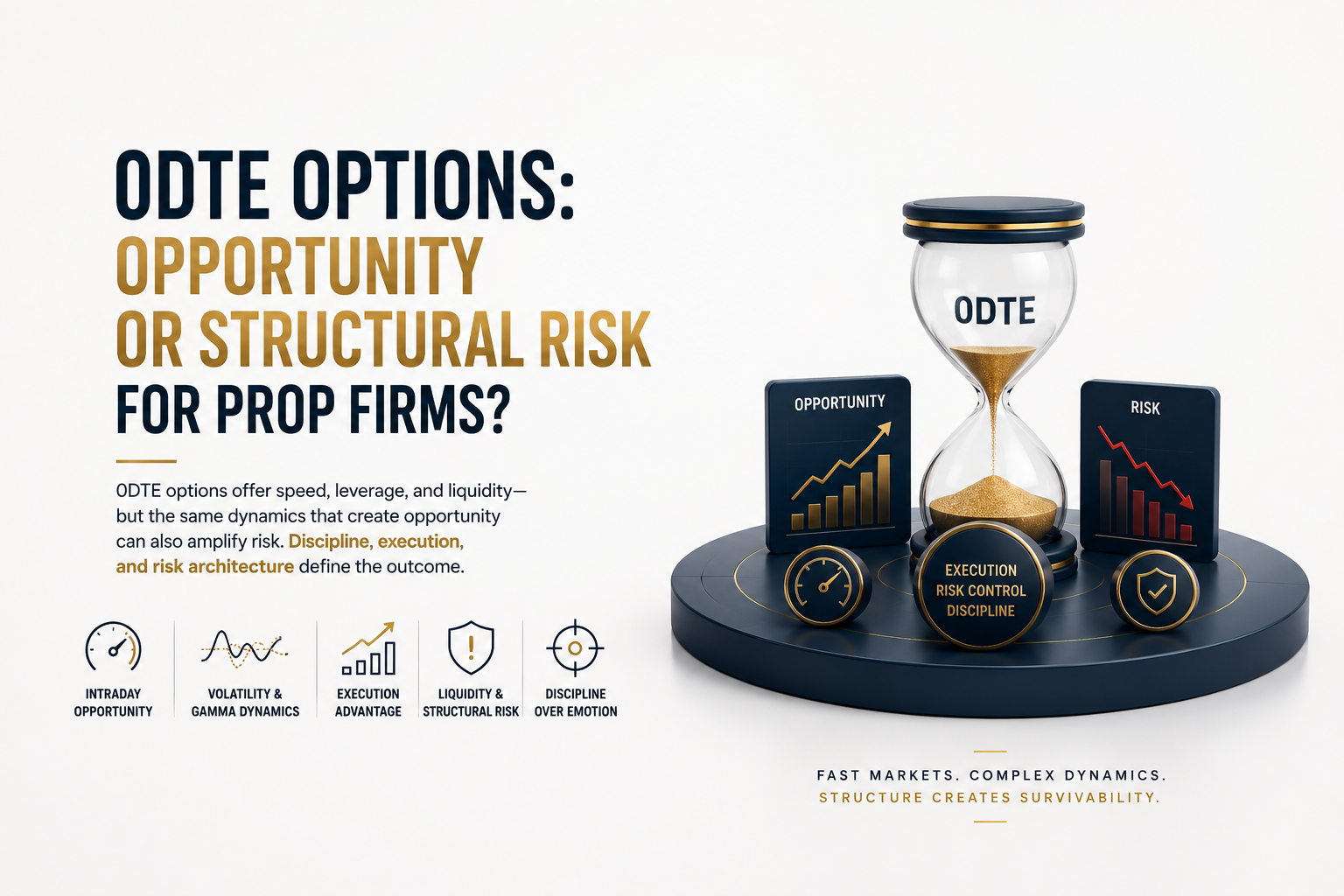
Few areas in modern derivatives trading have grown as rapidly as:
- 0DTE (Zero Days to Expiry) options.
What began as a niche trading activity has evolved into a major source of:
- intraday liquidity
- volatility exposure
- speculative positioning
- institutional flow interaction
For many traders, 0DTE represents:
- speed
- leverage
- rapid profit potential
But for professional trading firms, the question is more nuanced:
Is 0DTE a scalable opportunity—or a structural risk?
At Linitics, we believe 0DTE trading cannot be evaluated purely through:
- payoff diagrams
- win rates
- short-term profitability
It must be evaluated through the lens of:
- execution
- liquidity
- convexity
- survivability
- deployment architecture
Because:
strategies that appear profitable can still be structurally fragile.
1. What Makes 0DTE Unique?
0DTE options compress:
- time decay
- gamma exposure
- volatility sensitivity
Into an extremely short time horizon.
This creates:
- rapid PnL acceleration
- nonlinear risk dynamics
- highly reactive pricing behavior
Small market movements can generate:
- outsized percentage returns
or - rapid capital destruction.
2. The Attraction of 0DTE
0DTE products attract traders because they offer:
- low upfront premium
- high convexity
- intraday leverage
- fast feedback loops
For systematic firms, they also introduce:
- dense intraday data
- repeatable event structures
- exploitable microstructure behavior
This creates genuine research interest.
3. Why Prop Firms Are Interested in 0DTE
Sophisticated firms view 0DTE less as:
- directional gambling
And more as:
- a volatility and liquidity environment.
Opportunities may emerge from:
- dealer positioning
- gamma imbalances
- intraday volatility dislocations
- order flow behavior
- event-driven reactions
The edge is often structural—not predictive.
4. The Gamma Environment
0DTE options are heavily influenced by:
- gamma dynamics.
As expiry approaches:
- delta sensitivity accelerates rapidly.
This creates:
- violent hedging flows
- intraday feedback loops
- liquidity shocks
Dealer hedging activity itself can influence:
- short-term market movement.
5. Why Small Errors Become Dangerous
The compressed time horizon means:
- risk compounds extremely quickly.
Minor mistakes in:
- execution
- sizing
- timing
- liquidity assumptions
Can create:
- disproportionately large losses.
This makes 0DTE structurally unforgiving.
6. Liquidity Is Not Always Stable
0DTE markets may appear liquid during:
- calm market conditions.
But liquidity can deteriorate rapidly during:
- volatility spikes
- macro events
- sudden directional moves
Spreads widen aggressively under stress.
This creates:
- execution fragility.
7. The Illusion of Tight Risk
Many traders assume 0DTE provides:
- limited-risk exposure
Because option premium is predefined.
Institutional firms think differently.
They evaluate:
- probability distributions
- tail behavior
- liquidity stress
- execution failure scenarios
Because:
defined premium does not eliminate structural risk.
8. Convexity Cuts Both Ways
Convexity creates:
- asymmetric upside
But also:
- nonlinear downside dynamics.
Small volatility changes can dramatically alter:
- option pricing
- hedge requirements
- position behavior
This creates unstable risk profiles under stress.
9. The Capacity Problem
Many 0DTE opportunities are:
- highly capacity constrained.
As deployment size increases:
- market impact rises
- fills deteriorate
- edge compresses rapidly
This limits scalability for larger firms.
10. Why Execution Matters More Than Prediction
In 0DTE trading:
- execution quality often matters more than directional accuracy.
Small differences in:
- fills
- latency
- routing
- spread management
Can materially affect long-term expectancy.
This transforms 0DTE from:
- pure strategy problem
Into:
an execution engineering problem.
11. Structural Fragility During Volatility Events
0DTE systems can become unstable during:
- macro announcements
- volatility expansions
- liquidity vacuums
Under stress:
- slippage increases nonlinearly
- spreads widen rapidly
- hedging assumptions fail
Backtests often underestimate this behavior.
12. Why Backtests Frequently Mislead
Many 0DTE backtests fail to model:
- realistic slippage
- spread expansion
- execution latency
- liquidity deterioration
As a result:
- theoretical returns appear inflated.
The shorter the holding period:
- the more execution realism matters.
13. Psychological Reinforcement Loops
0DTE trading creates extremely rapid feedback cycles.
This can encourage:
- overtrading
- excessive leverage
- behavioral instability
Even systematic firms must guard against:
- operational impulsiveness.
14. Institutional Approaches Are Usually More Controlled
Sophisticated prop firms rarely treat 0DTE as:
- unrestricted directional speculation.
Instead, they focus on:
- tightly controlled deployment
- strict sizing frameworks
- volatility-aware positioning
- systematic execution discipline
The objective is not:
- maximizing excitement
But:
- controlling convexity exposure.
15. The Real Edge Often Exists Outside Direction
Many institutional 0DTE frameworks focus on:
- volatility structure
- liquidity behavior
- dealer positioning
- flow asymmetry
Rather than:
- predicting simple market direction.
This distinction is critical.
16. Why Most Retail Approaches Fail
Many retail 0DTE approaches rely on:
- excessive leverage
- emotional decision-making
- poor risk discipline
- unrealistic payoff expectations
This creates fragile systems vulnerable to:
- variance shocks
- execution stress
- capital depletion.
17. Opportunity vs Structural Risk
0DTE can absolutely create opportunity.
But only when supported by:
- infrastructure
- execution quality
- disciplined sizing
- controlled exposure
- robust risk systems
Without these:
- the same convexity that creates opportunity becomes structural fragility.
18. The Linitics Perspective
At Linitics, we view 0DTE as:
- a highly specialized market environment
Not:
- a shortcut to rapid profits.
We believe successful 0DTE deployment requires:
- institutional-grade execution
- liquidity awareness
- convexity management
- robust operational controls
Because the real challenge is not:
- generating occasional gains
But:
surviving the nonlinear risk profile over time.
Final Thoughts
0DTE options represent one of the most fascinating developments in modern derivatives markets.
They combine:
- leverage
- liquidity
- convexity
- behavioral dynamics
Into an extremely compressed timeframe.
For sophisticated firms:
- this creates opportunity.
For undisciplined operators:
- it creates structural risk.
At Linitics, we believe the future winners in 0DTE trading will not be the firms taking the most risk—
But the firms most capable of:
controlling it systematically.