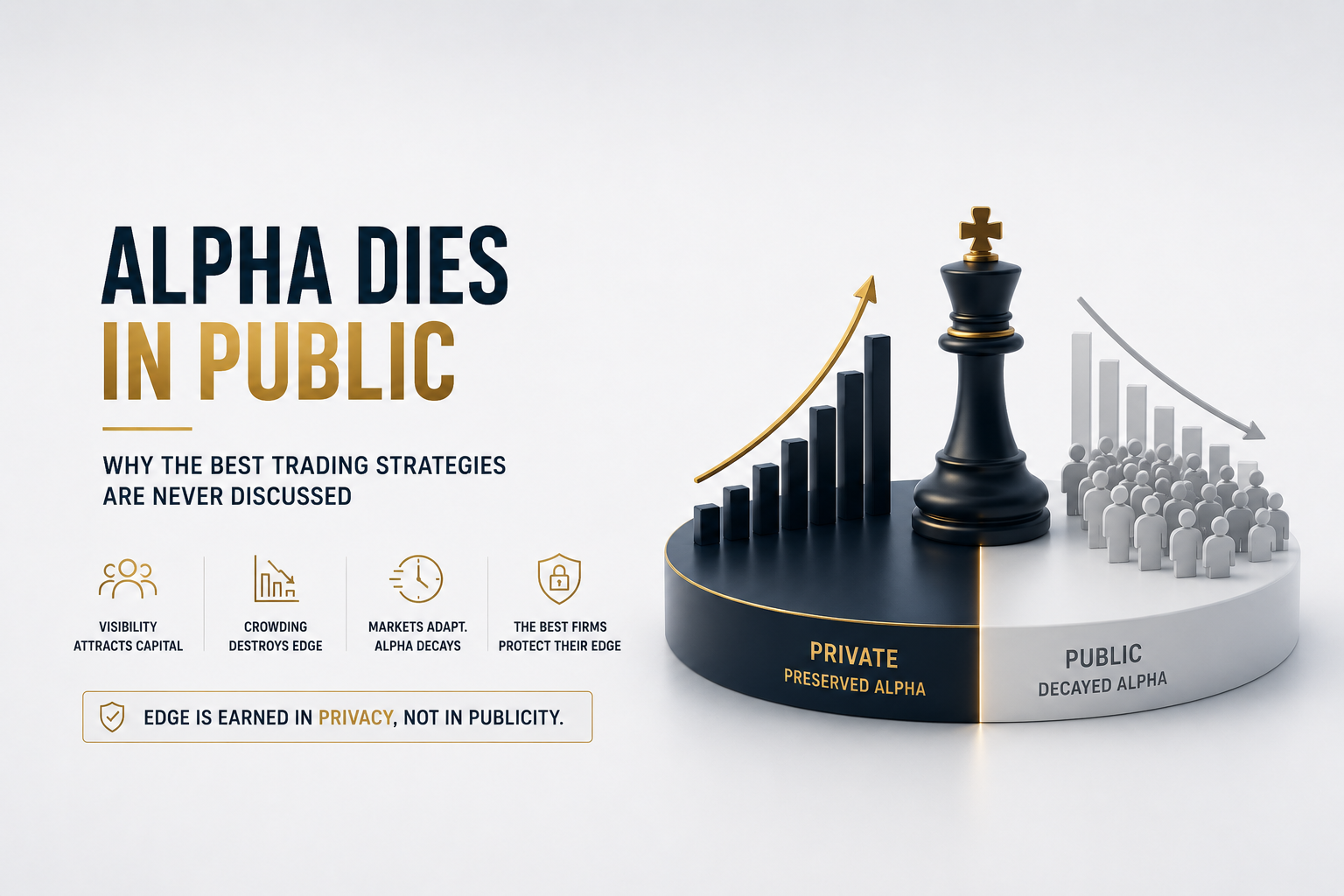
In modern markets, information spreads instantly.
A strategy posted publicly can reach:
- thousands of traders
- social media communities
- copy-trading networks
- automated replication systems
Within hours.
This creates a structural reality many retail traders underestimate:
the more visible an edge becomes, the faster it decays.
At Linitics, we believe one of the clearest differences between institutional operators and public trading culture is this:
- institutions protect alpha
- retail culture broadcasts it
Because in systematic trading:
durable edge rarely survives mass visibility.
1. Understanding Alpha Decay
Alpha is not static.
Most market inefficiencies exist because:
- they are underexploited
- structurally difficult
- operationally hidden
Once enough participants discover the same opportunity:
- execution crowding increases
- spreads compress
- capacity deteriorates
The edge weakens.
2. Public Visibility Accelerates Competition
When strategies become public:
- participation rises rapidly
- execution behavior changes
- liquidity patterns adapt
Markets are adaptive systems.
Public attention changes:
- order flow
- timing behavior
- execution dynamics
This means:
exposure itself alters the opportunity.
3. Why Elite Firms Operate Quietly
Many elite prop firms maintain:
- minimal public visibility
- limited strategic disclosure
- highly private research environments
This is intentional.
Because preserving edge requires:
- controlling information leakage
- limiting replication risk
- protecting execution patterns
4. Strategy Crowding Is a Structural Risk
As more participants deploy similar strategies:
- market impact increases
- entry efficiency declines
- exits become crowded
Eventually:
- the strategy begins competing against itself
This is especially dangerous in:
- short-duration systems
- high-frequency execution
- capacity-sensitive strategies
5. The Difference Between Theory and Deployable Alpha
Many public strategies appear profitable in theory.
Institutional firms evaluate something different:
deployable alpha after crowding.
A strategy may:
- backtest well
- look statistically attractive
- gain social popularity
But fail operationally once:
- execution scale increases
- participation expands
- market adaptation occurs
6. Social Media Incentives Conflict With Alpha Preservation
Modern trading content ecosystems reward:
- visibility
- engagement
- virality
- audience growth
Institutional trading rewards:
- secrecy
- controlled deployment
- limited competition
These incentives are fundamentally misaligned.
7. Why Real Edge Often Looks Boring Externally
Durable institutional strategies are often:
- operationally sophisticated
- infrastructure-driven
- execution-sensitive
Not:
- visually exciting
- socially marketable
- easily explained in short-form content
The strongest edges frequently exist in:
- implementation quality
- infrastructure precision
- operational integration
Not public storytelling.
8. Alpha Compression Happens Faster Than Ever
Modern markets adapt rapidly because of:
- automation
- machine learning
- institutional surveillance
- global information flow
A publicly visible inefficiency can now disappear extremely quickly.
This compresses:
- strategy lifespan
- capacity durability
- excess return persistence
9. Information Leakage Is Not Always Intentional
Alpha leakage occurs through:
- public discussions
- educational content
- open-source code
- execution patterns
- strategy replication behavior
Even partial disclosure can reveal:
- positioning logic
- timing behavior
- execution structure
10. Capacity Constraints Make Visibility Dangerous
Many profitable strategies operate within:
- limited liquidity environments
- narrow execution windows
- finite capacity conditions
As participation increases:
- slippage rises
- fills deteriorate
- alpha collapses
This is why:
some strategies are profitable precisely because few people trade them.
11. The Institutional View of Research
Professional research environments prioritize:
- confidentiality
- compartmentalization
- controlled information access
Because firms understand:
- research is intellectual capital
Protecting that capital matters operationally.
12. Why Public Strategies Often Become Educational Products
Once a strategy becomes:
- fully public
- heavily discussed
- broadly replicated
Its commercial value often shifts from:
- trading profitability
Toward:
- educational monetization
This is an important distinction many traders miss.
13. Infrastructure Often Matters More Than the Idea
Two firms may possess:
- similar signals
But generate very different outcomes due to differences in:
- execution quality
- latency
- routing
- portfolio construction
- risk systems
This means alpha increasingly lives inside:
- implementation architecture
Not just strategy logic.
14. Why Elite Firms Rarely Reveal Core Systems
The strongest firms rarely discuss:
- execution models
- allocation logic
- infrastructure architecture
- portfolio construction frameworks
Because:
operational secrecy preserves deployment quality.
15. Markets Reward Scarcity
Alpha behaves similarly to:
- scarce resources
The fewer participants capable of exploiting an inefficiency:
- the more valuable it becomes
Public visibility reduces scarcity.
And therefore:
- reduces edge durability.
16. The Illusion of Public Transparency
Retail culture often assumes:
- openness improves collective profitability
Markets do not function this way.
As more capital crowds into the same opportunity:
- returns compress
- execution deteriorates
- inefficiencies disappear
This is structural market behavior.
17. Why Institutions Invest in Silence
Many elite firms intentionally avoid:
- media visibility
- strategy discussion
- public positioning commentary
Because:
- protecting edge is more valuable than attention
Operational silence itself becomes:
- part of the competitive strategy.
18. The Linitics Perspective
At Linitics, we believe durable alpha increasingly depends on:
- operational sophistication
- execution precision
- infrastructure quality
- information discipline
We view markets as:
- adaptive competitive systems
Not static environments.
The strongest firms understand that:
edge preservation matters as much as edge discovery.
Final Thoughts
The internet rewards visibility.
Markets punish it.
The more capital flows toward a public strategy:
- the faster its edge compresses
This is why many elite firms operate quietly despite exceptional performance.
At Linitics, we believe modern trading success increasingly belongs to firms capable of:
- discovering edge
- deploying edge
- protecting edge
Because in systematic trading:
alpha rarely survives full public exposure.