In modern finance, trading firms are no longer constrained by geography.
Execution may be digital.
Markets may be global.
But location still matters.
At the institutional level, where a trading operation is structured influences:
- capital efficiency
- legal resilience
- counterparty relationships
- operational scalability
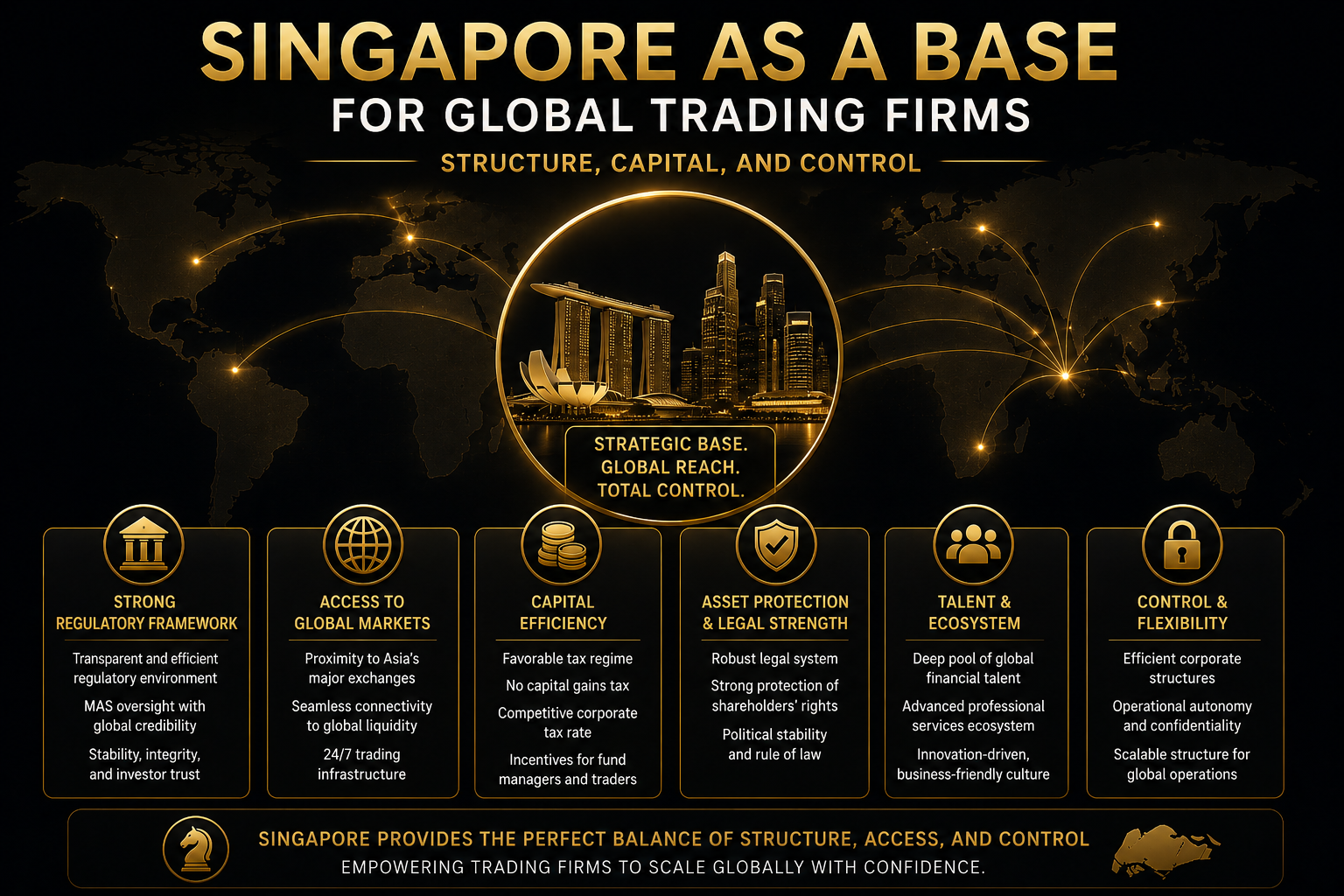
Over the last decade, Singapore has emerged as one of the most important global hubs for systematic trading and capital operations.
Not because it is “easy.”
But because it offers something more valuable:
Structure, clarity, and institutional trust.
At Linitics, we believe Singapore represents one of the most strategically balanced jurisdictions for modern trading firms operating globally.
1. Why Jurisdiction Still Matters in Digital Trading
Many assume that algorithmic trading makes location irrelevant.
In reality:
- capital remains jurisdictional
- entities remain legal structures
- counterparties evaluate operational credibility
Trading may happen electronically.
But firms still require:
- banking
- regulation
- legal protection
- operational infrastructure
This makes jurisdiction:
a strategic layer of the trading system itself.
2. Singapore’s Position in Global Capital Markets
Singapore occupies a unique position between:
- Western financial systems
and - Asian market access
This provides advantages in:
- time-zone coverage
- cross-border capital flows
- institutional connectivity
For global trading firms, Singapore functions as:
- an operational bridge
- a capital coordination hub
- a strategic regional base
3. Regulatory Clarity as an Institutional Advantage
Sophisticated firms do not seek:
- regulatory ambiguity
They seek:
- predictability
- clarity
- institutional credibility
Singapore’s regulatory framework is widely respected because it prioritizes:
- transparency
- operational integrity
- legal certainty
This matters deeply for:
- banking relationships
- prime brokerage access
- institutional counterparties
Because:
trust compounds operationally.
4. Structure Matters More Than Tax Narratives
Singapore is often discussed superficially in terms of taxation.
Institutional firms think differently.
The real advantage lies in:
- structural efficiency
- capital organization
- operational flexibility
The objective is not merely:
- reducing tax friction
It is:
building durable capital architecture.
5. Entity Structures & Liability Segmentation
Professional trading operations often separate activities across entities.
Reasons include:
- risk isolation
- operational clarity
- capital segregation
Singapore supports flexible corporate structuring for:
- proprietary trading entities
- holding structures
- investment vehicles
This allows firms to design:
- clearer operational boundaries
- stronger legal containment
6. Capital Segregation & Risk Containment
Institutional firms think in terms of:
- balance sheet durability
Not just:
- trading returns
Segregating capital and operational activities helps reduce:
- contagion risk
- operational spillover
- legal exposure
This becomes increasingly important as firms scale.
7. Banking & Counterparty Relationships
Global trading firms require more than broker access.
They require:
- stable banking
- capital movement capability
- institutional counterparties
Singapore’s financial ecosystem supports:
- international banking connectivity
- multi-currency operations
- institutional settlement infrastructure
Counterparties value:
- operational credibility
- jurisdictional stability
Both of which Singapore provides.
8. Access to Global Markets
Singapore-based firms can efficiently access:
- U.S. markets
- European markets
- Asian exchanges
This creates operational advantages in:
- multi-market trading
- cross-session execution
- global portfolio management
For systematic firms:
- market access flexibility is a strategic advantage.
9. Legal Stability & Rule of Law
Institutional capital prioritizes:
- enforceability
- predictability
- legal clarity
Singapore is widely regarded as:
- politically stable
- legally reliable
- commercially structured
This reduces:
- jurisdictional uncertainty
- operational friction
10. Infrastructure & Talent Ecosystem
Modern trading firms require:
- technology talent
- legal support
- infrastructure providers
- financial services ecosystem
Singapore has developed strong capabilities in:
- fintech
- quantitative finance
- institutional services
This supports:
- scalable operational growth
11. Confidentiality & Operational Control
Professional firms value:
- operational privacy
- controlled disclosure
- structured governance
Singapore balances:
- regulatory oversight
with - operational efficiency
This creates a framework where firms can maintain:
- institutional discipline
without - excessive operational friction
12. Strategic Neutrality
Singapore is viewed globally as:
- commercially neutral
- internationally connected
- politically stable
This makes it attractive for firms with:
- cross-border capital exposure
- international counterparties
- global investor relationships
13. Why Serious Trading Firms Think Structurally
Retail traders often optimize for:
- broker features
- low fees
- platform convenience
Institutional firms optimize for:
- structure
- survivability
- operational continuity
Because:
jurisdiction becomes increasingly important as capital scales.
14. The Difference Between Trading and Operating a Trading Firm
A trader focuses on:
- execution
A trading firm must manage:
- capital architecture
- legal structure
- counterparty relationships
- operational resilience
Singapore’s value emerges at this level.
15. The Linitics Perspective
At Linitics, we view structure as:
- part of the edge
Not separate from it.
We believe modern trading firms must think beyond:
- signals
- backtests
- short-term returns
And instead focus on:
- capital durability
- operational scalability
- institutional-grade frameworks
Singapore supports this evolution.
Final Thoughts
Global trading is no longer defined solely by:
- strategies
- execution
- technology
Increasingly, it is defined by:
- structure
- jurisdiction
- operational design
Singapore has emerged as a preferred base not because it promises shortcuts—
But because it provides:
clarity, credibility, and control.
At Linitics, we believe the strongest trading firms are built not only on alpha—
But on institutional foundations capable of sustaining it globally.