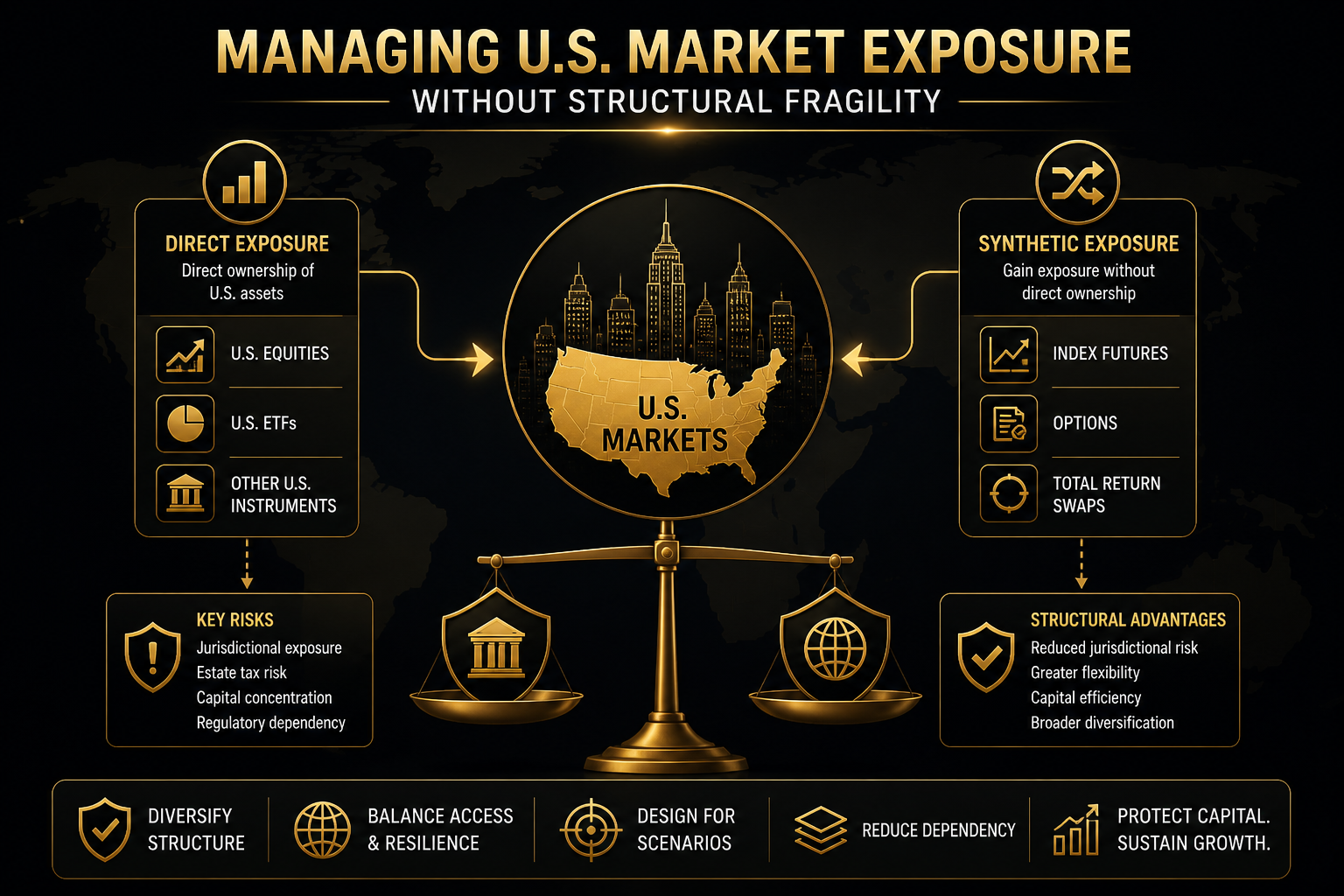
U.S. markets offer:
- unmatched liquidity
- tight spreads
- deep derivatives ecosystem
Which is why:
- most systematic strategies depend on them
But access comes with embedded structural risks:
- jurisdictional exposure
- counterparty dependency
- capital concentration
At Linitics, we view U.S. exposure not as a default—but as a design choice with trade-offs.
1. The Illusion of Frictionless Access
Modern trading platforms make it easy to:
- trade U.S. equities
- access ETFs
- deploy derivatives
This creates the perception:
- access = efficiency
But in reality:
access embeds structure
2. Understanding Structural Fragility
Structural fragility arises when:
- capital is exposed to a single system
- dependencies are concentrated
- risk is not diversified
In U.S. exposure, fragility can come from:
- jurisdiction
- broker dependency
- asset type
3. Direct Exposure vs Synthetic Exposure
Direct Exposure
- Holding U.S. equities or ETFs
- Full participation in underlying assets
Pros:
- transparency
- liquidity
Cons:
- jurisdictional exposure
- structural risk
Synthetic Exposure
- Using derivatives (futures, options, swaps)
- Exposure without direct ownership
Pros:
- flexibility
- potential structural advantages
Cons:
- counterparty dependency
- margin risk
4. The Liquidity vs Structure Trade-Off
U.S. markets dominate because of:
- scale
- efficiency
- execution quality
However:
- highest liquidity often comes with highest concentration
Trade-off:
Liquidity efficiency vs structural diversification
5. Asset Location vs Exposure Type
Key distinction:
- where the asset is located
vs - how exposure is obtained
Two portfolios may have:
- identical market exposure
But different:
- structural risk profiles
6. Diversification Beyond Assets
Most traders diversify:
- strategies
- instruments
Few diversify:
- jurisdictions
- brokers
- custody structures
Institutional setups diversify across:
- layers—not just assets
7. Broker & Infrastructure Dependency
U.S. exposure often involves:
- reliance on specific brokers
- dependence on U.S. market infrastructure
This creates:
- single points of failure
- operational concentration
8. Capital Concentration Risk
Heavy allocation to U.S. markets leads to:
- geographic concentration
- regulatory exposure
- correlated systemic risk
Diversification should include:
- structural dimensions
9. Regulatory & Policy Sensitivity
U.S. markets are:
- well-regulated
- stable
But also:
- policy-driven
- globally influential
Changes can impact:
- access
- taxation
- capital flows
10. Scenario-Based Risk Thinking
Institutional operators ask:
- What happens under stress scenarios?
Examples:
- regulatory shifts
- capital restrictions
- systemic shocks
Exposure design must consider:
- tail risks—not just base cases
11. Portfolio Construction Implications
U.S. exposure affects:
- correlation structure
- liquidity profile
- risk concentration
Portfolio design must integrate:
- structural considerations
- not just return optimization
12. Balancing Efficiency and Resilience
Efficient setups:
- maximize liquidity
- minimize friction
Resilient setups:
- reduce dependency
- diversify structure
The objective is not:
- maximum efficiency
But:
optimal balance between efficiency and resilience
13. Institutional Approach
Professional setups:
- evaluate exposure layers
- diversify structural dependencies
- design for resilience
They treat:
- market access
as - a strategic decision
14. The Linitics Perspective
At Linitics, we:
- separate exposure from structure
- analyze jurisdictional implications
- design capital allocation systems
We do not assume:
- default exposure is optimal
We design:
- intentional exposure
Final Thoughts
U.S. markets are central to global trading.
But:
- concentration without structure creates fragility
Managing exposure is not about:
- avoiding markets
It is about:
understanding how capital is exposed within them
At Linitics, we believe:
The real sophistication in trading lies in:
- balancing access
- managing structure
- protecting capital
Because:
The goal is not just to trade efficiently—
But to operate resiliently.