Modern quantitative trading is no longer defined by standalone strategy development.
Sustained market performance increasingly depends on the integration of quantitative research, engineering, infrastructure, data intelligence, execution systems, and disciplined risk management.
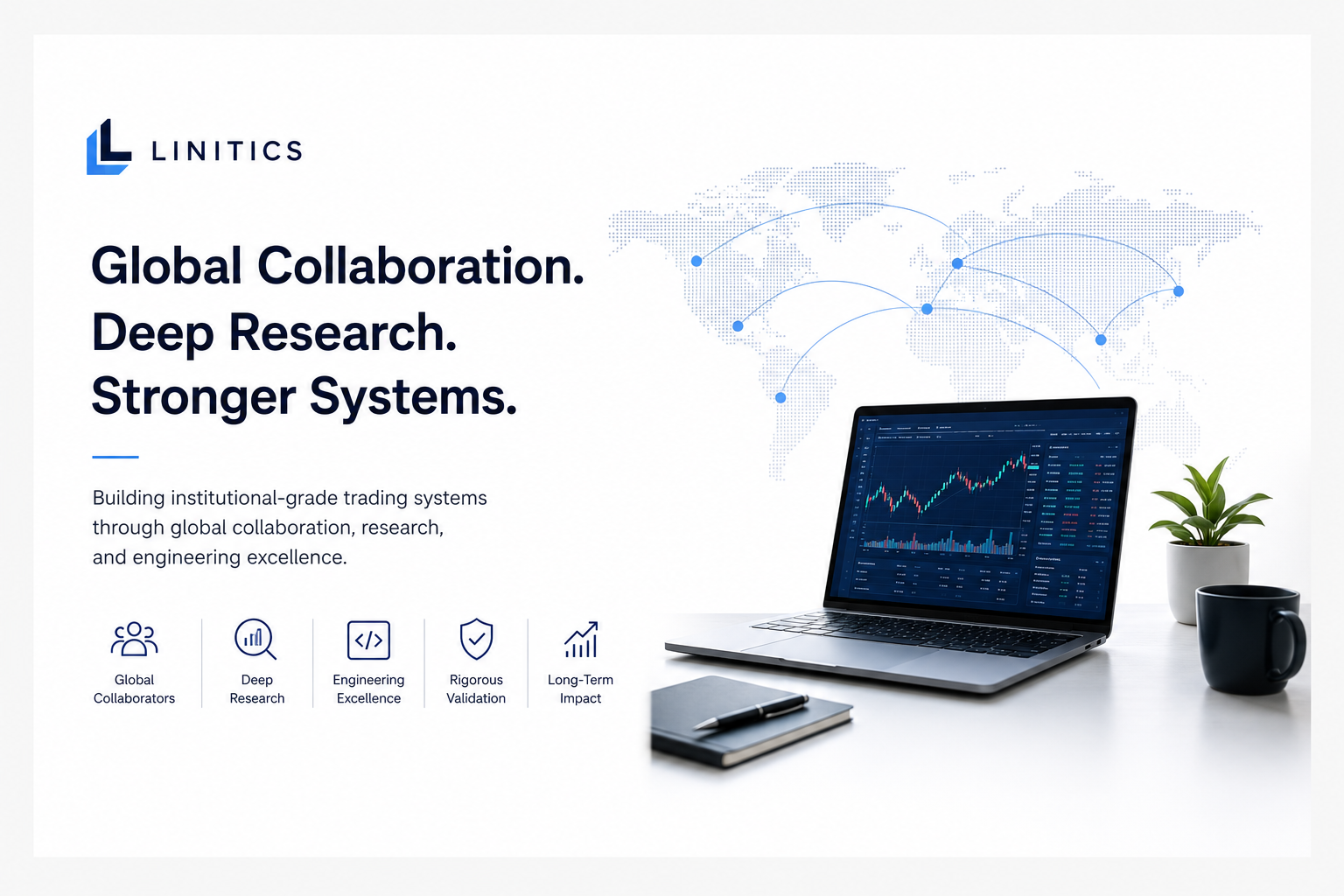
At Linitics, we believe institutional-grade trading systems emerge through collaborative intelligence — bringing together traders, quantitative researchers, engineers, analysts, and technologists across global markets and specialized domains.
Our operating philosophy is built upon three foundational pillars:
- Global collaborative development
- Rigorous expert-led validation
- Precision-driven automated decision-making and execution
Together, these principles enable the development of resilient algorithmic systems designed not only for performance generation, but also for execution reliability, scalability, operational robustness, and long-term adaptability in dynamic market environments.
A Global-First Quantitative Research Culture
Financial markets operate as globally interconnected systems.
Macroeconomic events, liquidity flows, volatility structures, derivatives positioning, and sentiment shifts now move across regions almost instantly.
To adapt to this evolving environment, quantitative research itself must become globally collaborative.
At Linitics, we work with collaborators across multiple regions, time zones, and areas of expertise. This distributed model creates an ecosystem where research, engineering, analytics, and experimentation continuously evolve through shared intelligence and disciplined review.
Our collaborators actively contribute across:
- Quantitative research
- System development
- Deep market analysis
- Data engineering
- Experimental modeling
- Automation frameworks
- Infrastructure optimization
- Backtesting environments
- Execution systems
- Risk evaluation
- Performance diagnostics
- Operational monitoring
This multidisciplinary collaboration enables us to approach systematic trading from both research and engineering perspectives simultaneously.
The Role of Collaborators in Research and Innovation
At Linitics, collaboration is not treated as operational assistance — it is embedded directly into the core research lifecycle.
Our collaborators actively participate in transforming early-stage concepts into production-ready trading systems.
In quantitative trading, no single individual can consistently capture every market nuance, technological challenge, or execution constraint alone. Diverse expertise creates stronger systems.
That is why collaborative participation plays a critical role in how we operate.
Collaborative Idea Discovery
Many research initiatives originate through discussions between traders, engineers, researchers, and market specialists observing different aspects of market behavior.
A derivatives researcher may identify structural inefficiencies in options pricing.
A systems engineer may detect execution bottlenecks affecting performance consistency.
A quantitative analyst may uncover recurring statistical behavior during volatility expansion.
A data specialist may identify anomalies hidden within large-scale datasets.
Individually, these insights may appear disconnected.
Collectively, they often evolve into actionable quantitative hypotheses worth exploring and validating.
This collaborative exchange of ideas enables broader market understanding and helps uncover opportunities that isolated research environments may overlook.
Deep Research and Analytical Validation
Building robust algorithmic systems requires far more than identifying profitable historical patterns.
Our collaborators actively participate in:
- Deep statistical research
- Dataset validation
- Market structure analysis
- Behavioral modeling
- Historical regime comparison
- Signal stability evaluation
- Risk scenario analysis
- Cross-market correlation studies
This research-driven approach helps ensure that trading models are based on structural market behavior rather than temporary randomness or over-optimized historical outcomes.
Technology and Engineering Collaboration
In modern quantitative trading, research and technology are inseparable.
A promising strategy can fail without reliable execution systems.
A valid statistical edge may become unusable without scalable infrastructure.
A profitable backtest may collapse under live operational conditions.
That is why engineering collaboration plays a central role within Linitics.
Our collaborators contribute actively to:
- System architecture and development
- Automation pipelines
- Data infrastructure
- Research tooling
- Backtesting frameworks
- Execution optimization
- Latency-sensitive systems
- Monitoring and alerting environments
- Infrastructure resilience
- Operational recovery mechanisms
This integrated engineering approach allows trading systems to evolve beyond theoretical models into scalable production-grade infrastructure.
A Culture of Experimentation and Continuous Improvement
Innovation in systematic trading is rarely linear.
Many improvements emerge through experimentation, collaborative testing, failure analysis, and iterative refinement.
At Linitics, our collaborators continuously explore:
- Alternative execution methodologies
- Data-driven optimizations
- Portfolio stress behavior
- Signal robustness across regimes
- Infrastructure scalability
- Automation enhancements
- Monitoring intelligence
- Operational efficiency improvements
This continuous experimentation culture allows both strategy intelligence and technological reliability to evolve together.
The objective is not simply to build profitable systems, but to continuously refine resilient systems capable of adapting to changing market environments.
Why Rigorous Expert Review Matters
Many algorithmic trading systems fail not because the idea itself is weak, but because the validation process surrounding it is insufficient.
A strategy may produce impressive backtests while hiding serious weaknesses such as:
- Overfitting
- Survivorship bias
- Liquidity assumptions
- Execution inefficiencies
- Regime dependency
- Tail-risk exposure
- Hidden correlation risks
At Linitics, no strategy is evaluated solely on headline returns.
Every system undergoes extensive multi-layer review before being considered deployment-ready.
Research Validation
The first layer focuses on validating whether the underlying hypothesis is structurally meaningful.
Key evaluation areas include:
- Statistical significance
- Economic rationale
- Market persistence
- Transaction cost sensitivity
- Slippage resilience
- Cross-market consistency
The objective is to distinguish durable inefficiencies from random historical noise.
Risk-Centric Evaluation
Strong returns alone are not sufficient.
A profitable strategy with uncontrolled downside exposure cannot be considered robust.
Our review process places strong emphasis on:
- Drawdown behavior
- Tail-risk analysis
- Volatility clustering
- Capital efficiency
- Exposure concentration
- Position sizing resilience
In many cases, improving risk architecture contributes more to long-term survivability than increasing short-term returns.
Execution Realism
Institutional-grade systems must survive real market conditions, not just theoretical simulations.
Our execution-focused reviews evaluate:
- Fill assumptions
- Market impact
- Spread expansion behavior
- Broker execution constraints
- Latency sensitivity
- Automation reliability
- Failure recovery handling
The objective is to ensure that live operational behavior aligns closely with research expectations.
Infrastructure and Operational Reliability
Algorithmic systems are only as reliable as the infrastructure supporting them.
Our engineering reviews focus heavily on:
- Fault tolerance
- Infrastructure resilience
- Monitoring systems
- Data integrity validation
- Deployment reliability
- Recovery workflows
- Operational continuity
This operational discipline helps reduce fragility during high-volatility or abnormal market conditions.
From Trading Strategies to Complete Systems
One of the biggest misconceptions in retail algorithmic trading is treating strategies as isolated products.
In reality, sustainable quantitative trading is an interconnected ecosystem involving:
- Research
- Engineering
- Risk management
- Execution infrastructure
- Automation
- Monitoring
- Operational discipline
At Linitics, we focus on building complete systematic trading environments rather than standalone indicators or signal generators.
This systems-oriented mindset enables scalability, consistency, and long-term operational stability.
Building for Long-Term Survivability
Markets constantly evolve.
Strategies optimized aggressively for recent market conditions often fail when volatility structures, liquidity dynamics, or macroeconomic environments shift.
Our philosophy prioritizes:
- Robustness over curve fitting
- Stability over excessive optimization
- Risk-adjusted consistency over temporary outperformance
- Long-term survivability over short-term performance spikes
The objective is not simply to create algorithms that perform well under ideal historical conditions, but systems capable of adapting to evolving market structures.
The Human Element Behind Systematic Trading
Despite advances in automation and quantitative modeling, experienced human oversight remains critical.
Collaborative review often reveals:
- Hidden assumptions
- Structural weaknesses
- Fragile dependencies
- Operational blind spots
- Risk concentration
- Infrastructure vulnerabilities
At Linitics, the combination of systematic research, collaborative engineering, and expert validation helps create stronger foundations for sustainable algorithmic development.
Final Thoughts
In quantitative trading, sustainable edge rarely comes from isolated brilliance.
It emerges through disciplined collaboration, deep research, engineering excellence, rigorous review, and continuous refinement.
At Linitics, our approach is centered around building institutional-grade trading systems through globally collaborative research and engineering-driven validation frameworks.
Because in modern markets, developing truly resilient algorithmic systems requires far more than writing strategies.
It requires building an ecosystem where research, technology, data, infrastructure, and expertise continuously evolve together.