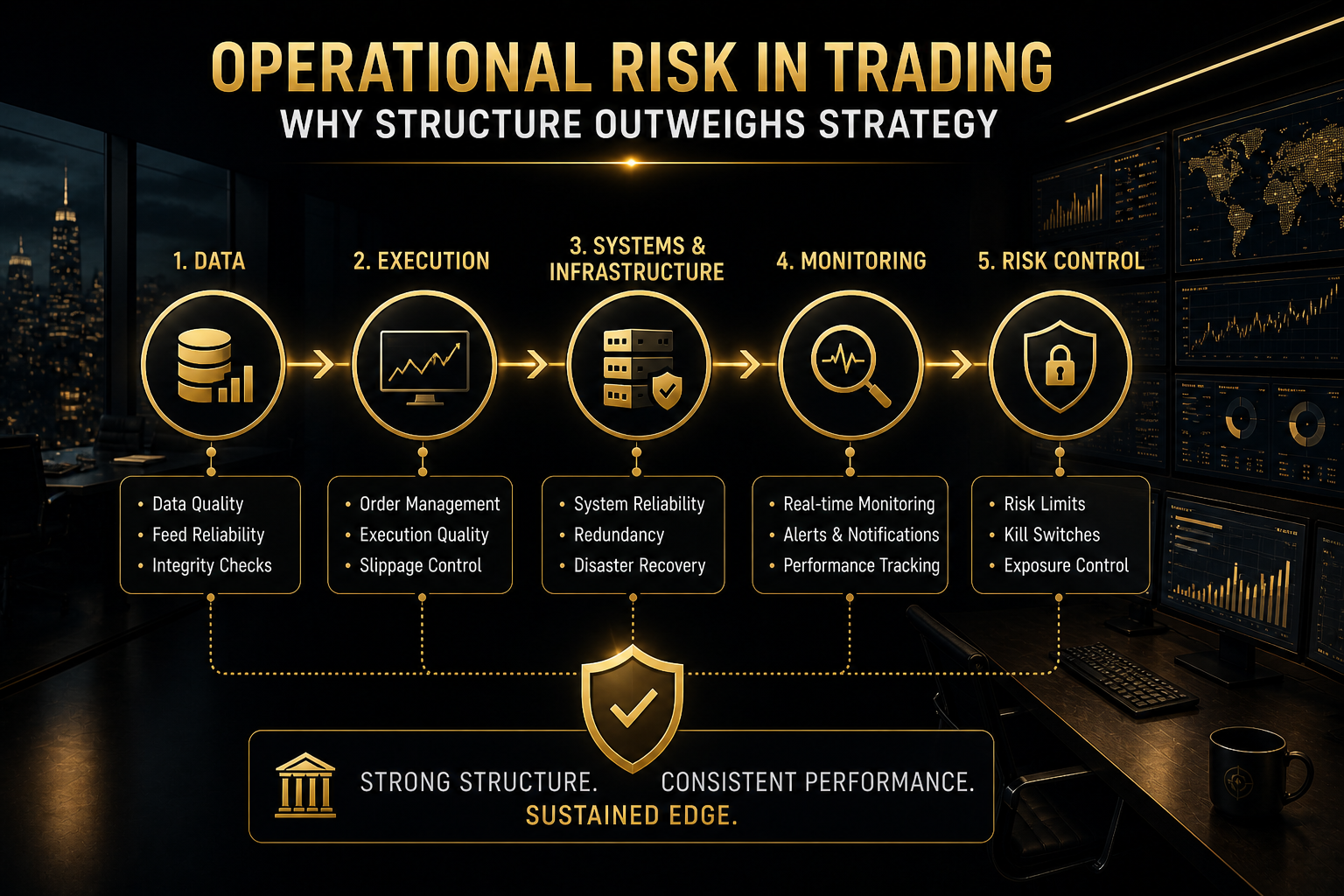
Most traders focus on:
- Strategy design
- signals
- backtests
Professionals focus on:
- execution
- systems
- operational integrity
Because in real markets:
A strategy does not fail in theory, It fails in implementation.
At Linitics, we treat operational risk as a first-order variable—not a secondary concern.
1. What Is Operational Risk?
Operational risk refers to failures arising from:
- Systems
- processes
- infrastructure
- human error
It includes:
- execution errors
- data issues
- system downtime
- process breakdown
Unlike market risk:
- It is controllable
- It is preventable
- It is often underestimated
2. The Strategy Illusion
Backtests assume:
- perfect execution
- clean data
- zero latency
- no slippage anomalies
Reality includes:
- delays
- partial fills
- data inconsistencies
- infrastructure failures
This gap is where:
operational risk destroys edge
3. Execution Risk
Even a correct signal can fail due to:
- poor order routing
- slippage
- spread expansion
- timing errors
Execution determines:
- realized returns
- variance
- consistency
In many strategies:
execution quality matters more than signal quality
4. Infrastructure Risk
Trading systems depend on:
- servers
- APIs
- data feeds
- connectivity
Failures include:
- system crashes
- delayed feeds
- order failures
Without redundancy:
- a single failure can cause disproportionate loss
5. Data Integrity Risk
Strategies rely on:
- historical data
- real-time feeds
- derived indicators
Data issues include:
- missing values
- incorrect timestamps
- feed discrepancies
Bad data leads to:
- wrong signals
- incorrect positioning
- hidden risk
6. Process Risk
Lack of defined processes leads to:
- inconsistent execution
- decision variability
- operational errors
Examples:
- manual overrides
- unclear responsibilities
- undocumented workflows
Institutional setups enforce:
- standardized processes
- defined protocols
- controlled workflows
7. Human Error
Even in systematic trading:
- configuration mistakes
- parameter errors
- incorrect inputs
Can lead to:
- unintended exposure
- large losses
- system breakdown
Human error is inevitable.
Structure reduces its impact.
8. Monitoring & Control Failure
Without real-time monitoring:
- risks go unnoticed
- issues escalate
- losses compound
Institutional systems include:
- live dashboards
- alerts
- risk triggers
Because:
detection speed determines damage
9. Dependency Risk
Many systems depend on:
- single data source
- single broker
- single infrastructure layer
This creates:
- fragility
- single points of failure
Robust systems use:
- redundancy
- diversification of dependencies
10. Scaling Amplifies Operational Risk
As capital increases:
- position sizes grow
- execution complexity rises
- system load increases
Operational weaknesses that are invisible at small scale:
- become critical at larger scale
11. Latency & Timing Risk
In certain strategies:
- milliseconds matter
Delays can cause:
- missed trades
- worse fills
- loss of edge
Latency becomes:
- a structural variable
12. Lack of Fail-Safes
Many systems lack:
- circuit breakers
- kill switches
- exposure limits
Without these:
- small issues escalate into major losses
Fail-safes are essential.
13. Operational Risk vs Market Risk
Market risk:
- cannot be controlled
- must be managed
Operational risk:
- can be designed
- must be engineered out
Ignoring operational risk:
- is a design failure
14. Why Institutions Prioritize Operations
Institutional capital focuses heavily on:
- infrastructure
- execution systems
- monitoring frameworks
Because they understand:
most losses come from operational breakdowns—not market moves
15. The Linitics Perspective
At Linitics, we design systems where:
- execution is controlled
- infrastructure is resilient
- processes are defined
- monitoring is continuous
We treat:
- operations as part of the strategy
Not separate from it.
Final Thoughts
In trading:
- strategies create opportunity
- execution captures it
But operations determine:
- whether it survives
A strong strategy with weak operations:
- fails
A structured system with disciplined operations:
- endures
At Linitics, we believe:
The real edge is not just in what you trade, But in how reliably you can trade it.