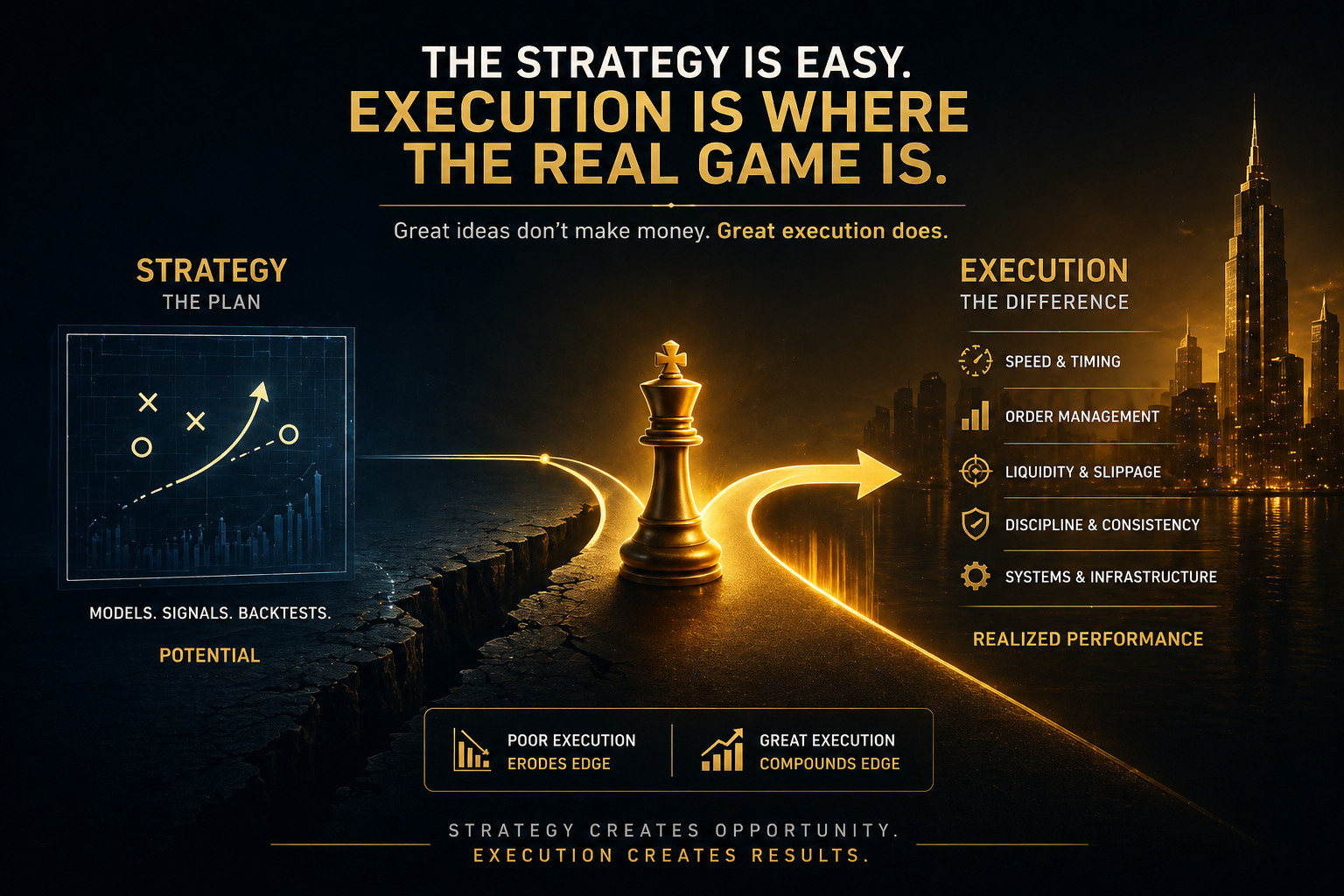
Most traders spend their time searching for better strategies.
Professionals spend their time improving execution.
Because in systematic trading, the difference between:
- A profitable system
and - A failing one
Is rarely the signal.
It is execution.
At Linitics, execution is not considered an implementation detail.
It is where performance is created—or destroyed.
1. Strategy vs Reality
A strategy defines:
- Entry logic
- Exit rules
- Risk framework
But real-world trading introduces:
- Slippage
- Latency
- Partial fills
- Spread variation
- Market impact
A backtest shows what could happen.
Execution determines what does happen.
2. The Execution Gap
Even strong strategies experience:
- Lower live returns
- Higher drawdowns
- Increased volatility
Why?
Because of the execution gap:
Backtest performance – Real execution = Real outcome
Small inefficiencies compound into large deviations.
3. Slippage: The Silent Alpha Killer
Slippage is not constant.
It increases with:
- Volatility
- Trade size
- Market conditions
For high-frequency or options strategies:
- Slippage can consume a large portion of edge
Many strategies that look strong:
Are unprofitable after realistic slippage.
4. Timing Matters More Than Logic
Two traders can use the same strategy.
Different outcomes arise due to:
- Entry timing
- Order placement
- Reaction speed
Examples:
- Entering late reduces edge
- Exiting late increases loss
- Delays distort risk
Execution precision defines realized returns.
5. Discipline: The Human Execution Layer
Even systematic traders introduce discretion:
- Skipping trades
- Adjusting position size
- Overriding signals
- Exiting early
These decisions often:
- Reduce consistency
- Increase variance
- Break statistical edge
A strategy works only if:
It is executed as designed.
6. Execution Under Stress
Execution quality deteriorates during:
- Drawdowns
- High volatility
- Uncertainty
Common failures:
- Hesitation
- Overreaction
- Risk aversion
The system remains valid.
The execution breaks.
7. Order Execution Mechanics
Execution is not just “buy” and “sell”.
It involves:
- Limit vs market orders
- Order sizing
- Order splitting
- Liquidity awareness
Poor execution decisions lead to:
- Worse fills
- Higher costs
- Missed trades
Execution is a process—not a click.
8. Strategy Sensitivity to Execution
Some strategies are:
Highly sensitive:
- Intraday systems
- Options strategies
- Mean reversion trades
Less sensitive:
- Longer-term trend strategies
- Low turnover systems
Understanding this determines:
- Required precision
- Infrastructure needs
- Expected deviation
9. Automation vs Manual Execution
Manual execution introduces:
- Delay
- Emotion
- Inconsistency
Automation provides:
- Speed
- Consistency
- Repeatability
However:
Automation requires:
- Robust systems
- Monitoring
- Fail-safes
Execution quality improves with systemization.
10. Execution as Edge
Most traders assume:
Better strategy = better performance
Institutional reality:
Better execution = better performance
Because:
- Signals are increasingly commoditized
- Execution remains differentiated
Execution is not a cost center.
It is an alpha driver.
11. Feedback & Continuous Improvement
Professional workflows include:
- Execution analytics
- Slippage tracking
- Fill quality monitoring
- Strategy vs live comparison
Without feedback:
- Errors persist
- Edge erodes
- Performance drifts
Execution must be measured to be improved.
12. The Linitics Perspective
At Linitics, execution is integrated into:
- Strategy design
- Risk systems
- Infrastructure
- Monitoring
We do not separate:
- Signal
and - Execution
Because:
The strategy is theoretical.
Execution is reality.
Final Thoughts
In quant trading:
- Strategy defines potential
- Execution defines outcome
A perfect model with poor execution:
Fails.
A good model with strong execution:
Survives and compounds.
At Linitics, we emphasize execution as the core layer where:
- Alpha is preserved
- Risk is controlled
- Performance becomes real
Because in the end:
The strategy is easy.
Execution is where the real game is.