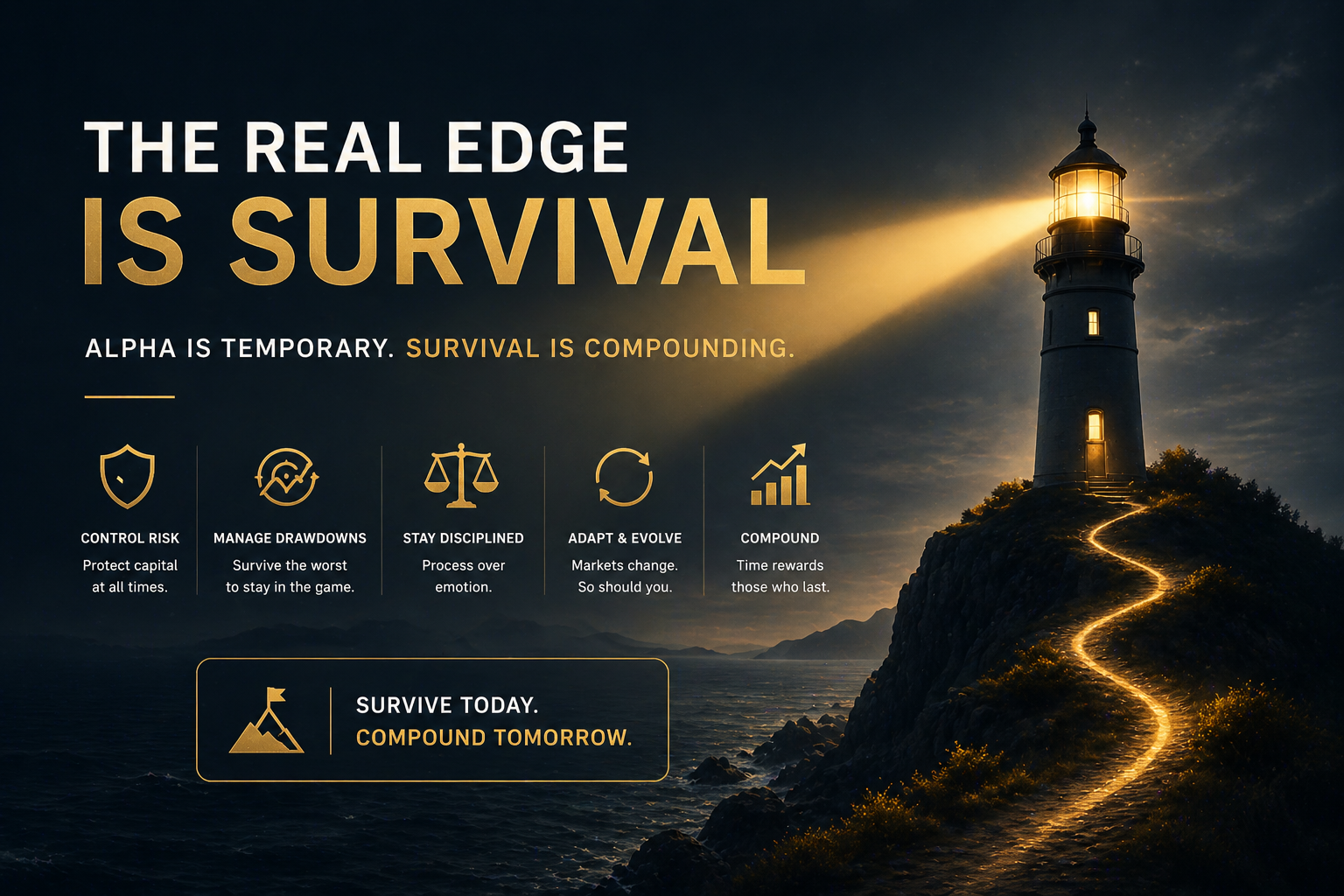
Most traders search for edge in signals.
Professionals search for edge in survival.
In quantitative trading, the defining factor of long-term success is not:
- Model sophistication
- Signal strength
- Backtest performance
It is the ability to remain in the game long enough for edge to compound.
At Linitics, survival is not a defensive concept.
It is a strategic advantage.
1. Alpha Is Temporary
Every strategy:
- Works for a period
- Degrades over time
- Eventually fails
Drivers of decay:
- Crowding
- Regime shifts
- Structural market change
- Cost pressure
No strategy is permanent.
But capital can be.
2. The Mathematics of Staying Alive
Compounding requires:
- Avoiding catastrophic loss
- Maintaining capital base
- Surviving adverse sequences
A strategy that:
- Gains 20% annually
- Suffers a 50% drawdown
Has failed structurally.
Because recovery becomes exponentially harder.
Survival is mathematical before it is strategic.
3. Drawdowns Define Reality
Backtests highlight:
- Returns
- Sharpe ratios
- Win rates
Live trading emphasizes:
- Drawdowns
- Duration of losses
- Recovery time
The key question is not:
“How much can this strategy make?”
It is:
“How much can it lose — and can I survive it?”
4. Risk of Ruin Is Always Present
Even profitable strategies can fail.
Because:
- Losses cluster
- Volatility expands
- Correlations spike
Risk of ruin increases with:
- Leverage
- Poor sizing
- Concentration
- Lack of diversification
Survival requires controlling tail risk — not average outcomes.
5. Leverage Is the Fastest Path to Failure
Leverage:
- Accelerates returns
- Accelerates losses
Applied incorrectly, it leads to:
- Rapid drawdowns
- Forced liquidation
- Strategy termination
Most strategies do not fail slowly.
They fail under leverage.
6. The Illusion of High Win Rates
Many strategies exhibit:
- High probability of small gains
- Occasional large losses
These are:
- Short volatility profiles
- Negative convexity systems
They appear stable.
Until they are not.
Survival requires understanding payoff structure — not just win rate.
7. Regime Shifts Test Survival
Strategies are often:
- Built in one environment
- Deployed in another
When regimes shift:
- Performance deteriorates
- Drawdowns increase
- Correlations change
Without adaptation:
- Strategies fail
- Capital erodes
Survival depends on flexibility.
8. Portfolio Diversification as Survival Tool
Single strategies are fragile.
Portfolios provide:
- Risk distribution
- Regime coverage
- Drawdown reduction
Diversification does not eliminate loss.
It reduces:
- Severity
- Frequency
- Correlation risk
Survival is a portfolio-level property.
9. Position Sizing Determines Longevity
Even strong strategies fail with poor sizing.
Key principles:
- Risk small per trade
- Scale gradually
- Adjust to volatility
Over-sizing leads to:
- Large drawdowns
- Emotional decision-making
- Strategy abandonment
Sizing is the bridge between theory and survival.
10. Infrastructure Supports Survival
Robust systems provide:
- Risk controls
- Execution discipline
- Monitoring frameworks
Without infrastructure:
- Errors compound
- Risks go unmanaged
- Performance drifts
Survival is operational.
11. Psychological Survival
Mathematical survival is insufficient.
Traders must also survive:
- Drawdown stress
- Performance stagnation
- Uncertainty
Most strategies fail not because they stop working.
But because:
The operator stops following them.
12. The Institutional Mindset
Professional firms focus on:
- Risk before return
- Drawdown control
- Capital preservation
- Long-term consistency
Because they understand:
The goal is not to win every trade.
It is to remain solvent across all trades.
13. Survival Creates Optionality
When you survive:
- You can adapt
- You can refine
- You can deploy new strategies
When you fail:
- Opportunity ends
Survival preserves optionality.
Optionality creates future edge.
14. The Linitics Perspective
At Linitics, we design systems that:
- Control drawdowns
- Limit leverage
- Diversify intelligently
- Monitor continuously
- Adapt to changing regimes
We do not optimize for maximum returns.
We optimize for maximum survivability with acceptable returns.
Final Thoughts
In quant trading:
- Signals generate opportunity
- Execution realizes returns
- Risk defines outcomes
But survival determines:
Whether any of it matters.
Because:
A strategy that survives mediocre periods will compound.
A strategy that fails once will not.
At Linitics, we believe:
The real edge is not prediction.
It is persistence.