Most individual traders ask the wrong question.
“How do I trade like a hedge fund?”
The better question is:
“What works at my scale?”
Because in quantitative trading, edge is not universal.
It is scale-dependent.
At Linitics, we view individual trading not as a smaller version of institutional trading — but as a fundamentally different optimization problem.
1. The Myth of Institutional Replication
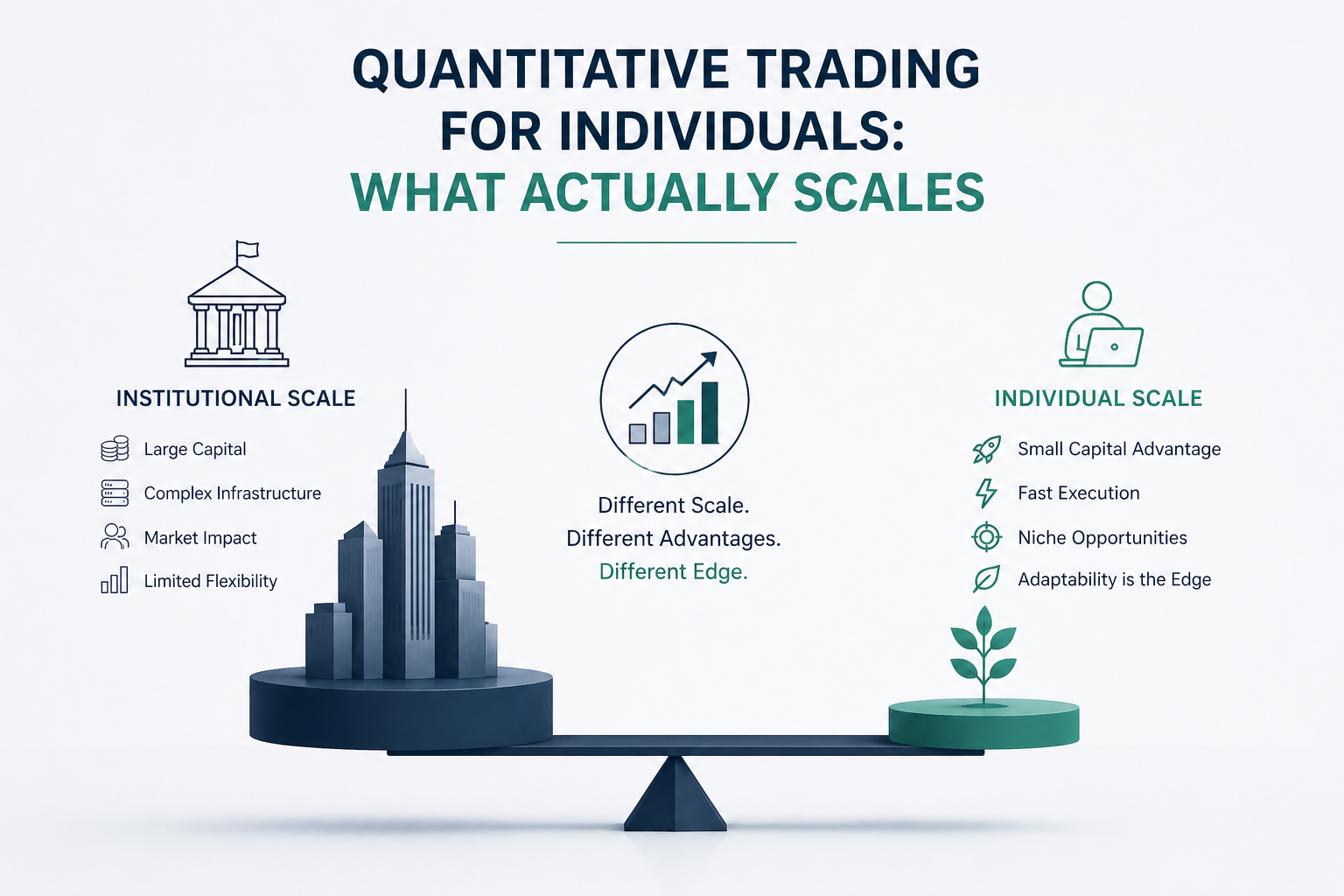
Institutional firms operate with:
- Large capital bases
- Execution infrastructure
- Dedicated research teams
- Access to premium data
Individuals do not.
Attempting to replicate institutional strategies often leads to:
- Over-complex models
- Overfitting
- Misaligned expectations
- Poor execution
The goal is not imitation.
It is adaptation.
2. The Hidden Advantage of Small Capital
Small capital has structural advantages:
- Minimal market impact
- Ability to enter/exit quickly
- Access to niche inefficiencies
- Flexibility across instruments
Large funds cannot:
- Trade illiquid opportunities
- Scale micro-edges
- Move quickly without impact
Individuals can.
Small is not a limitation. It is an edge.
3. What Actually Scales for Individuals
Not all strategies scale equally.
Strategies that scale well at small capital:
- Short-term mean reversion
- ETF-based tactical allocation
- Options income strategies (with discipline)
- Medium-frequency systematic trading
Strategies that do NOT scale well:
- High-frequency trading (requires infrastructure)
- Ultra-low latency strategies
- Large-cap statistical arbitrage at size
The key:
Choose strategies aligned with your structural advantages.
4. Frequency vs Capacity Trade-Off
Individuals can benefit from:
- Higher turnover strategies
- Smaller position sizes
- Faster capital rotation
Because:
- Slippage is minimal
- Impact is negligible
Institutions avoid high turnover due to cost.
Individuals can exploit it — within limits.
5. Simplicity Outperforms Complexity
Retail traders often:
- Over-engineer models
- Add excessive parameters
- Chase precision
Institutional reality favors:
- Robust logic
- Fewer parameters
- Cross-market validity
For individuals:
A simple, robust strategy executed consistently outperforms complex fragile systems.
6. Execution Still Matters
Even at small scale:
- Slippage exists
- Spreads matter
- Timing impacts results
However, individuals benefit from:
- Faster fills
- Lower execution complexity
- No need for advanced routing
Execution is easier — but not irrelevant.
7. Risk Management Is the Real Differentiator
Most individual failures are not due to:
- Poor strategy ideas
But due to:
- Over-leverage
- Poor sizing
- Lack of discipline
- Drawdown mismanagement
Institutional success is built on:
- Risk frameworks
- Capital preservation
- Controlled exposure
Individuals must adopt the same mindset.
8. Avoid the Scaling Trap
A common mistake:
Scaling too quickly after early success.
This leads to:
- Larger drawdowns
- Psychological pressure
- Strategy breakdown
A strategy that works at small size may:
- Degrade with size
- Require adjustment
- Lose efficiency
Scaling must be:
- Gradual
- Measured
- Data-driven
9. The Portfolio Approach
Even for individuals:
Relying on one strategy is fragile.
Better approach:
- Multiple strategies
- Different behaviors
- Low correlation
This reduces:
- Drawdown volatility
- Dependency risk
- Regime exposure
You do not need many strategies.
But you should not rely on one.
10. Time Horizon Alignment
Individuals often have:
- Full-time jobs
- Limited monitoring ability
Strategies must align with:
- Available time
- Execution capacity
- Lifestyle constraints
Examples:
- Daily systems
- Weekly options strategies
- Medium-term allocation models
Misalignment leads to execution failure.
11. Data & Technology Reality
You do not need:
- Institutional data feeds
- Ultra-low latency systems
- Complex infrastructure
You do need:
- Clean data
- Reliable execution
- Consistent process
Technology is an enabler.
Not the edge.
12. The Linitics Perspective
At Linitics, we believe individual traders should:
- Leverage small-capital advantages
- Focus on robust, scalable logic
- Prioritize risk management
- Avoid unnecessary complexity
- Build repeatable processes
Because the objective is not to:
Trade like an institution.
It is to:
Operate efficiently within your scale.
Final Thoughts
Quantitative trading is not one-size-fits-all.
What works at $1B does not necessarily work at $100K.
But the reverse is also true.
Many strategies that are impossible at institutional scale are highly effective at individual scale.
The edge lies in alignment.
At Linitics, we emphasize:
- Structural awareness
- Scale-appropriate strategy design
- Risk-first thinking
Because in quant trading:
Success is not about scale.
It is about fit.