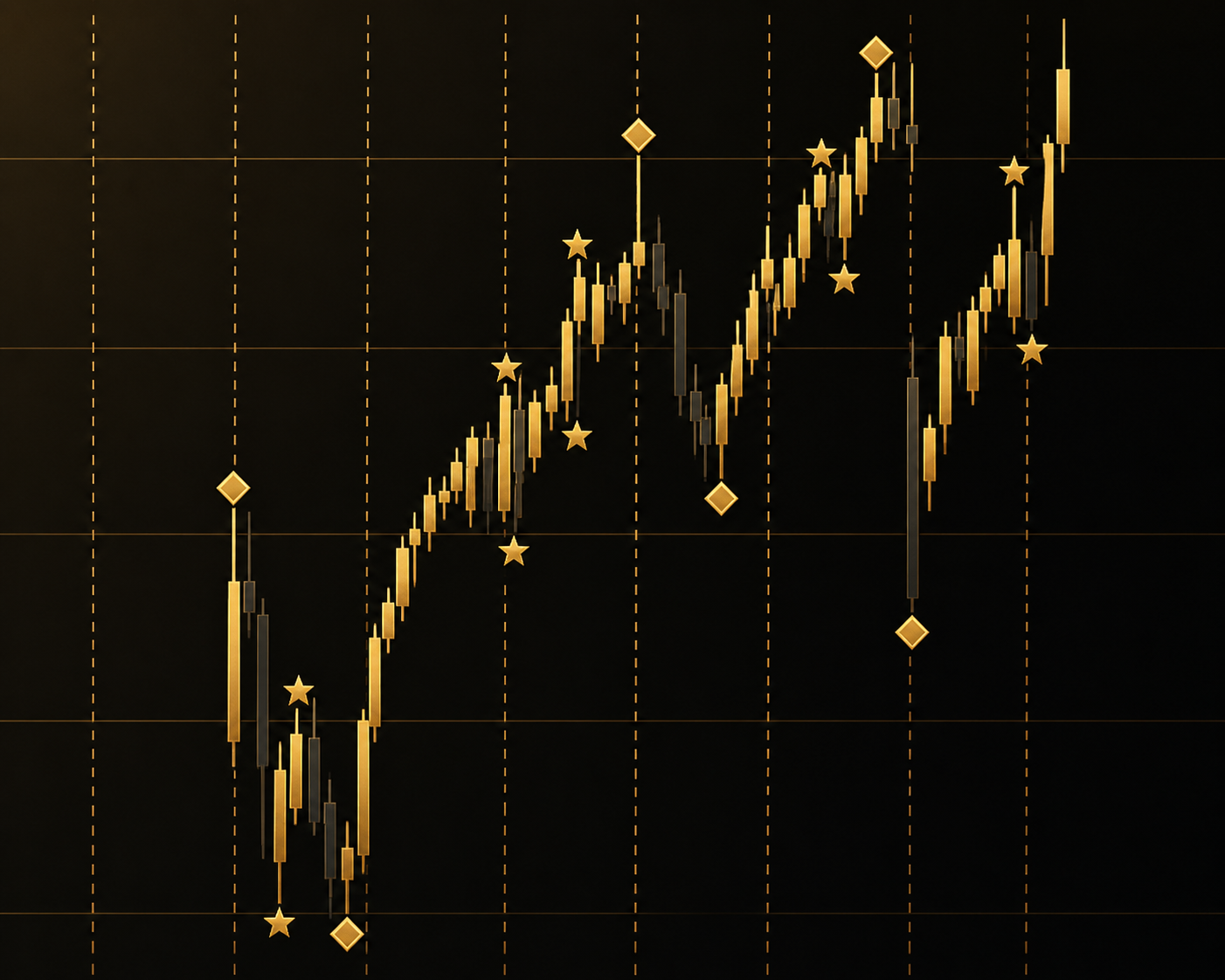
Understanding Markets Through Structure, Not Noise
In most trading approaches, the focus is on prediction—what will happen next. But markets don’t reward prediction. They reward alignment.
At Linitics, the foundation of StructurePulse is built on a simple but powerful principle:
Price is not random—it evolves in structured sequences that can be objectively identified and systematically traded.
This idea comes from decades of price action research and real-market observation, where the only consistent truth is price itself.
The Core Insight: Markets Build Structure Before They Move
Before any significant move—whether a breakout, reversal, or continuation—markets go through a process of structure formation.
This structure reflects:
- Accumulation and distribution
- Strength vs weakness
- Acceptance vs rejection of price levels
Instead of reacting to outcomes, StructurePulse focuses on tracking how this structure evolves in real time.
At a high level, the strategy continuously answers three questions:
- Is the market building strength or losing it?
- Is the current move part of a larger trend or a temporary fluctuation?
- Has the structure shifted enough to justify a position change?
Micro vs Macro: The Dual-Layer Engine
A key differentiator of StructurePulse is its dual-layer framework:
Micro Layer (Tactical Intelligence)
- Tracks short-term structural changes
- Identifies early signs of exhaustion or continuation
- Enables timely entries, exits, and re-entries
Macro Layer (Strategic Direction)
- Defines the dominant trend
- Filters noise from meaningful moves
- Prevents overtrading during non-directional phases
Most systems fail because they operate on a single layer. StructurePulse integrates both—allowing it to be responsive without being reactive.
From Visual Patterns to Systematic Logic
Traditional price action relies heavily on discretion. The same chart can lead to multiple interpretations.
StructurePulse removes this ambiguity by:
- Translating price behavior into rule-based structural definitions
- Using consistent reference points to define turning zones
- Ensuring that signals are repeatable across timeframes and markets
This transformation—from visual intuition to systematic logic—is what enables:
- Robust backtesting
- Consistent execution
- Scalable deployment
As highlighted in systematic trading frameworks, having clear entry/exit rules and testing across large datasets is critical for building conviction.
Trend Participation, Not Prediction
At its core, StructurePulse is a trend-aligned strategy with adaptive responsiveness.
It operates on two key principles:
- Participate when structure confirms strength
- Step aside or reverse when structure weakens
Importantly:
- It does not attempt to catch exact tops or bottoms
- It avoids premature entries based on anticipation
- It focuses on confirmation through structural shifts
This leads to a more stable equity curve by:
- Reducing false signals
- Avoiding chop-heavy environments
- Capturing meaningful directional moves
Built for Real-World Execution
A strategy is only as good as its ability to be executed consistently.
StructurePulse is designed with execution in mind:
- Rule simplicity: Minimal but powerful conditions
- Clarity: No ambiguity in decision-making
- Adaptability: Works across instruments and timeframes
- Robustness: Tested across different market cycles
The underlying philosophy aligns with a key principle of system trading:
Simpler, well-defined systems often outperform complex ones in real-world conditions.
Universality Across Markets and Timeframes
Because StructurePulse is based purely on price structure:
- It is timeframe-independent (intraday to positional or various time charts)
- It is asset-agnostic (equities, indices, commodities, derivatives)
- It is geography-neutral (works across global markets)
This universality is not accidental—it is a direct consequence of building on how markets behave, rather than where they trade.
The Edge: Structured Observation + Disciplined Execution
StructurePulse does not rely on:
- News
- Forecasts
- Economic predictions
- Lagging indicators
Instead, its edge comes from:
- Objectively identifying structural shifts
- Aligning with dominant market flow
- Executing consistently with predefined rules
Combined with proper risk and money management, this creates a system with positive expectancy over large samples—the only edge that truly matters in trading.
Why StructurePulse Matters Today
In a world of increasing noise, faster information flow, and over-optimization:
- Many strategies break under regime shifts
- Indicator-heavy systems lag or overfit
- Discretionary approaches lack consistency
StructurePulse offers an alternative:
A clean, structural, and repeatable framework that adapts to changing markets without needing constant reinvention.
Final Takeaway: Trading the Pulse, Not the Noise
Markets will always fluctuate. Noise will always exist.
But beneath that noise lies structure—and within that structure lies opportunity.
StructurePulse is built to capture that.
- Not by predicting
- Not by overfitting
- But by listening to the pulse of the market itself