Artificial Intelligence does not replace risk management.
It enhances structured decision-making.
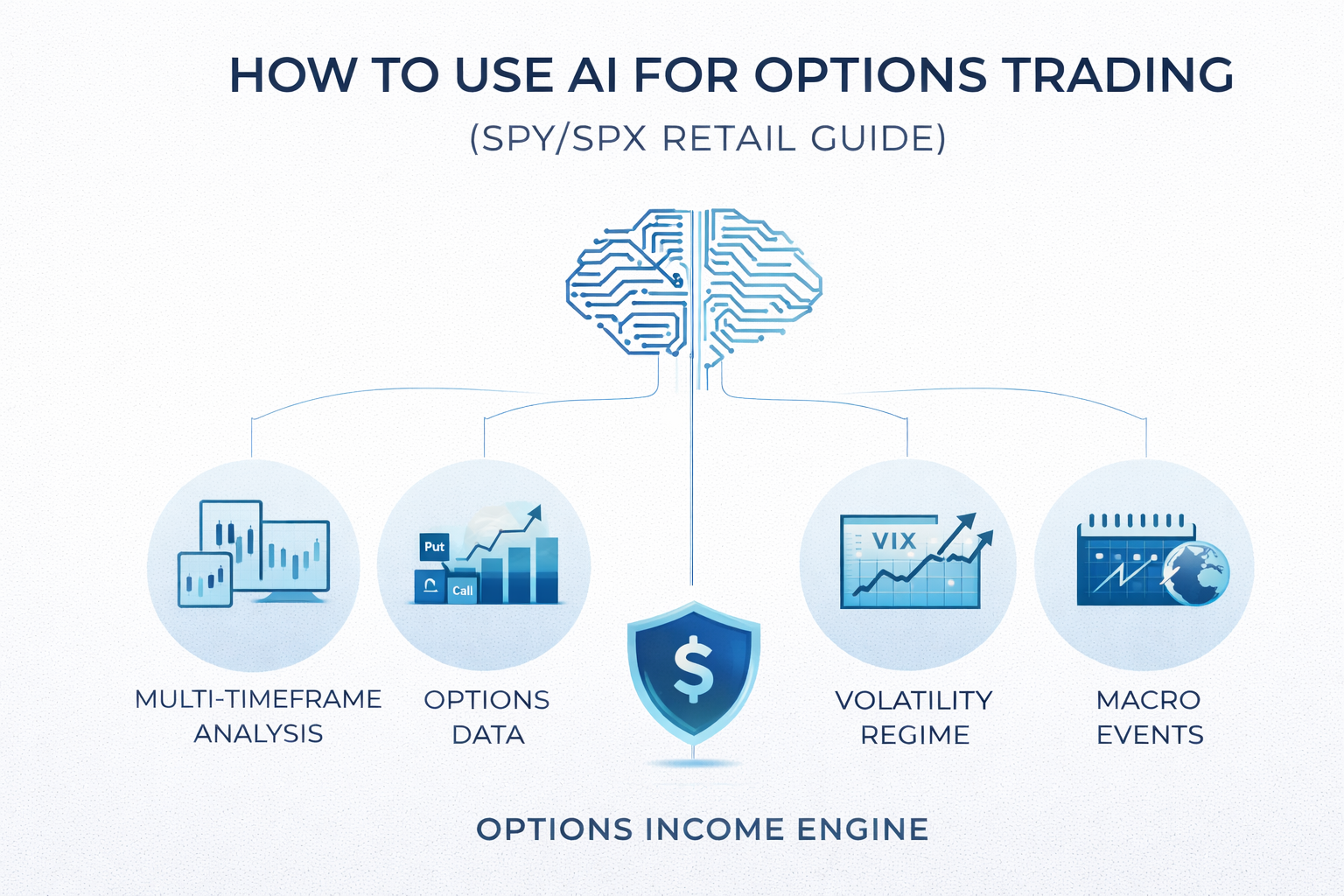
When used correctly, AI can help retail traders design a systematic framework for selling weekly SPY or SPX credit spreads based on:
- Multi-timeframe technical analysis
- Options chain positioning
- Volatility regime classification
- Institutional flow indicators
- Macro event filters
A simple one-line question to ChatGPT or Grok such as “What SPX option trade should I take for next week?” can generate an answer — but it typically produces a broad, generic market opinion.
A structured prompt, by contrast, forces AI to reason within defined constraints — timeframe, volatility regime, options positioning, and risk context.
That shift transforms AI from a prediction tool into a controlled decision engine.This article outlines a professional structure that readers can use to build their own AI-assisted options process.
⚠ Risk Disclaimer
This content is for educational purposes only.
It is not investment advice, not a recommendation, and not a solicitation to trade SPY, SPX, or any derivative instrument.
Options trading involves substantial risk.
Credit spreads have defined risk but can still result in significant losses, especially during sharp market moves.
Always assess your own risk tolerance and consult a licensed professional before trading.
Why SPY / SPX?
SPY and SPX are suitable for systematic options selling because they offer:
- Deep liquidity
- Tight spreads
- Weekly expirations
- Institutional participation
- Transparent volatility pricing
SPX is cash-settled and European-style (no early assignment).
SPY requires lower capital but has assignment risk.
Liquidity reduces execution uncertainty — essential for systematic models.
Core Concept: AI as a Decision Engine
AI should not predict direction blindly.
Instead, it should:
- Classify market regime
- Detect short-term directional bias
- Identify high-probability zones
- Filter macro risk
- Output structured trade parameters
The output must be rule-based — not narrative-based.
Step 1: Define Your Data Inputs
Your AI model should evaluate:
A. Multi-Timeframe Technical Structure
- 30-minute trend (short-term momentum)
- Daily trend alignment
- Weekly structure
- ATR (volatility expansion/contraction)
- Moving average alignment
- Volume confirmation
B. Options Chain Intelligence
- Put/Call Ratio (PCR)
- Strike-level Open Interest clusters
- Gamma concentration zones
- Implied Volatility (IV Rank)
- Delta distribution
C. Volatility Regime
- VIX trend (3–5 day direction)
- Term structure (contango/backwardation)
- IV percentile vs 1-year range
D. Event Risk Filter (Next 7 Days)
- CPI
- FOMC
- Non-Farm Payrolls
- Major earnings (AAPL, MSFT, NVDA)
- Geopolitical risk
No short premium trades before high-impact macro events.
Step 2: Define Your Strategy Logic
We use directional weekly credit spreads only:
- Mild Bullish → Sell Put Credit Spread
- Mild Bearish → Sell Call Credit Spread
- Neutral / High Event Risk → No Trade
Better, do not sell both sides simultaneously.
Step 3: Systematic Strike Selection Rules
Use objective filters:
- Sell 10–20 delta options
- Strike at least 1.5× daily ATR away
- Hedge width:
- SPX: 25–50 points
- SPY: $3–$5
- Target premium based on DTE:
- ≤ 2 DTE → lower premium acceptable
- 2 DTE → require higher premium
Avoid:
- Selling inside gamma walls
- Selling near major OI clusters
- Selling into rising VIX spikes
Step 4: Risk Framework
- Risk per trade: ≤ 1–2% of capital
- Hard stop: 2× premium received
- Exit on technical invalidation
- No averaging down
- No emotional overrides
AI suggests. Discipline executes.
Example AI Prompt Structure
Below is a clean, reusable AI prompt structure tailored for SPY/SPX weekly credit spreads.
You can adapt in to this.
AI Prompt Template for SPY/SPX Weekly Credit Spread Strategy
### Context:
You are a professional derivatives trader and quantitative analyst.
Use the provided SPX/SPY data to build a directional weekly credit spread strategy.### Data Provided:
- 30-minute OHLC data (last 50 bars)
- Daily OHLC data (last 60 days)
- Current VIX value and 3-day trend
- SPX/SPY option chain (weekly expiry)
    - Strike
    - OI
    - Volume
    - Implied Volatility
    - Delta
- Upcoming macro events within 7 days
- ETF fund flows (if available)### Instructions:1. Perform multi-timeframe technical analysis:
   - Short-term momentum (30-min)
   - Daily trend structure
   - Support/resistance zones
   - ATR-based volatility expansion2. Analyze options structure:
   - Identify major OI clusters
   - Calculate Put/Call Ratio
   - Detect gamma concentration zones
   - Evaluate IV percentile3. Evaluate volatility regime:
   - Is VIX rising, falling, or stable?
   - Is IV elevated relative to 1-year range?4. Check macro event risk:
   - Avoid recommending trades if major event within 48 hours.5. Forecast directional bias for the current weekly expiry.6. Recommend ONLY one side (Call or Put spread).### Output Format (Strict):- Recommendation: Strong Bullish / Mild Bullish / Neutral / Mild Bearish / Strong Bearish
- Major Resistance Levels:
- Major Support Levels:
- Volatility Regime:
- Recommended Strike to Sell:
    Example:
    Sell SPX 5100 PE
    Hedge with 5050 PE
    Target Credit:
- Position Size Guidance:
- Exit Signal:
    Exit if 30-min candle closes above/below X level
    OR spread reaches 2x credit received
How This Becomes a System
Over time, you can:
- Log AI outputs weekly
- Track win rate vs regime
- Track performance by VIX level
- Optimize delta range
- Refine event filters
The edge emerges from process consistency — not prediction brilliance.
Common Retail Mistakes
- Selling too close to price (high delta)
- Ignoring VIX regime
- Trading before CPI/FOMC
- Over-sizing
- Treating high probability as low risk
Credit spreads are asymmetric:
Many small wins.
Occasional large loss.
Risk discipline determines long-term outcome.
Final Thoughts
AI in options trading should function as:
A structured analytical assistant.
Not a forecasting oracle.
A disciplined SPY/SPX weekly credit spread framework requires:
- Regime classification
- Strike discipline
- Event filtering
- Capital control
- Strict exits
When used systematically, AI enhances decision quality.
When used impulsively, it magnifies leverage.
The difference lies not in the model — but in the operator.