Most traders focus on:
- strategies
- signals
- execution
Institutional operators focus on:
- where capital is held
- who holds it
- under which legal framework
Because in modern markets:
Trading risk is not just market risk.
It is also structural risk.
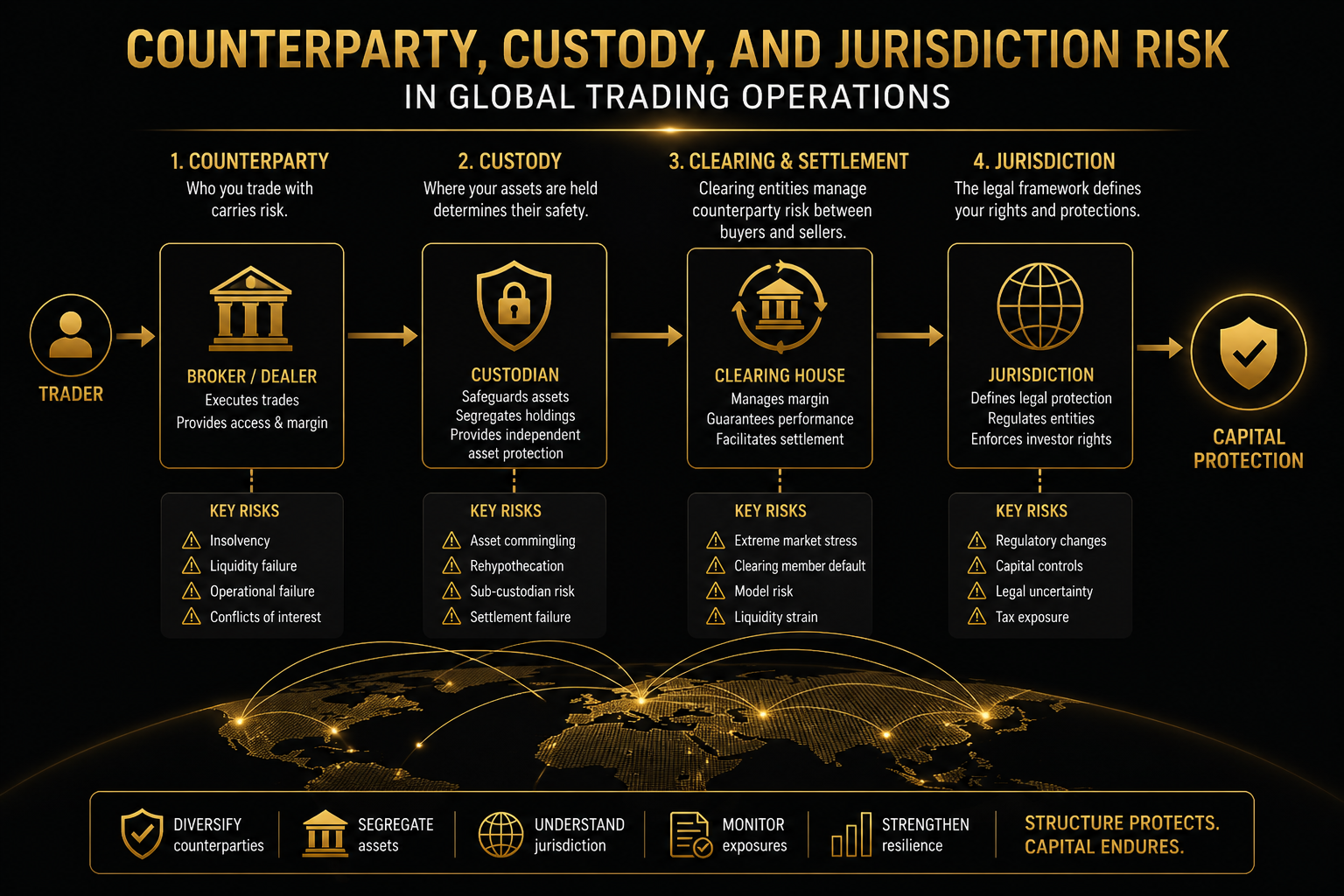
At Linitics, we treat counterparty, custody, and jurisdiction as core components of capital protection.
1. The Invisible Risk Layer
A typical trading setup involves:
- Broker
- Custodian (sometimes)
- Clearing entity
- Exchange
- Jurisdiction
Each layer introduces:
- dependency
- legal exposure
- operational risk
These risks are often:
- invisible
- underestimated
- material in extreme scenarios
2. Counterparty Risk: Who You Trust to Execute
Counterparty risk arises when:
- a broker or trading partner fails
Key risks include:
- insolvency
- liquidity issues
- operational failure
Examples of exposure:
- Margin held with broker
- unsettled trades
- derivative exposure
Even profitable positions can be impacted if:
the counterparty fails.
3. Broker vs Custodian: A Critical Distinction
Many traders assume:
- Broker = asset holder
In reality:
Broker
- Executes trades
- May hold assets
- Provides margin
Custodian
- Safeguards assets
- Segregates holdings
- Provides independent security
Institutional setups often separate:
- execution
from - custody
This reduces:
- concentration risk
- counterparty exposure
4. Asset Segregation Matters
Key question:
Are assets segregated or pooled?
Segregated Accounts
- Client assets held separately
- Protected from broker liabilities
Pooled Accounts
- Assets commingled
- Higher risk in default scenarios
Segregation determines:
- recovery probability
- capital safety
5. Clearing Layer Risk
In derivatives markets:
- clearing houses sit between counterparties
They manage:
- margin requirements
- settlement
- default risk
While generally robust:
- extreme stress can impact clearing stability
Understanding clearing exposure is essential.
6. Jurisdiction Risk: Legal Framework Matters
Where assets are held determines:
- legal protection
- investor rights
- recovery processes
Different jurisdictions offer:
- varying levels of protection
- different enforcement mechanisms
Examples of risk:
- capital controls
- legal ambiguity
- regulatory intervention
7. Cross-Border Complexity
Global trading introduces:
- multiple jurisdictions
- fragmented regulation
- overlapping legal frameworks
This creates:
- enforcement uncertainty
- operational friction
- recovery challenges
Jurisdictional alignment is critical.
8. Custody Chains & Indirect Exposure
Assets may pass through:
- prime brokers
- sub-custodians
- clearing agents
This creates:
- layered dependencies
- indirect exposure
Risk is not always:
- direct
- visible
Understanding the full chain is essential.
9. Margin & Collateral Risk
When trading leveraged products:
- collateral is posted
- capital is transferred
Risks include:
- rehypothecation
- restricted access
- delayed recovery
Collateral management is a core risk layer.
10. Concentration Risk
Many traders:
- use a single broker
- operate within one jurisdiction
This creates:
- concentration risk
Institutional setups diversify across:
- brokers
- custodians
- jurisdictions
To reduce:
- single point failure
11. Liquidity vs Safety Trade-Off
Highly liquid platforms may:
- offer efficiency
- but increase counterparty exposure
Highly secure setups may:
- reduce risk
- but increase operational complexity
Balancing:
- liquidity
- safety
Is a strategic decision.
12. Regulatory Risk
Regulatory changes can:
- impact access
- restrict capital movement
- alter trading conditions
Stable jurisdictions provide:
- predictability
- institutional trust
Regulatory clarity is an asset.
13. Crisis Scenarios: Where Risk Materializes
These risks become visible during:
- market crises
- broker failures
- liquidity shocks
- regulatory interventions
In such moments:
- structure determines survival
14. Institutional Approach to Risk Mitigation
Professional setups include:
- broker diversification
- custody separation
- jurisdictional planning
- exposure limits
They treat:
capital location as part of risk management
15. The Linitics Perspective
At Linitics, we consider:
- counterparty risk
- custody structure
- jurisdictional exposure
As integral to:
- capital protection
- system design
- long-term stability
We do not view trading as:
- isolated execution
But as:
- a structured capital system
Final Thoughts
In global trading:
- strategy determines opportunity
- execution captures returns
But:
- structure protects capital
Ignoring counterparty, custody, and jurisdiction risk:
- exposes capital to non-market failures
At Linitics, we believe:
The real sophistication in trading is not just:
- what you trade
But:
where your capital lives—and how it is protected.