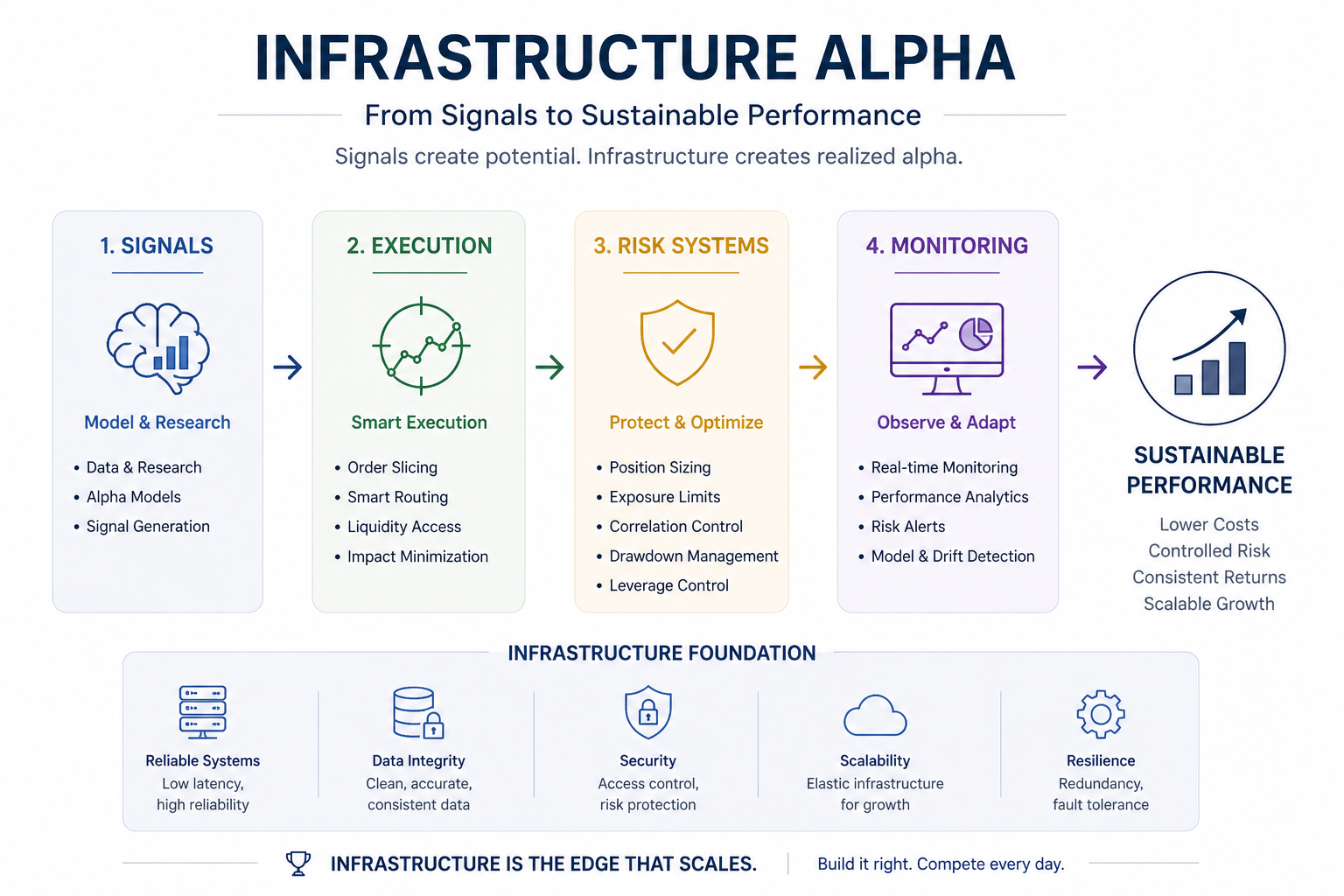
Most traders focus on signals.
Professionals focus on systems.
In modern quantitative trading, alpha is no longer driven primarily by discovering new signals — but by how efficiently those signals are executed, scaled, and risk-managed.
At Linitics, we refer to this as Infrastructure Alpha.
Because in competitive markets:
Signal quality determines potential.
Infrastructure determines realized performance.
1. The Commoditization of Signals
Historically, edge came from:
- Proprietary models
- Limited access to data
- Analytical advantage
Today:
- Data is widely available
- Academic research is accessible
- Open-source tools are abundant
Many signals are:
- Known
- Replicated
- Crowded
The edge has shifted.
From what you trade → to how you trade it
2. The Reality Gap: Signal vs Execution
A strategy might show:
- 15% backtested return
- Strong Sharpe ratio
- Controlled drawdowns
But live performance depends on:
- Execution cost
- Slippage
- Timing
- Liquidity access
Even small inefficiencies can:
- Erase alpha
- Increase volatility
- Extend drawdowns
Execution is not implementation.
It is transformation.
3. Execution Systems as Alpha Drivers
Institutional execution frameworks include:
- Smart order routing
- Order slicing algorithms
- Liquidity detection
- Timing optimization
These systems aim to:
- Minimize market impact
- Reduce slippage
- Optimize fill quality
For high-turnover strategies, execution quality can determine:
- Profitability
or - Complete alpha erosion
4. Risk Systems: The True Control Layer
Signals generate trades.
Risk systems control exposure.
Key functions include:
- Position sizing
- Portfolio-level exposure limits
- Correlation monitoring
- Drawdown controls
- Leverage adjustment
Without a robust risk system:
- Good signals can produce poor outcomes
- Drawdowns can exceed tolerance
- Capital can be impaired
Risk systems are not protective layers.
They are structural components of performance.
5. Latency vs Reliability
Retail focus often emphasizes:
- Speed
- Low latency
Institutional reality prioritizes:
- Reliability
- Consistency
- Stability
A slightly slower but stable system:
Outperforms a fast but unreliable one.
Execution failure is more damaging than execution delay.
6. Cost Control as Alpha Preservation
Transaction costs include:
- Bid–ask spread
- Slippage
- Market impact
- Fees
For many strategies:
Costs consume a significant portion of gross returns.
Infrastructure reduces:
- Cost variance
- Execution inefficiency
- Performance drift
Alpha is often not created.
It is preserved.
7. Portfolio-Level Risk Engineering
Individual trades are not independent.
They interact.
Risk systems must manage:
- Cross-strategy correlation
- Exposure concentration
- Tail risk
- Regime sensitivity
Institutional portfolios are engineered to:
- Survive stress
- Maintain stability
- Control drawdowns
This cannot be achieved at signal level alone.
8. Monitoring & Feedback Loops
Professional systems include:
- Real-time performance tracking
- Execution diagnostics
- Risk alerts
- Drift detection
Without monitoring:
- Problems are detected late
- Losses compound
- Models degrade unnoticed
Infrastructure enables:
Continuous adaptation.
9. Scalability Depends on Infrastructure
Signals do not scale naturally.
Infrastructure enables scaling through:
- Liquidity-aware execution
- Capacity management
- Dynamic sizing
- Cost optimization
Without infrastructure:
Scaling destroys performance.
With infrastructure:
Scaling becomes controlled.
10. The Illusion of “Better Signals”
Retail traders often chase:
- Higher Sharpe ratios
- More complex models
- Additional indicators
Institutional focus is different:
- Improve execution
- Reduce costs
- Strengthen risk control
A modest signal with strong infrastructure:
Outperforms a superior signal with weak execution.
11. Infrastructure as a Competitive Moat
Signals can be copied.
Infrastructure cannot be replicated easily.
It requires:
- Engineering discipline
- Process design
- Operational rigor
- Continuous refinement
This creates:
- Sustainability
- Scalability
- Consistency
Infrastructure becomes the moat.
12. The Linitics Perspective
At Linitics, we emphasize:
- Execution-aware strategy design
- Integrated risk frameworks
- Liquidity-conscious deployment
- Continuous monitoring systems
Because we recognize:
The edge is no longer in discovering signals.
It is in operationalizing them effectively.
Final Thoughts
In modern quant trading:
- Signals are necessary
- Infrastructure is decisive
Performance is not determined by:
What the model predicts.
But by:
How efficiently capital interacts with the market.
At Linitics, we build systems where:
- Execution preserves alpha
- Risk controls drawdowns
- Infrastructure enables scale
Because in competitive markets:
The strongest edge is not intellectual.
It is operational.