Quantitative trading was once peripheral.
In the 1990s, it was experimental.
In the early 2000s, it was alternative.
Today, it is structural.
Systematic strategies are no longer niche overlays — they are embedded within the architecture of global capital markets.
At Linitics, we view this transformation not as a trend, but as a structural reconfiguration of how capital is deployed.
1. From Academic Curiosity to Institutional Core
Early quant strategies emerged from:
- Statistical arbitrage desks
- Academic factor research
- Pairs trading experiments
- Convertible arbitrage models
Today:
- Systematic hedge funds manage hundreds of billions collectively.
- Multi-manager platforms allocate capital across dozens of internal quant teams.
- Major asset managers run factor-based ETFs at massive scale.
What began as anomaly exploitation has evolved into capital infrastructure.
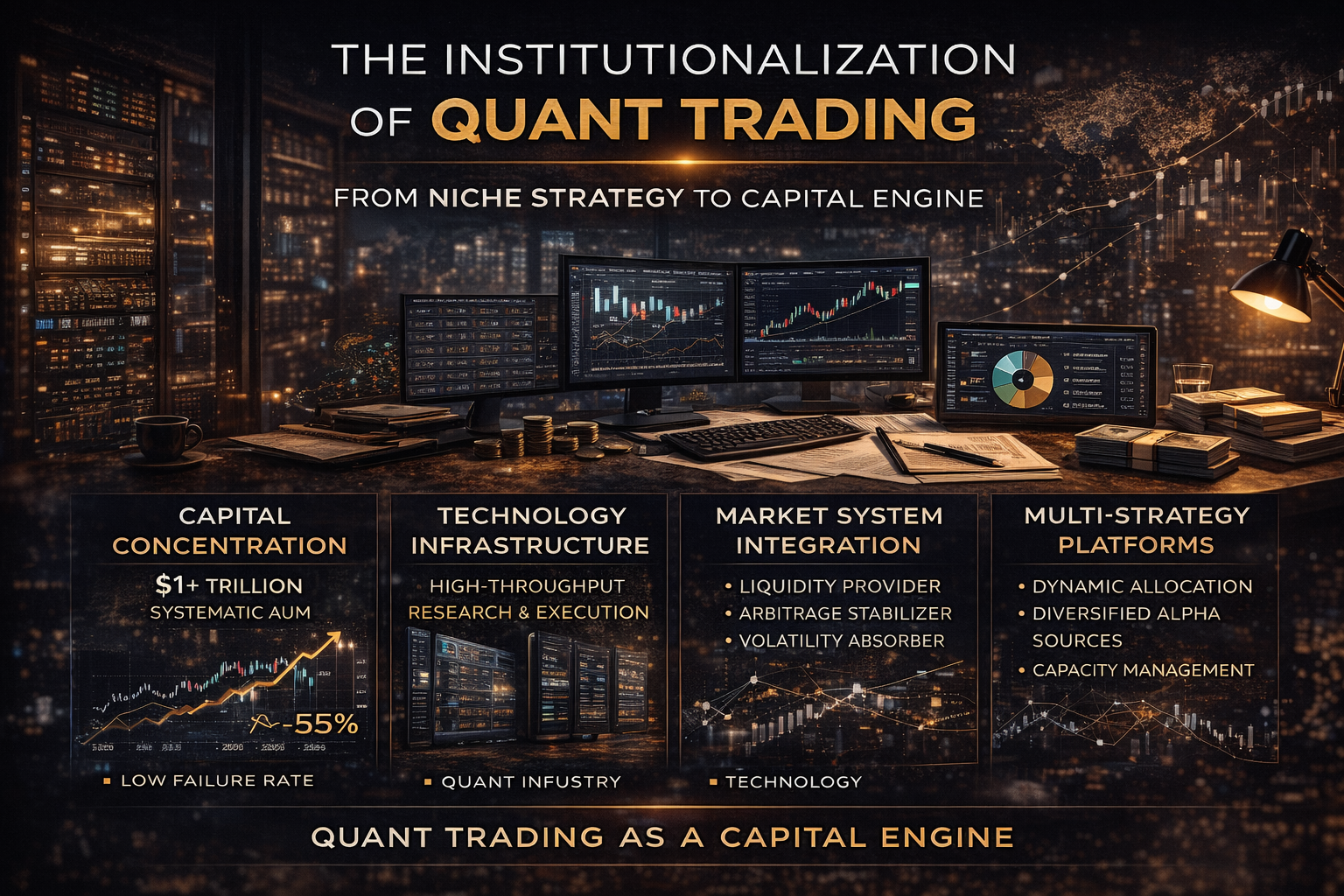
2. Capital Concentration & Scale
Industry data from Hedge Fund Research (HFR) and Preqin consistently show:
- A significant share of hedge fund assets is concentrated in the largest firms.
- The top decile of managers control a disproportionate share of industry AUM.
- Systematic and quantitative strategies represent a growing share of total hedge fund capital.
This concentration reflects:
- Infrastructure barriers
- Research sophistication
- Risk governance standards
- Talent competition
Quant trading is no longer democratized at scale.
It is institutionalized.
3. Infrastructure as Competitive Moat
The modern quant firm resembles a technology company:
- Distributed research clusters
- Co-location infrastructure
- High-throughput data pipelines
- Real-time risk engines
- Execution analytics frameworks
Technology budgets across electronic trading firms have expanded meaningfully in recent years, reflecting:
- AI integration
- Alternative data ingestion
- Latency competition
- Cloud scalability
Infrastructure is no longer support.
It is strategy.
4. Regulatory & Structural Integration
Systematic trading is embedded in:
- Market-making liquidity provision
- ETF arbitrage mechanisms
- Index rebalancing flows
- Volatility markets
- Futures basis trading
Regulatory scrutiny has intensified accordingly.
Quant firms must operate with:
- Compliance architecture
- Surveillance frameworks
- Auditability
- Governance transparency
Institutionalization means integration into systemic stability — not fringe participation.
5. The Rise of Multi-Strategy Platforms
One defining feature of institutionalization is platformization.
Large systematic platforms:
- Allocate capital dynamically
- Diversify across independent pods
- Control intra-firm correlation
- Optimize capital efficiency
This reduces idiosyncratic strategy risk and enhances survival probability.
The model resembles internal capital markets rather than isolated strategy bets.
6. The Democratization Paradox
Retail tools have improved:
- Backtesting libraries
- Open-source ML frameworks
- API-based broker connectivity
Yet the competitive edge has shifted upward.
While entry barriers appear lower, true institutional-grade performance requires:
- Data quality
- Infrastructure redundancy
- Capital scale
- Research governance
The surface is democratized.
The depth is institutional.
7. Capacity & Liquidity as Structural Constraints
As capital institutionalizes, capacity limits become binding.
Large quant firms increasingly focus on:
- Highly liquid futures
- Index derivatives
- FX markets
- Fixed income instruments
Liquidity is the oxygen of scalable systematic trading.
Without it, alpha suffocates under impact.
8. From Strategy to Capital Engine
Institutional quant trading today functions as:
- Liquidity provider
- Volatility absorber
- Arbitrage stabilizer
- Risk premium harvester
It is no longer simply exploiting inefficiencies.
It is embedded within price formation.
Systematic flows influence market microstructure itself.
9. Implications for Smaller Operators
Institutionalization changes the competitive landscape:
- Edges decay faster
- Crowding increases
- Cost efficiency becomes critical
- Governance standards rise
Smaller operators must:
- Focus on niche markets
- Maintain capital discipline
- Emphasize risk containment
- Avoid over-scaling prematurely
The era of effortless anomaly extraction has ended.
10. Where Linitics Positions Itself
Linitics recognizes the structural evolution of the industry.
Our approach reflects institutional principles:
- Liquidity-aware deployment
- Infrastructure-backed research
- Continuous strategy pipeline
- Capacity modeling
- Risk-first governance
Quant trading is no longer a strategy selection problem.
It is a capital engineering discipline.
Final Thoughts
The institutionalization of quant trading represents a structural shift in global capital markets.
From niche experiment to systemic capital engine, quantitative strategies now:
- Influence liquidity
- Shape volatility
- Allocate risk
- Define execution standards
In this environment, success requires:
- Infrastructure
- Governance
- Discipline
- Adaptation
Because in modern markets, quantitative trading is no longer optional.
It is foundational.