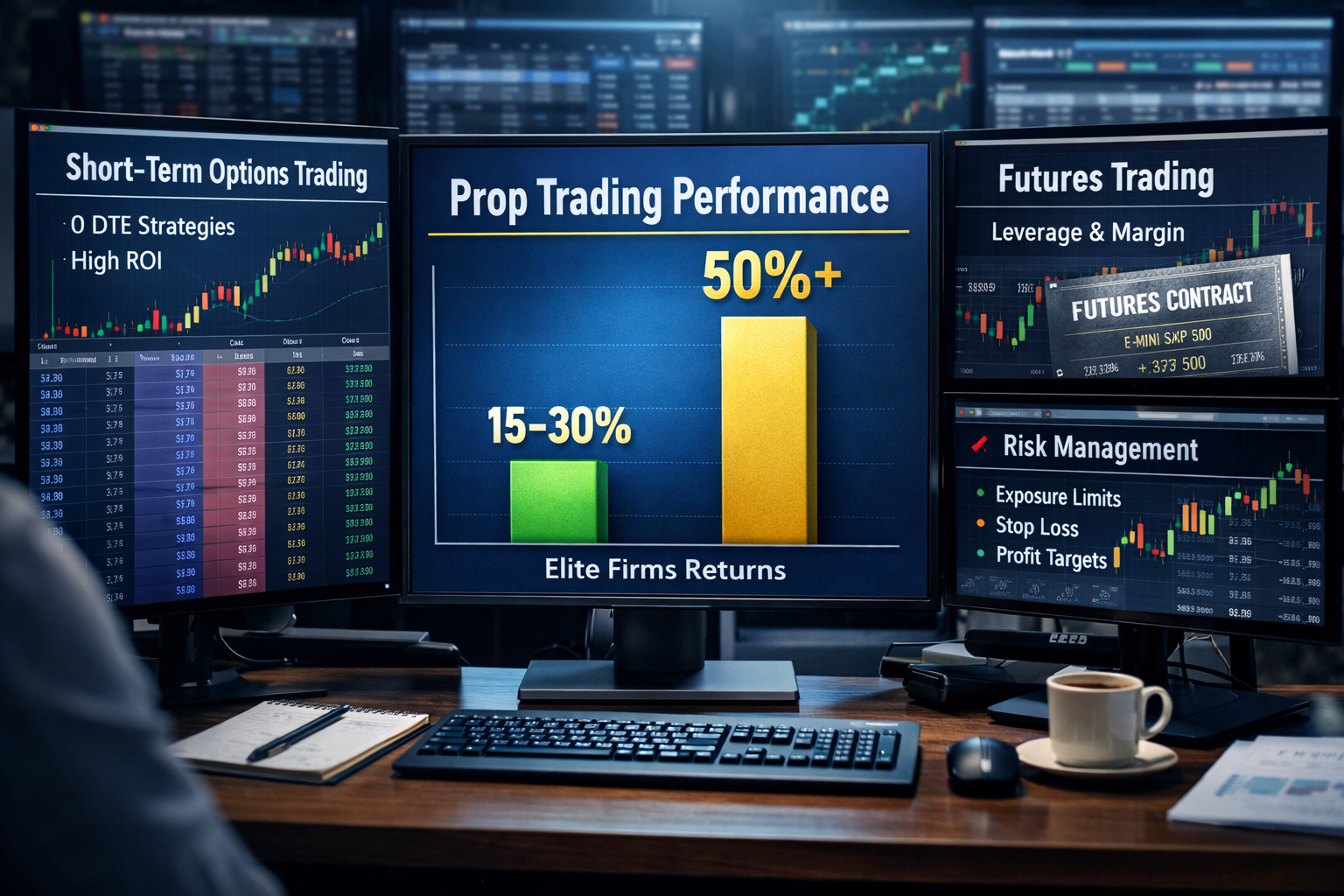
Proprietary trading firms (prop trading firms) operate by trading the firm’s own capital to generate profits. Unlike hedge funds or asset managers, they do not manage external client money. All trading strategies, risk-taking, and returns are generated internally by professional trading desks using the firm’s balance sheet.
While performance varies substantially across the industry, the upper tier of proprietary trading is distinguished by a different operating model. The strongest organizations combine systematic research, capital efficiency, derivatives expertise, execution infrastructure, disciplined risk management, and the ability to compound productive capital over time.
For these firms, exceptional performance is less a function of a single trading strategy than the result of an integrated system in which multiple sources of structural edge can be converted into repeatable, risk-controlled returns.
Understanding Prop Trading Firm Returns
Prop trading firm returns differ fundamentally from hedge fund or mutual fund returns. Without external investors, performance is evaluated purely on:
- Return on firm capital
- Risk-adjusted profitability
- Consistency across market cycles
Most prop trading strategies are short-term, market-neutral, or arbitrage-based. As a result, benchmarking against long-only indices such as the S&P 500 is often irrelevant.
Performance Statistics of Prop Trading Firms
Typical Firm-Level Returns
Established proprietary trading firms generate returns through a diverse mix of strategies, including:
- Market-making and liquidity provision
- Statistical arbitrage and quantitative trading
- Volatility and event-driven strategies
- Short-term directional trading
Industry observations indicate:
Industry performance varies materially by strategy, market regime, capital base, and execution model. Performance is influenced by:
- Market volatility and liquidity conditions
- Strategy capacity and competition
- Execution quality and technology infrastructure
- Risk-adjusted capital efficiency
Elite Prop Trading Firms: The Upper End of Performance
At the upper end of proprietary trading, a relatively small group of firms demonstrates a materially different level of performance, consistency, and operational sophistication from the broader industry.
These organizations typically share several characteristics:
- Highly specialized systematic strategies
- Advanced quantitative research capabilities
- Sophisticated derivatives and options expertise
- Production-grade technology and execution infrastructure
- Tight integration between research, trading, and risk management
- High capital efficiency
- Disciplined reinvestment and compounding
- Strong controls around drawdown, liquidity, and operational risk
Exceptional performance at this level should not be interpreted simply as a willingness to assume greater risk. In many cases, the differentiation comes from identifying multiple forms of structural edge and converting them into repeatable trading processes.
This can include opportunities associated with volatility, convexity, time decay, short-duration market structure, liquidity conditions, statistical relationships, and temporary pricing dislocations.
The implementation of these concepts is highly proprietary. Sophisticated trading organizations generally do not disclose the exact architecture, signals, position-sizing logic, or execution rules that produce their results.
What can be observed externally is the sophistication of the framework: differentiated sources of edge, efficient capital deployment, execution integrity, robust risk controls, and the ability to reinvest productive capital while maintaining appropriate constraints.
This is an important distinction when assessing elite proprietary trading organizations. The relevant question is not simply the return achieved during a particular period, but whether the underlying system is capable of producing repeatable performance across changing market regimes.
How Prop Trading Firms Generate High Returns
High returns in proprietary trading are driven by capital efficiency, not excessive risk-taking. Below are several well-established mechanisms used by professional prop firms.
Short-Term Options Trading and Expiration-Driven Market Structure
Short-dated options represent one of the most structurally complex opportunity sets available to systematic trading organizations.
As time-to-expiration declines, the behavior of options changes rapidly. Theta decay, gamma exposure, implied volatility, realized volatility, liquidity, bid-ask spreads, and dealer positioning can all become increasingly important to the risk and return profile of a position.
This creates several distinct strategy concepts.
Options-buying frameworks can provide exposure to convexity and asymmetric payoff distributions when the expected magnitude of market movement is sufficiently favorable relative to the premium paid.
Conversely, near-expiration options-selling frameworks can seek to monetize accelerated time decay and the changing distribution of short-horizon outcomes. These strategies introduce a fundamentally different risk profile and therefore require disciplined exposure management, liquidity controls, and careful consideration of tail behavior.
The important institutional insight is not that one approach is universally superior to another.
Rather, different options structures can respond differently to:
- Intraday volatility regimes
- Realized versus implied volatility
- Market direction and dispersion
- Gamma and convexity
- Time-to-expiration
- Dealer hedging activity
- Liquidity conditions
- Spread behavior
- Execution latency
- Tail-risk characteristics
This creates the possibility of constructing complementary systematic return engines rather than relying on a single market behavior.
For sophisticated proprietary trading organizations, the strategy itself is only one component of the architecture. The ability to translate an options signal into realized performance depends on execution quality, real-time recalculation, position sizing, risk limits, transaction costs, liquidity, and operational reliability.
The precise implementation of these concepts remains proprietary. What matters from an institutional perspective is the underlying principle: differentiated options exposures can be combined with disciplined capital allocation to pursue a more efficient and adaptive return-generation framework.
Futures Trading and Margin Efficiency
Futures markets are a core component of proprietary trading due to their liquidity and standardized margin framework.
Prop firms use futures to:
- Capture short-term momentum or mean reversion
- Express macro or relative-value views efficiently
- Hedge correlated exposures
Margin in this context is used to optimize capital usage, not to increase unmanaged risk. Position sizes are adjusted dynamically based on volatility and liquidity.
Margin as a Professional Risk Management Tool
In proprietary trading, leverage is treated as a risk-control mechanism, not a speculative shortcut.
Professional practices include:
- Firm-wide exposure and drawdown limits
- Volatility-adjusted position sizing
- Real-time risk monitoring and forced de-risking
Used appropriately, margin can improve capital efficiency and capital turnover while allowing risk to be allocated across differentiated opportunities.
The institutional objective is not maximum leverage. It is maximum productive use of risk capital within defined constraints. As profitable capital is redeployed, compounding can become an important driver of long-term growth, provided that position sizing, liquidity, capacity, drawdown limits, and execution quality remain under control.
High-Frequency, Market-Making, and Event-Driven Strategies
Some elite prop firms focus on:
- High-frequency trading and market-making
- Earnings and macro event-driven volatility
- Short-lived pricing inefficiencies
These strategies rely on:
- Very short holding periods
- High trade frequency
- Small but consistent per-trade profits
The longer-term significance of these strategies extends beyond individual trade economics. When systematic processes generate repeatable positive expectancy and capital can be redeployed within defined risk parameters, compounding becomes an important component of long-term capital efficiency.
The institutional challenge is balancing reinvestment against capacity, liquidity, drawdown tolerance, execution quality, and operational resilience.
Cost Structure and Capital Efficiency
Unlike hedge funds, proprietary trading firms do not charge management or performance fees. However, returns are influenced by internal costs such as:
- Technology and data infrastructure
- Exchange, clearing, and execution fees
- Risk management and compliance systems
- Compensation and incentive structures
Despite high fixed costs, elite firms maintain superior capital efficiency through rapid turnover, disciplined reinvestment, and continuous optimization.
Comparing Prop Trading Returns to Traditional Investments
| Investment Type | Return Profile | Risk Profile | Capital Characteristics |
|---|---|---|---|
| Elite Proprietary Trading Operations | Exceptional, strategy-dependent | High and actively managed | Internal capital |
| Established Prop Trading Firms | Strategy-dependent | High | Internal capital |
| Hedge Funds | Moderate, strategy-dependent | Moderate to high | External capital |
| S&P 500 Index | Long-term market return | Market risk | Highly liquid |
| Nasdaq-100 | Higher-growth equity exposure | Higher equity volatility | Highly liquid |
| Broad Market ETFs | Market-dependent | Market risk | Highly liquid |
Key distinction: Prop trading returns are strategy-, execution-, and technology-driven, rather than dependent on long-term asset appreciation.
Risks and Limitations
- Performance can vary significantly across market regimes
- Profitable strategies may degrade as competition increases
- Many high-return strategies face scalability constraints
- Operational and technology complexity remains high
Sustained success depends on continuous research, adaptation, and disciplined risk control.
Key Takeaways
- Elite proprietary trading combines systematic research, execution, risk management, and capital efficiency.
- Short-duration options can create distinct opportunities through volatility, convexity, and time decay.
- Long-term performance depends not only on strategy quality, but also on infrastructure, capacity, risk controls, and disciplined compounding.
Final Thoughts
Elite proprietary trading is ultimately about converting structural market opportunities into repeatable, risk-controlled processes. The strongest operations combine differentiated strategies with execution integrity, capital efficiency, operational resilience, and disciplined compounding.
The specific strategy architecture may remain proprietary. The institutional principle is straightforward: durable performance depends on the quality of the system behind the returns.
The strategy may remain proprietary; the institutional principle is clear: durable performance comes from the quality of the system behind the returns.